Although I studied music before, I choose this course to deepen my knowledge in music history and to learn a better communication about music. This course involved a much deeper investigation of topics and introduced more sociological aspects of music than my previous studies. It was containing more practical exercises and research which are perfect tool to gain a deeper understanding and knowledge on this field.
Overall, there were many aspects in the course which helped me gain a wider knowledge such as the exposure to a broad range of unfamiliar music including many contemporary genres. I also got an insight into a wider social and political context of music of different periods. Through the better understanding of the relevant philosophical context, I appreciate more those genres that I did not like before. I can also see clearly that music reflects the society in which it is created which could have a negative consequence, for example Wagner`s work and the anti-Semitism. Other problem between society and music is the innovations as sometimes this could clash between composer and listener.
I faced a couple of challenges during the whole course. The first issue was my academic writing. My tutor`s feedback helped me a lot on this area. Focusing on the advice I really had to work on my essay writing skills such as clear and logical structure and flow. I also had to learn to implement my own analysis and criticism and link them more strongly to concrete features. I had difficulty with the use of different sources and implement them in my essays in such a way that I avoid plagiarism. I believe I made some progress, but there is more room to improve here in the future.
Another challenge was my listening log as making entries was problematic at times. The main issue was the right balance between personal response, technical analysis and contextual information. I think at the end of the course my writings improved but still I need to develop more. Other issue was the number of entries I put on my page. I never did this type of exercise before so it took me some time to realise the number of entries I have to do for each part.
I also encountered a practical challenge as the access to appropriate reference materials, in particular books and contemporary scores were limited especially after the Covid break out. Mostly I had to rely on digital material. Beside this issue my ability to use a variety of right resources improved.
Another part of my studies which I had to focus on was my language. Originally, I am from Hungary, so English is my second language. When I wrote my essays and analysis, I had to make sure that I am communicating on a professional level using the correct words, expressions and grammar. I think I developed a lot since from the beginning but I could improve more.
It is difficult to chose which project was my favourite as I liked the different challenge and aspect that each work brought. I looked at them as a learning opportunity. But I found one particular part of the course interesting and that was the exercise of the folk tradition. The use of the folk elements in music was fascinating. I also enjoyed talking about my own traditional folksong and give a small insight of Hungarian life. Overall, I enjoyed all areas within this course except the word count. Although I understand the purpose of it, I found challenging and sometimes annoying to write the required number of words.
There are several areas I would like to develop more. Firstly, as I previously mentioned there is still improvement needed in my score analysis task. I hope I will have more opportunity for this in the future courses. I also like to dive deeper into several genres and composers I have discovered throughout this course, for example early music. I am also interested to understand better how composers can evoke specific emotional responses using different musical devices.
Finally, I appreciated the high quality and constructive feedback that I received from my tutor. The tone of his message was very professional and well balanced. He started his feedback on a positive tone than explained the error I made in a respectful but straight to the point manner. This gave me a better understanding of my mistakes and also it was an excellent help for preparing to my next assignment. I found it was the best way to improve my abilities.
LO1: Recognize a range of repertoire from different eras and demonstrate an understanding of historical concepts of western art (classical) music from the Renaissance to the present day, in terms of its exponents and major developments.
These posts are representing a range of repertoire from different eras such as Renaissance, Baroque and Classical.
The Renaissance composers William Byrd entry gives an insight of the Renaissance period. First, we are introduced to Byrd`s life, then two of his compositions.
Finally, the Exercise: The Classical opera entry represents the Classical period by the analysis of the opera Orfeo and Euridice composed by Gluck.
LO2: Demonstrate an understanding of the relevant forms and modes of communicating musical information, including textual, aural and electronic.
The following posts are reflects the different forms and modes of communicating musical information.
LO4: Express your own opinions and preferences and reflect upon your own learning experience.
These posts are representing my opinions and preferences about music. They are also reflecting upon my learning experience.
The Genres and Emotionsentry demonstrates my view and opinion from different genres such as classical, dance, early, folk music etc. with examples.
The Listening to early music entry reflects my experience from a concert which recorded in The National Centre for Early Music. A group called Rumorum held a concert called Medieval music for voice and instruments where they played a selection of early music.
My Favorite Thingsby John Coltare entry is expressing my opinion about a song My Favorite Things which originated from the musical called The Sound of Music.
When I was choosing my assignments for submission, I focused to select works which represents different aspects of the music. This assignment is focused on music analysis where I compared Kyrie from two different Masses, than I explored Fantasia on a Theme of Thomas Tallis by Ralph Vaughan Williams.
Similarities and differences between Giovanni Pierluigi da Palestrina and Arvo Pärt
In this essay I picked Kyrie as extracts from two Masses. The first one is Pope Marcellus Mass by Giovanni Pierluigi da Palestrina (1525-1594) and the second is Berlin Mass by Arvo Pärt (born in 1935). I will discuss the similarities and differences of these compositions and closing the essay with a conclusion.
The first difference between the two pieces is that both music scored differently. Palestrina`s work written for six acapella voices (SATTBB). Pärt originally scored the mass for soloists (SATB) and organ, then later he revised the piece for mixed choir or soloists (SATB) and string orchestra.
Although the score is different, the structure of the Kyrie is similar in both masses. It has three distinct sections (Kyrie eleison, Christe eleison and Kyrie eleison). The two composers use different compositional technique however both of them are influenced by Gregorian chant. Palestrina`s Kyrie consists of imitative polyphony which is based on the main motif. The basic melodies and their words are stated early in a single voice before the other layers (voices) are gradually added which represented by Example 1 where the piece begins with Tenor I followed by Cantus, than Bassus II and finally the Altus. The composer also uses imitation which also can be seen. While the work is written to six acapella voices, the announcement of the text with the motive ideas is represented by only four and the movement set up as two duets. Palestrina also uses a contrapuntal texture and perfect intervals in Tenor I (D rises to G by perfect 4th, then descends to C by perfect 5th). (Gutmann, 1998) (Moore, 2006)
Example 1, Palestrina, Kyrie eleison (Gutmann, 1998)
Pärt is using the tintinnabuli method which is characterized by two types of voice. The first of which arpeggiates the tonic triad and the second of which moves diatonically in stepwise motion. Example II shows the complete tintinnabulating passage in measures 2-4 between the soprano voice and organ. After the establishment of the first tintinnabulating chord B in the soprano line, Pärt brings the tintinnabulating line into the organ by an octave higher and continue the process he started in the soprano. The two voices can be described as scalic and arpeggiated. I also observed, that Pärt using notes in a way which creates dissonance between tintinnabulating voices and melodic voices.(Forrestal, 2011)
Example 2, Arvo Pärt, ” Berliner Messe”, Kyrie, mm.2-4 (Forrestal, 2011)
Palestrina uses the same time signature with similar rhythms throughout his piece but Pärt constantly changes the time signature and stressing syllabus by augmentation of rhythm to create a leaning forward motion. Also, there is a punctuating period for the orchestra after each line of the text sang by the choir.
The Christe eleison in both masses are in contrast with Kyrie. Palestrina used simple and lighter structure with more rests and slightly more transparent part. It brings homophonic texture by pairs of voices answering each other before the fuller texture is exposed. Pärt `s piece is characterized by the presentation of two melodic idea.
I enjoyed listening both masses. Although both pieces are written for a mass setting, the composers own techniques make them individual. In my opinion these methods create an overall texture which is slow, meditative, and entrancing on its unique way.
Word: 544
References
Gutmann, P., 1998. Classical Notes – Classical Classics – Palestrina’s Missa Papae Marcelli, By Peter Gutmann. [online] Classicalnotes.net. Available at: <http://www.classicalnotes.net/classics4/palestrina.html> [Accessed 5 June 2020]
Moore, M., 2006. Missa Papae Marcelli: A Comparative Analysis Of The Kyrie And Gloria Movements Of Giovanni Pierluigi Da Palestrina And An Adaptation By Giovanni Francesco Anerio. [ebook] Texas, United States: University of North Texas, pp.13-38. Available at: <https://digital.library.unt.edu/ark:/67531/metadc5257/m1/1/> [Accessed 7 June 2020]
2) Fantasia on a Theme of Thomas Tallis by Ralph Vaughan Williams
In this essay I chose Fantasia on a Theme of Thomas Tallis by Ralph Vaughan Williams. I begin with a brief introduction about the composition which followed by an analyzation where I describe the ways in the earlier material has been used and also identify new materials. Finally, I finish my essay with a conclusion where I summarise my findings.
In 1567 Thomas Tallis contributed nine tunes for Archbishop Parker`s Psalter. Why fum`th in sight (Psalm 2) is the third psalm tune and it is given the title Third Mode Melody because it written in Phrygian mode. Between 1904 and 1906 Ralph Vaughan Williams was asked to edit the music for The English Hymnal when he came across Tallis`s metrical psalm tunes. He used this theme as the basis of his piece called Fantasia on a Theme of Thomas Tallis. It was composed in 1910 and first performance was on 10 September at Gloucester Cathedral for the Three Choirs Festival. He revised the work twice, in 1913 and 1919.
After listening Thomas Tallis`s psalm, I found the piece simple, lacks a regular time signature but still it is in the double common metre. This type of metre is wildly used in English psalmody and hymnody. It also uses the unique colour of the Phrygian mode. I think the beauty of the tune, the balance and its construction must have affected Vaughan Williams deeply. The composer incorporates the past to reassert the present. The base of Vaughan Williams`s composition is the old church mode, the Elizabethan fantasy which is an instrumental form. It derives from the contrapuntal nature of madrigal with several related themes in independent sections.
While Tallis`s composition written for voices, Vaughan Williams scored for an extended string orchestra which divided into three groups. Orchestra I, Orchestra II (smaller group), and a string quartet.
The Fantasia uses Tallis`s psalm as a main theme (subject) which we can hear in its full form in mm. 15-31. The composer applied this subject in several ways such as a response to another theme, as a transition from one theme to another or as an approach to or departure from a climax, and as a theme in its own. Vaughan Williams also breaks up the hymn into subthemes. For example, A1. A rising theme which begins with an identifying minor third interval. Example 1 shows this interval plucked in the lower strings at the beginning of the piece.
Example 1: Minor third interval in the lower strings. (Williams, 2015)
A 2. An answering phrase which has the same rhythm as A 1, and it is also used in the lower strings (Example 2).
Example 2: Answering phrase. (Williams, 2015)
A 3. A rising and craving phrase with dotted rhythm in triple time in Phrygian mode (Example 3).
Example 3: Dotted rhythm. (Williams, 2015)
A4. Another phrase which contain dotted rhythm in triple time but generally the pitch moves down. This phrase moves as a lively dance and usually appear at climaxes and soft at the quieter parts (Example 4).
Example 4: Dotted rhythm with moving down pitches. (Williams, 2015)
In the introduction we can experience a sway motion feeling. It created by the low strings where the A1 plucked slowly in the low strings (bar 4) which answered by quavers connected with slur (bar 6) under the held note from the high strings. In the first episode Vaughan Williams alternates the A2 with the sway (Example 5).
Example 5: A2 theme alternates with the connected quavers “sway”. (Williams, 2015)
In the second episode of the Fantasia the A3 is exploded. Example 6 represents this where the solo viola plays a variation of A3. The melodic material is based closely on Tallis`s tune, which we can see on the first three notes of the solo viola melody. They are reflected from the repeated notes which occur in the first two strains and also at the end of Tallis`s hymn. It gives the part a rhapsodic feeling.
Example 6: Viola solo (Williams, 2015)
In the viola solo, the composer tended to use F# and C# to avoid F♮ and C♮. However, the C♮ of the Phrygian mode appears which gives Lydian sound to the piece. (Example 7)
Example 7 (Williams, 2015)
After the solo, we can hear the A3 subtheme in a polyphonic style played by the string quartet. The third episode is the major climax of the work. The “swaying” subject extended and brings to a new melodic path with annotations played by the string quartet (Example 8).
Example 8 (Williams, 2015)
In the fourth episode (transition) the “sway” subject starts again but this time the composer mainly uses two notes (Example 9).
Example 9 (Williams, 2015)
Vaughan Williams starts the Fantasia by giving the attention to tritones, the melodic progressions and the Phrygian flat seconds. In his outer sections, he used various elements of the Phrygian mode which he contrasted with elements of the Dorian (occasionally Lydian) in the rhapsodic centre of the piece. For shifting tonalities, the composer uses two prominent features in Tallis`s harmony, the semitone and the tritone. For example, between E and I where we can see the exploration of these harmonic features used as roots of chords and as tonalities. Tritones and semitones are also incorporate in the harmonic relationships. For example, while the composer preserves the minor third and seventh of the Phrygian mode, the piece sounds as major second above the tonic and dominant pitches instead of Phrygian minor (Dorian mode after letter S). He also builds on the semitonal relationship between C♮ and C# and extend it by using phrase (Example 10, a) from Tallis`s tune in a retrograde inversion (Example 10, b).
Example 10, a (Pike, 1984)Example 10, b (Pike, 1984)
The composer used new ways when he combined melodic figures. For example, letter H where the composer used a version of his opening chords transposed down by a minor third (Example 11). The inversion reflected by the use of the phrases from the original material by using phrase a in the bass line and phrase b in the top line (Example 12).
Example 11 (Pike, 1984)Example 12 (Pike, 1984)
The Fantasia shows that Vaughan Williams were understood the structure and modality of Tallis work. He was able to isolate the vital features from the hymn and recreated them in his composition. Tallis tune is simple and ecclesiastical which Vaughan Williams elevated by the richness and sweetness of the strings. The strings also creating quiet soundscape with shimmering colours and echoes while the parallel fifths heighten a sense of awe and mystery. The piece brings us to a beautiful musical journey which use a simple hymn with new voice and new sense of direction.
Graham, A., 2012. Interregnum: An Original Work Incorporating Archaic Compositional Elements, With A Study Of “Fantasia On A Theme By Thomas Tallis” By Ralph Vaughan Williams. Degree of Doctor of Arts. UNIVERSITY OF NORTHERN COLORADO
In this reflective account, I will describe my journey of the last part of this course and highlight the parts that I found it particularly interesting and challenging.
The last part of the course was a full discovery of the music from the Baroque and Renaissance era. The journey began with the introduction of early instruments. During the research I discovered new instruments which I was not familiar with. The biggest issue was to narrow down the number of instruments and information to the blog.
This was followed by another exercise which actually showed how these instruments work within a musical composition. The only difficulty was while the exercises required live concert, I had to use recorded one due to the present situation with Covid19. The internet was a great tool for this, and I found an ensemble who represented early music (instrumental and singing) in a great way.
Introducing of Baroque forms was also a great exercise. It extended my knowledge about different terms which used in this period. To deepen this understanding, I focused on these terms throughout listening to different pieces and also gathered information about the circumstances which these works were written.
The musical patronage exercise was interesting. I do not like this subject as unfortunately the art section is affected by politics and economics. Although there are funding out there, getting them is difficult.
The last part of the course improved my knowledge and view about the different elements that affect the music such as dissonance, intellectual and philosophical movements. It was also interesting to see how the handwritten manuscript turned into a printed form and how they distributed the printed works.
The final exercise was summary of this course and also it was an introduction to the assignment. I gained more practice by describing a chosen composer`s life, work, his musical innovations, and his influence on modern composers.
Another challenging part was the assignment. First it was difficult to gather information about my chosen composer Tallis. Second, the word count. I found it difficult to keep the required number, so I had to focus on to keep only the relevant information. Following my tutor advice, I wrote more details with explanation. I also supported my findings with score evidence which I left out from my previous assignment. I also kept focusing on my academic writing and my grammar. I asked for help proof reading to avoid grammatical errors.
During my studies, I tried to gather evidence from a wide range of sources. I avoided Wikipedia and focused on more reliable sources. Most of my research was based on internet resources as unfortunately the Libraries are closed. I also made sure that my referencing is in a correct form.
In the last feedback I had an issue with my listening log. I followed the course material and completed the required exercises and posted them on my blog. I hope this way my listening log is in a correct form and fulfil the requirements.
Word: 496
Reflection on Tutor Feedback for Assignment Five
Mass Essay
The tutor`s feedback was very positive and inspiring. Although the assignment was good, I still had a couple issues.
The main problem was the length of the essay. Unfortunately, my word count was over the required number, so I had to edit down my content. I also featured my own interpretation of the music more prominently. Another problem was the terminology of tintinnabulation, which I corrected and made clearer the description.
Vaughan Williams Essay
As with the previous essay, I had to remove some parts of the content. I tighten up the points and supported them with some examples. I also gave more space to my own interpretation as requested by my tutor.
Other issue was the limited resources I used to the essay, so I made sure I use more versatile materials when I re visited this work.
My listening log was much more developed than the previous ones, but my tutor made me aware that I need much more focus on my own responses to the music. I corrected this by wrote up more entries.
Assignment 5
Similarities and differences between Giovanni Pierluigi da Palestrina and Arvo Pärt
In this essay I picked Kyrie as extracts from two Masses. The first one is Pope Marcellus Mass by Palestrina and the second is Berlin Mass by Arvo Pärt. After the brief introduction of the composers and the Masses I will discuss the similarities and differences of these compositions and closing the essay with a conclusion.
Giovanni Pierluigi da Palestrina (1525-1594) was an Italian Renaissance composer. He was a master of contrapuntal composition and a major representative of the 16th century conservative approach to church music during the Roman Catholic Counter Reformation. Missa Papae Marcelli or Pope Marcellus Mass is the most popular piece of Palestrina which he composed while he was working in the Vatican to his second papal employer Marcellus II. He completed his work in 1561 and published in 1567. The piece is a prime example of Renaissance polyphonic choral music. (Madrigal | vocal music, 2020)
Arvo Pärt (born in 1935) is an Estonian composer of classical and religious music. He created a new compositional style called tintinnabuli. Berliner Messe (or Berlin Mass) was composed for the 90th German Catholics Days in Berlin May 1990 and first performed at St. Hedwig`s Cathedral on 24 May 1990. Later the composer re wrote the piece and the second premier with the new setting was in December 1991, in Erlangen, Germany. (Biography – Arvo Pärt Centre, n.d.)
Kyrie is described as a short responsive prayer which begins with the Greek words Kyrie eleison (Lord have mercy). It is the first part of the Roman Catholic Mass or any other Christian liturgies. The text is Latin. (Kyrie dictionary definition | Kyrie defined, 1996)
Both pieces scored differently. Palestrina`s work written for six acapella voices such as soprano, alto, two tenor and two basses. However, Pärt originally scored the mass for soloists (SATB) and organ, than later he revised the piece for mixed choir or soloists (SATB) and string orchestra.
The Kyrie in both masses has three distinct sections which follows the structure of the text Kyrie eleison, Christe eleison and Kyrie eleison. The two composers use different compositional technique however both of them are influenced by Gregorian chant. Palestrina`s Kyrie consists of imitative polyphony which is based on the main motif. This means that the basic melodies and their words are stated early in a single voice before the other layers (voices) are gradually added. For example, the first part of the Kyrie (Example 1) where the piece begins with Tenor I than Cantus joins in which followed by Bassus II and finally the Altus. The composer also uses imitation which also can be seen at the first part of the Kyrie. While the work is written to six acapella voices, the announcement of the text with the motive ideas is represented by only four and the movement set up as two duets. (Gutmann, 1998) (Moore, 2006)
Example 1, Palestrina, Kyrie eleison (Gutmann, 1998)
Pärt is using the tintinnabuli method which is characterized by two types of voice. The first of which arpeggiates the tonic triad and the second of which moves diatonically in stepwise motion. For example this technique is displayed in the Kyrie by the sopranos and tenors sing only notes of a triad chord and their lines move by leaps and the altos and tenors start each phrase on a note which is not in the triad and their lines move only stepwise. Example II shows the complete tintinnabulating passage in measures 2-4 between the soprano voice and organ. After the establishment of the first tintinnabulating chord B in the soprano line, Pärt brings the tintinnabulating line into the organ by an octave higher and continue the process he started in the soprano. (Forrestal, 2011)
Example 2, Arvo Pärt, “Berliner Messe”, Kyrie, mm.2-4 (Forrestal, 2011)
Palestrina uses a contrapuntal texture and uses perfect intervals. For example, in the opening of the Kyrie the Tenor I starts the piece on D than rises to G by a perfect four and finally it descends to C by perfect fifth. Pärt using notes to create dissonance between tintinnabulating voices and melodic voices.
While Palestrina uses the same time signature with similar rhythms throughout his piece, Pärt constantly changes the time signature and stressing syllabus by augmentation of rhythm to create a leaning forward motion. Also, in the Berlin Mass there is a punctuating period for the orchestra after each line of the text sang by the choir.
The Christe eleison in both masses are in contrast with Kyrie. Palestrina used simple and lighter structure with more rests and slightly more transparent part. It brings homophonic texture by pairs of voices answering each other before the fuller texture is exposed. Pärt `s piece is characterized by the presentation of two melodic idea.
After listening to both masses I cannot chose my favourite as I enjoyed both. Although both pieces are written for a mass setting, the composers own techniques make them individual. In my opinion these methods create an overall texture which is slow, meditative, and entrancing on its unique way.
Yourdictionary.com. 1996. Kyrie Dictionary Definition | Kyrie Defined. [online] Available at: <https://www.yourdictionary.com/kyrie> [Accessed 5 June 2020]
Gutmann, P., 1998. Classical Notes – Classical Classics – Palestrina’s Missa Papae Marcelli, By Peter Gutmann. [online] Classicalnotes.net. Available at: <http://www.classicalnotes.net/classics4/palestrina.html> [Accessed 5 June 2020]
Moore, M., 2006. Missa Papae Marcelli: A Comparative Analysis Of The Kyrie And Gloria Movements Of Giovanni Pierluigi Da Palestrina And An Adaptation By Giovanni Francesco Anerio. [ebook] Texas, United States: University of North Texas, pp.13-38. Available at: <https://digital.library.unt.edu/ark:/67531/metadc5257/m1/1/> [Accessed 7 June 2020]
2) Fantasia on a Theme of Thomas Tallis by Ralph Vaughan Williams
In this essay I chose Fantasia on a Theme of Thomas Tallis by Ralph Vaughan Williams. I begin with a brief introduction about the composition of both pieces and the circumstances and influences which helped the composition process. This was followed by an analyzation where I describe the ways in which the earlier material has been used and also identify new material that Vaughan Williams built in his composition. Finally, I finish my essay with a conclusion where I summarise my findings.
Thomas Tallis (1505-1585) was a Tudor organist and composer who is considered one of the greatest English composers of sacred music. His style encloses the reformation service music and polyphony and was largely responsible for introducing into English music. (Thomas Tallis | English composer, 2020)
Ralph Vaughan Williams (1872-1958) was an English composer and founder of the nationalist movement in English music. His works were strongly influenced by Tudor music and English folk song. (Ralph Vaughan Williams | British composer, 2020)
In 1567 Thomas Tallis contributed nine tunes for Archbishop Parker`s Psalter. Why fum`th in sight (Psalm 2) is the third psalm tune and it is given the title Third Mode Melody because it written in Phrygian mode. Between 1904 and 1906 Ralph Vaughan Williams was asked to edit the music for The English Hymnal when he came across Tallis`s metrical psalm tunes. He used this theme as the basis of his piece called Fantasia on a Theme of Thomas Tallis. It was composed in 1910 and first performance was on 10 September at Gloucester Cathedral for the Three Choirs Festival. He revised the work twice, in 1913 and 1919.
Thomas Tallis`s psalm is simple. It lacks a regular time signature but still it is in the double common metre which is wildly used in English psalmody and hymnody. It also uses the unique colour of the Phrygian mode which includes a semitone step above the tonic and dominant pitches. The beauty of the tune, the balance and its construction must have affected Vaughan Williams very deeply. The composer incorporates the past to reassert the present unlike his colleague Stravinsky who created artistic tension between two eras by keeping past procedures and present distinct. The base of Vaughan Williams`s composition is the old church mode, the Elizabethan fantasy. This Elizabethan fantasy is an instrumental form which derives from the contrapuntal nature of madrigal with several related themes in independent sections.
While Tallis`s composition written for voices, Vaughan Williams scored for an extended string orchestra which divided into three groups. Orchestra I, Orchestra II (smaller group), and a string quartet.
The Fantasia uses Tallis`s psalm as a main theme (subject) which the composer applied in several ways. As a response to another theme, as a transition from one theme to another or as an approach to or departure from a climax, and as a theme in its own. Vaughan Williams also breaks up the hymn into subthemes. For example, A1. A rising theme which begins with an identifying minor third interval. Example 1 shows this interval plucked in the lower strings at the beginning of the piece.
Example 1: Minor third interval in the lower strings. (Williams, 2015)
A 2. An answering phrase which has the same rhythm as A 1, and it is also used in the lower strings (Example 2).
Example 2: Answering phrase. (Williams, 2015)
A 3. A rising and craving phrase with dotted rhythm in triple time in Phrygian mode (Example 3).
Example 3: Dotted rhythm. (Williams, 2015)
A4. Another phrase which contain dotted rhythm in triple time but generally the pitch moves down. This phrase moves as a lively dance and usually appear at climaxes and soft at the quieter parts (Example 4).
Example 4: Dotted rhythm with moving down pitches. (Williams, 2015)
In the introduction of the piece (Example 5) the A1 plucked slowly in the low strings in bar 4 which answered by quavers connected with slur (bar 6) under the held note from the high strings. These quavers give the sequence a sway motion feeling. From bar 9 the low strings pluck out A2 which followed by another sway motion from bar 11. The introduction part closes with a rising sway motion (bar 13) which leads to a shortened A3 (bar 14).
Example 5: Introduction (Williams, 2015)
The introduction is followed by a full statement (bar 15 in Ex 5) where Tallis all themes sound in their full forms. In the first episode A2 and A3 explored by first the A2 alternate with the sway (Example 6, a) than A3 (Example 6, b).
Example 6, a: A2 theme alternates with the connected quavers “sway”. (Williams, 2015)Example 6, b: A3 theme alternates with the “sway” motion. (Williams, 2015)
Next part of the Fantasia is the second episode where A3 exploded. Example 7 shows an example of this where the solo viola plays a variation of A3. The melodic material is based closely on Tallis`s tune, which we can see on the first three notes of the solo viola melody. They are reflected from the repeated notes which occur in the first two strains and also at the end of Tallis`s hymn. It gives the part a rhapsodic feeling.
Example 7: Viola solo (Williams, 2015)
After the solo, the piece merges with the sway motion which followed by a sudden statement of A3. This subtheme played by the string quartet in a polyphonic style until the end of the second episode (Example 8).
Example 8 (Williams, 2015)
In the third episode we arrive to the major climax of the work. The “swaying” subject extended and brings to a new melodic path with annotations played by the string quartet (Example 9).
Example 9 (Williams, 2015)
This followed by a section where all instruments begin the exploration and brings the piece to a climax culminating in A3 (Example 10).
Example 10 (Williams, 2015)
Next part in the composition is the fourth episode. The “sway” subject starts again but this time the composer mainly uses two notes (Example 11). The fourth episode is a transition which leading to the Restatement part.
Example 11 (Williams, 2015)
In the Restatement the lower strings begin to pluck Tally’s hymn (A1) which supported with a soft sound played by the Orchestra II. The solo violin and viola duet come in with theme A2, A3 and “sway” (Example 12). Finally, all instruments join together to play the A4 theme (Example 13).
Example 12 (Williams, 2015)Example 13 (Williams, 2015)
The final part of the piece is Coda where the “sway” theme carried by the string until the work closes with a short benediction (Example 14 a, b).
Example 14 a (Williams, 2015)Example 14 b (Williams, 2015)
Vaughan Williams starts the Fantasia by giving the attention to three things, the tritones, the melodic progressions and the Phrygian flat seconds.
Example 14 shows the parallel fifth technique which derives from the Phrygian material. The use of semitone above the pitches I and V in the D major chord with E flat cause contrasting effect.
Example 14 (Pike, 1984)
For shifting tonalities, the composer uses two prominent features in Tallis`s harmony, the semitone and the tritone. For example, between E and I where we can see the exploration of these harmonic features used as roots of chords and as tonalities.
In his outer sections, Vaughan Williams used various elements of the Phrygian mode which he contrasted with elements of the Dorian (occasionally Lydian) in the rhapsodic centre of the piece. Tritones and semitones are also incorporate in the harmonic relationships. For example, while the composer preserves the minor third and seventh of the Phrygian mode, the piece sounds as major second above the tonic and dominant pitches instead of Phrygian minor. Example 15 shows the mode transposed to E.
Example 15 (Pike, 1984)
Example 16 shows the section which leads to the central part. The composer tended to use F# and C# to avoid F♮ and C♮. However, the C♮ of the Phrygian mode appears (Example 17). This example also shows the coincidence of C♮ and F# which gives Lydian sound to the piece.
Example 16 (Williams, 2015) Example 17 (Williams, 2015)
Vaughan Williams builds on the semitonal relationship between C♮ and C# and extend it by using phrase C (Example 18) from Tallis`s tune in a retrograde inversion (Example 19).
Example 18 (Pike, 1984)Example 19 (Pike, 1984)
The Dorian mode also appears just after the letter S where the composer retained the minor third and seventh of the Phrygian mode. It gives the piece a major sound instead of the Phrygian minor.
Vaughan Williams also used new ways when he combined melodic figures. For example, just after letter F, figure f (at the top) is placed above the inversion of c. Other example can be found at letter H where the composer used a version of his opening chords (Example 20) transposed down by a minor third. The inversion reflected by the use of the phrases from the original material by using phrase a in the bass line and phrase b in the top line (Example 21).
Example 20 (Pike, 1984)Example 21 (Pike, 1984)
The Fantasia shows that Vaughan Williams were understood the structure and modality of Tallis work. He was able to isolate the vital features from the hymn and recreated them in his composition. Tallis tune is simple and ecclesiastical which Vaughan Williams elevated by the richness and sweetness of the strings. The strings also creating quiet soundscape with shimmering colours and echoes while the parallel fifths heighten a sense of awe and mystery. The piece brings us to a beautiful musical journey which use a simple hymn with new voice and new sense of direction.
In this reflective account, I will describe my journey of the last part of this course and highlight the parts that I found it particularly interesting and challenging.
The last part of the course was a full discovery of the music from the Baroque and Renaissance era. The journey began with the introduction of early instruments. During the research I discovered new instruments which I was not familiar with. The biggest issue was to narrow down the number of instruments and information to the blog.
This was followed by another exercise which actually showed how these instruments work within a musical composition. The only difficulty was while the exercises required live concert, I had to use recorded one due to the present situation with Covid19. The internet was a great tool for this, and I found an ensemble who represented early music (instrumental and singing) in a great way.
Introducing of Baroque forms was also a great exercise. It extended my knowledge about different terms which used in this period. To deepen this understanding, I focused on these terms throughout listening to different pieces and also gathered information about the circumstances which these works were written.
The musical patronage exercise was interesting. I do not like this subject as unfortunately the art section is affected by politics and economics. Although there are funding out there, getting them is difficult.
The last part of the course improved my knowledge and view about the different elements that affect the music such as dissonance, intellectual and philosophical movements. It was also interesting to see how the handwritten manuscript turned into a printed form and how they distributed the printed works.
The final exercise was summary of this course and also it was an introduction to the assignment. I gained more practice by describing a chosen composer`s life, work, his musical innovations, and his influence on modern composers.
Another challenging part was the assignment. First it was difficult to gather information about my chosen composer Tallis. Second, the word count. I found it difficult to keep the required number, so I had to focus on to keep only the relevant information. Following my tutor advice, I wrote more details with explanation. I also supported my findings with score evidence which I left out from my previous assignment. I also kept focusing on my academic writing and my grammar. I asked for help proof reading to avoid grammatical errors.
During my studies, I tried to gather evidence from a wide range of sources. I avoided Wikipedia and focused on more reliable sources. Most of my research was based on internet resources as unfortunately the Libraries are closed. I also made sure that my referencing is in a correct form.
In the last feedback I had an issue with my listening log. I followed the course material and completed the required exercises and posted them on my blog. I hope this way my listening log is in a correct form and fulfill the requirements.
When I was choosing my assignments for submission, I focused to select works which represents different aspects of the music. This assignment is focused on music analysis from the Classical period by comparing two works Pulcinella by Igor Stravinsky and Symphony No.1 in D major, Op.25 “Classical Symphony” by Sergei Prokofiev.
The Classical Period
The History of Classical Music (Mertin, 2013)
In this essay I compared two works from the early twentieth century. These compositions are Pulcinella by Igor Stravinsky and Symphony No.1 in D major, Op.25 “Classical Symphony” by Sergei Prokofiev. Both works are early examples of the neo-classical period. After the brief introduction of the composers, I describe the circumstances and influences which helped the composition process. This followed by an analyzation of the stylistic elements which typical to the Classical era. Beside the Classical influence I also explore other characteristic elements, which brings us more to the twentieth century style. The analyzation followed by a discussion of the different approach by the two composers. Finally, I finish my essay with a conclusion where I summarise my findings.
The word Classicism originated from Latin. It refers the art produced in antiquity or the art inspired by that antiquity. The elements of the Classical style have been described by Pecsi are generally associated with the art of antiquity. Texture is simpler than the Baroque era. The music was polished, refined, and melodic. It has less polyphony, but more leading melodies supported by simple harmonies. The instrumental music became more important than vocal music, which standardized the symphony orchestras, chamber ensembles, pianos, and other different compositional forms. Modulation is staying close to the original key and the dissonance is always resolved. The use of the rhythmic effects gives interests to the accompaniment. If there are multiple themes within the piece, they are often contrasted by the use of a tempo. For example, if a work begins with an energetic (fast) first theme, it will be followed by a lyrical (slow) second one. Phrases are balanced, and the music is usually arranged in certain forms even dance forms, for example sonata, theme and variations, rondo, minuet, and other dance forms. (Pecsi, 1998), (Kuiper, 2020)
Neoclassicism was a development between the two World Wars, where composers drew inspiration from the 18th century music. Stravinsky and Prokofiev are not only the two leading composers of this period, but also part of the development of neoclassical music. The composers return to balanced form, clarity, economy and emotional restraint, and 18th century compositional processes and techniques. (White and Taruskin, 2020)
Igor Stravinsky (1882-1971) was a Russian composer who had a major impact on music after World War I. Serge Diaghilev commissioned Stravinsky for Ballets Russes after he heard Scherzo. After World War I Diaghilev proposed a ballet which based on an early 18th century commedia dell`arte libretto and the music was written by Giovanni Battista Pergolesi (1710-1736). Although Stravinsky was hesitant at first, he re-wrote the piece in a more modern way. He began writing Pulcinella in 1919 and he completed the score in April 1920. The ballet was premiered on the 15th May 1920 by the Ballets Russes at the Paris opera. This piece marked the beginning of Stravinsky`s neoclassical period. (Pecsi, 1998)
The piece written in a modern way using specific themes, textures, modern rhythms, cadences, and harmonies. In this new work Stravinsky abandoned the large orchestra and he wrote for a modern chamber orchestra with three solo singers. Structurally, the work is quite classical. It remains straightforward with little alterations. The composer used different technic in each piece to create contrast, such as different tempo, tone colour, regular or irregular rhythms and straightforward or complex tonality.
In the first movement Sinfonia, Stravinszky uses a classical contrast of tonic and dominant key and employs a rounded binary form. Although the form is concerto grosso, the composer also uses several Baroque dance forms such as toccata, gavotte, minuet and siciliana.
While Stravinsky is following the original melodic and bass lines, he implements twentieth century elements. One of the examples is in the second movement Serenata (bar 1-4), where the oboe and viola play the original melody and bass lines, while the rest of the orchestra plays ostinato Cs and Gs. Also, in this movement he uses saltando figures in the strings which are typical effects of late romantic to modern era and an example of harmonic colouring. Example 1 shows the saltando figures in the Serenata in the strings.
Example 1: Saltando figures in II mm (Straus, 1986)
In the Andantino (third movement) Stravinsky adds odd notes which creating new, non-triadic harmony. These added notes (circled in Example 2) are not in the original score and also, they are not indicated by the figured bass.
Example 2: Non-triadic harmony in Andantino (Straus,1986)
Stravinsky broke away from the Classical style was the use of rhythm. For example, the additional beats in the first movement Sinfonia bars 11-14th. (Example 3).
Example 3: Sinfonia bars 11-14 (Boosey and Hawkes, 1949)
Other example is the subtraction of the beats in the eighth movement Minuetto bars 1-9. Another example is the introduction of the bass aria “Con queste paroline”, where he creates a prominent sounding effects through the use of unexpected accents. Allegro Assai also have a modern effect with its irregular phrase structure, sudden dynamic and rhythmic changes, intensive, disjunct melodies, and a wide range of tone colour. Tarantella has a colourful orchestration and in Vivo the original cello and basso concerto is completed with additional effects from the brass section.
The frequent use of techniques such as ostinato, glissando, pizzicato, or staccato are uncharacteristic to the Classical style. Occasionally, basic imitative counterpoint is used which is a stylistic shift, as Stravinsky avoided imitation in counterpoint before his neoclassical period. (Szabo, 2011 and Myers, 2015)
Sergey Prokofiev (1891-1953) was a 20th century Russian composer. After the Russian revolution in 1917 Prokofiev was full of joy of victory. This social and national renewal inspired him, and he wrote a lot of new music including the Classical Symphony which premiered on April 21, 1918 in Petrograd, conducted by Prokofiev himself, and has become one of his most popular works. (Nestyev and Taruskin, 2020)
With the composition of Classical Symphony Prokofiev took some unique decisions. First, he decided to work in a farm outside the capital. He also approached the symphony as a true master which means he did not use piano during the composition process. However, the most significant decision was his overall approaches to the piece. He followed Joseph Haydn`s style and draw inspiration from other classical composers such as Mannheim group. The result was a piece that concise and playful, renewed traditional classical forms by modern harmonies, rhythms, and orchestral colours.
Prokofiev`s work is in four movements (Sonata, Slower Lyrical, Gavotte and Sonata) typical of a classical symphony. One part of the piece gives an overall sense of balance which is classical. The other part sounds more modern by the new elements.
The melodies are clear and supported by a vibrant and dynamic texture. Sections of piano and forte are alternating which is connected to classical style such as Mannheim rockets. For example, the first movement Allegro opens with an explosively rising arpeggio. Also, in the second theme the composer applies wide pitch range which is not a typical Classical era style.
The tonal language of this piece considered 20th century. While there is still interaction between tonic and dominant, the composer also uses modulations to distant keys. For example, the first theme in the first movement is in D major which modulates to the distant key of C major. This practice is different than the one in Haydn`s time.
Other 20th century style is the phrase length. Haydn altered phrase length to create a surprise effect. Prokofiev is doing this much more freely and frequently. Example the third repetition of the first movement exposition which is in a tonic key of D major, but now the composer altered the phrase length which gives an irregular sound to the piece.
In the third movement, Prokofiev replaced the generally used minuet to gavotte which is a stylized classical dance movement. This change is a twentieth century style but the use of the da capo repeat is eighteenth century practice.
Also, the composer returns to the twentieth century with use of harmonies. (A Modern Classic: Prokofiev’s Classical Symphony, 2018)
In conclusion, both works are based on the 18th century musical style, with modern alterations. Both composers created an original piece of music imitating the Classical period but there are noticeable differences between the two compositions. First is the original of the material. While Stravinsky used an 18th century piece written by another composer, Prokofiev`s work is original which he composed himself. Other difference is the use of the tone colours. While Prokofiev stays close to the tone colours and playing styles of the Classical era, Stravinsky uses instrumentation to bring 20th century style into the piece. For example, the use of instrumental effects such as flautando and saltando in the strings, and glissandi by the trombone. Stravinsky also use greater ranges for example in the oboe and bassoon section. He also creates imbalance between the instruments of different timbres such as the combination of fortissimo trombone and contrabass in the seventh movement. Another difference is the use of vocals. Stravinsky included three solo singers in his piece while Prokofiev only used instruments.
As we see there are lot of similarities between the two pieces, but Prokofiev`s Classical Symphony is closer to the classical style than Pulcinella by Stravinsky, as the characteristic elements in his work are brings us more to the twentieth century style.
Word: 1554
Reference
Geza, P., 1998. Kulcs A Muzsikahoz. 4th ed. Pecs: Kulcs a Muzsikahoz Alapitvany, pp.79-82.
English: Pecsi, G., 1998. Key To The Music. 4th ed. Pecs: Key of the Music Foundation, pp.79-82.
White, E. and Taruskin, R., 2020. Classicism And Neoclassicism | Arts. [online] Encyclopedia Britannica. Available at: <https://www.britannica.com/art/Neoclassicism> [Accessed 14 March 2020].
Pecsi, G., 1998. Key To The Music. 4th ed. Pecs: Key to the Music Foundation, pp.262-263.
Stravinsky, I. (1949) Suite de Pulcinella. London: Boosey and Hawkes Music Publishers Ltd
In this reflective account, I will focus more on parts where I found it particularly interesting and challenging. Also, I highlight issues which occurred in previous assignments and following tutor advice these are corrected.
The Classical period broke down the tradition of Baroque. It started a new era with new characteristics on the field of Arts. The musicians developed a highly successful way for creating art which would please both senses and the intellect.
During part four of the course I have extended my knowledge about music and composers from the Classical era. Although I am familiar with vocal pieces from Mozart for example, the instrumental music was a grey area for me. I was introduced to details of the elements of the Classical style throughout listening to different pieces such as Mozart Piano Concerto No.20 and Beethoven Piano Sonata No.14. Certainly, this listening exercise increased my understanding of classical characteristics within a piece just like opera and instrumental works. Also, I found two exercises really interesting and useful. One was the first exercise in this part, where I had to describe a piece with simple words. Today more children learning about music, so it is important to be able to explain different compositions on their own words. This way they have a better understanding. Another exercise was Amadeus. I always followed the music in a film, but only the main theme. Now I had an opportunity to hear every sound in detail and analyse its connection with the scene.
One of the course practices was following the score whilst listening to pieces. As an active musician I had opportunities to perform within different settings, so this is not new for me and feel comfortable with. I find that listening to music can be enjoyable if I follow the whole score at the same time, it is like reading a story from a book.
Also, the projects extended my research and the practice of gathering evidence from a wide range of sources. Following my tutor feedback, I avoided Wikipedia and focused on more reliable sources such as relevant websites, blogs, books, and journals. I also continue to ensure that all research is correctly referenced, including materials that in Hungarian language. I used Hungarian and also English referencing for a better understanding.
Following my tutor advice, I had two more areas I had to focus on. One was my blog. I changed the structure of the page and made it clear and straightforward. Now visitors can easily navigate within the content. Another issue was my academic writing skills. To improve it I had to approach my essay carefully. To begin with I wrote a rough idea of how the essay was to be written, for example include conclusion which I left out from my last assignment. I also made sure to do proof reading to avoid grammatical errors.
I organised to attend two live concerts during this part of the course, but unfortunately the present situations did not allow to participate them as both of them were cancelled.
Word: 507
Reflection on Tutor Feedback for Assignment Four
I was happy with my tutor`s feedback as it reflects my improvement. Although the comment was positive, I still made a few mistakes throughout my assignment.
First, I had to add more details and supported my content with score examples. Then I made clearer which composer I am talking about in the discussion of the piece. In my conclusion I also followed my tutor`s advice and took some of my points further. As requested, I moved my reference after the essay so it clearly shows that the resources belong directly to the content.
My listening log had a lack of content so I developed it by adding more entries.
Assignment 4
The Classical Period
In this essay I compared two works from the early twentieth century. These compositions are Pulcinella by Igor Stravinsky and Symphony No.1 in D major, Op.25 “Classical Symphony” by Sergei Prokofiev. Both works are early examples of the neo-classical period. After the brief introduction of the composers, I describe the circumstances and influences which helped the composition process. This followed by an analyzation of the stylistic elements which typical to the Classical era. Beside the Classical influence I also explore other characteristic elements, which brings us more to the twentieth century style. The analyzation followed by a discussion of the different approach by the two composers. Finally, I finish my essay with a conclusion where I summarise my findings.
The word Classicism originated from Latin. It refers the art produced in antiquity or the art inspired by that antiquity. The elements of the Classical style have been described by Pecsi are generally associated with the art of antiquity. Texture is simpler than the Baroque era. The music was polished, refined and melodic. It has less polyphony, but more leading melodies supported by simple harmonies. The instrumental music became more important than vocal music, which standardized the symphony orchestras, chamber ensembles, pianos and other different compositional forms. Modulation is staying close to the original key and the dissonance is always resolved. The use of the rhythmic effects gives interests to the accompaniment. If there are multiple themes within the piece, they are often contrasted by the use of a tempo. For example, if a work begins with an energetic (fast) first theme, it will be followed by a lyrical (slow) second one. Phrases are balanced, and the music is usually arranged in certain forms even dance forms, for example sonata, theme and variations, rondo, minuet and other dance forms. (Pecsi, 1998), (Kuiper, 2020)
Neoclassicism was a development between the two World Wars, where composers drew inspiration from the 18th century music. Stravinsky and Prokofiev are not only the two leading composers of this period, but also part of the development of neoclassical music. The composers return to balanced form, clarity, economy and emotional restraint, and 18th century compositional processes and techniques. (White and Taruskin, 2020)
Igor Stravinsky (1882-1971) was a Russian composer who had a major impact on music after World War I. Serge Diaghilev commissioned Stravinsky for Ballets Russes after he heard Scherzo. After World War I Diaghilev proposed a ballet which based on an early 18th century commedia dell`arte libretto and the music was written by Giovanni Battista Pergolesi (1710-1736). Although Stravinsky was hesitant at first, he re-wrote the piece in a more modern way. He began writing Pulcinella in 1919 and he completed the score in April 1920. The ballet was premiered on the 15th May 1920 by the Ballets Russes at the Paris opera. This piece marked the beginning of Stravinsky`s neoclassical period. (Pecsi, 1998)
The piece written in a modern way using specific themes, textures, modern rhythms, cadences and harmonies. In this new work Stravinsky abandoned the large orchestra and he wrote for a modern chamber orchestra with three solo singers. Structurally, the work is quite classical. It remains quite straightforward with little alterations. The composer used different technic in each piece to create contrast, such as different tempo, tone colour, regular or irregular rhythms and straightforward or complex tonality.
In the first movement Sinfonia, he uses a classical contrast of tonic and dominant key and employs a rounded binary form. Although the form is concerto grosso, the composer also uses several Baroque dance forms such as toccata, gavotte, minuet and siciliana.
While Stravinsky is following the original melodic and bass lines, he implements twentieth century elements. One of the examples is in the second movement Serenata (bar 1-4), where the oboe and viola play the original melody and bass lines, while the rest of the orchestra plays ostinato Cs and Gs. Also, in this movement he uses saltando figures in the strings which are typical effects of late romantic to modern era.
In the Andantino (third movement) Stravinsky adds odd notes which creating new, non-triadic harmony.
Stravinsky broke away from the Classical style was the use of rhythm. For example, the additional beats in the first movement Sinfonia bars 11-14th or the subtraction of the beats in the eighth movement Minuetto bars 1-9. Another example is the introduction of the bass aria “Con queste paroline”,where he creates a prominent sounding effects through the use of unexpected accents. Allegro Assai also have a modern effectwith its irregular phrase structure, sudden dynamic and rhythmic changes, intensive, disjunct melodies and a wide range of tone colour. Tarantella has a colourful orchestration and in Vivo the original cello and basso concerto is completed with additional effects from the brass section.
The frequent use of techniques such as ostinato, glissando, pizzicato or staccato are uncharacteristic to the Classical style. Occasionally, basic imitative counterpoint is used which is a stylistic shift, as Stravinsky avoided imitation in counterpoint before his neoclassical period. (Szabo, 2011 and Myers, 2015)
Sergey Prokofiev (1891-1953) was a 20th century Russian composer. After the Russian revolution in 1917 Prokofiev was full of joy of victory. This social and national renewal inspired him, and he wrote a lot of new music including the Classical Symphony which premiered on April 21, 1918 in Petrograd, conducted by Prokofiev himself, and has become one of his most popular works.. (Nestyev and Taruskin, 2020)
With the composition of Classical Symphony Prokofiev took some unique decisions. First, he decided to work in a farm outside the capital. He also approached the symphony as a true master which means he did not use piano during the composition process. However, the most significant decision was his overall approaches to the piece. He followed Joseph Haydn`s style and draw inspiration from other classical composers such as Mannheim group. The result was a piece that concise and playful, renewed traditional classical forms by modern harmonies, rhythms and orchestral colours.
Prokofiev`s work is in four movements (Sonata, Slower Lyrical, Gavotte and Sonata) typical of a classical symphony. One part of the piece gives an overall sense of balance which is classical. The other part sounds more modern by the new elements.
The melodies are clear and supported by a vibrant and dynamic texture. Sections of piano and forte are alternating which is connected to classical style such as Mannheim rockets. For example, the first movement Allegro opens with an explosively rising arpeggio. Also, in the second theme the composer applies wide pitch range which is not a typical Classical era style.
The tonal language of this piece considered 20th century. While there is still interaction between tonic and dominant, the composer also uses modulations to distant keys. For example, the first theme in the first movement is in D major which modulates to the distant key of C major. This practice is different than the one in Haydn`s time.
Other 20th century style is the phrase length. Haydn altered phrase length to create a surprise effect. Prokofiev is doing this much more freely and frequently. Example the third repetition of the first movement exposition which is in a tonic key of D major, but now the composer altered the phrase length which gives an irregular sound to the piece.
In the third movement, Prokofiev replaced the generally used minuet to gavotte which is a stylized classical dance movement. This change is a twentieth century style but the use of the da capo repeat is eighteenth century practice.
Also, the composer returns to the twentieth century with use of harmonies. (A Modern Classic: Prokofiev’s Classical Symphony, 2018)
Both composers created an original piece of music imitating the Classical period. The most noticeable difference between the two composers is the original of the material. Stravinsky used an 18th century piece written by another composer. Prokofiev`s work is original which he composed himself. Other difference is the use of the tone colours. While Prokofiev stays close to the tone colours and playing styles of the Classical era, Stravinsky uses instrumentation to bring 20th century style into the piece. For example, the use of instrumental effects such as flautando and saltando in the strings, and glissandi by the trombone. Stravinsky also use greater ranges for example in the oboe and bassoon section. He also creates imbalance between the instruments of different timbres such as the combination of fortissimo trombone and contrabass in the seventh movement. Another difference is the use of vocals. Stravinsky included three solo singers in his piece while Prokofiev only used instruments.
In conclusion, both works are based on the 18th century musical style, with modern alterations. Although there are lot of similarities between the two pieces, Prokofiev`s Classical Symphony is closer to the classical style than Pulcinella by Stravinsky.
Word: 1462
Reflective Account
In this reflective account, I will focus more on parts where I found it particularly interesting and challenging. Also, I highlight issues which occurred in previous assignments and following tutor advice these are corrected.
The Classical period broke down the tradition of Baroque. It started a new era with new characteristics on the field of Arts. The musicians developed a very successful way for creating art which would please both senses and the intellect.
During part four of the course I have extended my knowledge about music and composers from the Classical era. Although I am familiar with vocal pieces from Mozart for example, the instrumental music was a grey area for me. I was introduced to details of the elements of the Classical style throughout listening to different pieces such as Mozart Piano Concerto No.20 and Beethoven Piano Sonata No.14. Certainly, this listening exercise increased my understanding of classical characteristics within a piece just like opera and instrumental works. Also, I found two exercises really interesting and useful. One was the first exercise in this part, where I had to describe a piece with simple words. Today more children learning about music, so it is important to be able to explain different compositions on their own words. This way they have a better understanding. Another exercise was Amadeus. I always followed the music in a film, but only the main theme. Now I had an opportunity to hear every sound in detail and analyse its connection with the scene.
One of the course practices was following the score whilst listening to pieces. As an active musician I had opportunities to perform within different settings, so this is not new for me and feel comfortable with. I find that listening to music can be enjoyable if I follow the whole score at the same time, it is like reading a story from a book.
Also, the projects extended my research and the practice of gathering evidence from a wide range of sources. Following my tutor feedback, I avoided Wikipedia and focused on more reliable sources such as relevant websites, blogs, books and journals. I also continue to ensure that all research is correctly referenced, including materials that in Hungarian language. I used Hungarian and also English referencing for a better understanding.
Following my tutor advice, I had two more areas I had to focus on. One was my blog. I changed the structure of the page and made it clear and straightforward. Now visitors can easily navigate within the content. Another issue was my academic writing skills. To improve it I had to approach my essay carefully. To begin with I wrote a rough idea of how the essay was to be written, for example include conclusion which I left out from my last assignment. I also made sure to do proof reading to avoid grammatical errors.
I organised to attend two live concerts during this part of the course, but unfortunately the present situations did not allow to participate them as both of them were cancelled.
Word: 507
Reference
Geza, P., 1998. Kulcs A Muzsikahoz. 4th ed. Pecs: Kulcs a Muzsikahoz Alapitvany, pp.79-82.
English: Pecsi, G., 1998. Key To The Music. 4th ed. Pecs: Key of the Music Foundation, pp.79-82.
White, E. and Taruskin, R., 2020. Classicism And Neoclassicism | Arts. [online] Encyclopedia Britannica. Available at: <https://www.britannica.com/art/Neoclassicism> [Accessed 14 March 2020].
Pecsi, G., 1998. Key To The Music. 4th ed. Pecs: Key to the Music Foundation, pp.262-263.
Stravinsky, I. (1949) Suite de Pulcinella. London: Boosey and Hawkes Music Publishers Ltd
When I was choosing my assignments for submission, I focused to select works which represents different aspects of the music. This assignment is focused on exploring musical instruments, specifically on the piccolo.
The Piccolo
Piccolo (Piccolo, 2021)
At the beginning of human history, the flute and the recorder were symbols of love spell, life, and rebirth for many primitive nations. Based on an old Greek mythology, we know that Zeus and Mnemosyne had nine daughters. Since ancient times we look at them as the muse of poetry, art and science. One of the daughters, Euterpe was the goddesses of music, song and dance. (Pécsi, 1998) As we can see on the picture below, the painter Francesco del Cassa portray Euterpe with a wind instrument.
Francesco del Cassa: The Muse Euterpe (del Cossa, n.d.)
The piccolo is a member of the woodwind family of musical instruments. It is a small flute which sounds an octave higher than the ordinary or concert flute. (Oxfordmusiconline.com, 2019) The instrument made from wood, metal, or a combination of both.
During the nineteenth century, there was an industrial revolution which bought a social change as well as the development in science and manufacturing. This development had an effect on the design of the instruments and music performance. Auxiliary instruments such as the piccolo evolved and enhanced. It became a more frequent member of the orchestral wind section. (Rees, n.d.)
The piccolo evolved from the military transverse flute of the Middle Ages. From the 17th century to the 19th century there were rapid technical innovation in the flute making process which mirrored to the piccolo. The result of these technical improvements was a smaller sized piccolo traverso. By the early 18th century it appears with one to four keys and later more keys added. In the middle of the nineteenth century, piccolos were made using the new Boehm fingering mechanism invented by Theobald Boehm in 1832. Besides the development piccolos with older key mechanisms were still in use well into the twentieth century. The sound is produced the same way as on the flute. The musician blows through the mouth hole (embouchure hole) and the stream of air contacts the edge which cyclically directed outward and inward. This cyclically vibrating air stream is the sound generator and excites cyclic vibrations of the air column inside the flute’s cylindrical tube. The tone holes and keys shorten the vibrating air columns and produces an increase in pitch. The sound is projected through the open lower end and the open keys. The strength of blowing has an effect of pitch.
Blowing strongly results high pitch than blowing softly. The flutist’s lips also have an important role with intonation and expression. (Vsl.co.at, 2002)
The first time when parts appeared in scores for piccolo was in the first third of the eighteenth century. These parts appeared in the opera called Rinaldo (1711) and Water Music (1715) written by Georg Friedrich Handel. They also can be found in The Three Concerti per flautino composed by Antonio Vivaldi. The only problem that there was no clear indication which instrument plays these parts; the piccolo with one key or the high recorder or flageolet. Today this is not a problem as these parts are played by the piccolo.
The first composer who consciously wrote parts to the piccolo in his works was Ludwig van Beethoven. He used this instrument to imitate the sounds of the nature. For example, the whistling of a stormy wind in the fourth movement of his 6th Symphony. Other example is Giuseppe Verdi`s Rigoletto where the composer used a piccolo to symbolize lightning. And Wolfgang Amadeus Mozart`s Magic Flute where the instrument was used for special effects or compositions where the fortissimo of the piccolo is used to heighten terror in frightening scenes.
The Piccolo became a part of the Orchestra`s woodwind section by composers of the Romantic period especially Richard Strauss and Gustav Mahler. It became a widely used instrument to add colour and shading to the sound of the orchestra. Occasionally the piccolo also used as a solo instrument. (Vsl.co.at, 2002)
Beside the orchestral pieces there are other type of works composed for piccolo such as solos, concertos, chamber music and duets with piano which many of them are sonatas.
As the piccolo`s popularity increased, more and more flutists turned to this instrument. Beside playing in the Orchestra, the musicians turned to recording due to major improvement in the equipment such as Edison`s phonograph. Many virtuoso performers started recording their pieces which gained an international success. There were piccolo soloists all around the world.
Eli Hudson Rennison (1877-1919), was a sensational piccolo virtuoso and a pioneer recording artist in England. His skills and techniques were exceptional. The perfect intonation, clean articulation and brilliant passages made him an excellent piccolo player. After the Royal College of Music, he became a member of several orchestras such as the London Symphony Orchestra, Queen’s Hall Orchestra and the Crystal Palace Orchestra. In 1905 he was a co-founder of the New Symphony Orchestra which was the first orchestra that contracted with a gramophone company. Beside his orchestral play he was a regular soloist. For example, he played solo in the Bach’s Orchestral Suite No 2 in Prom 48 at the Queen’s Hall. He also explored other ways of working. He formed a trio with his wife and sister and started touring. They had several show pieces such as The Wren, Victoriana and The Sunshine of your smile which became a huge hit. They also did recordings together as a trio and individually as well. During his career he became famous not only as a flute and piccolo player but as a conductor, arranger, music hall star and recording artist. (Johnson, 2014)
On the picture below is the sheet music of one of his solo piece Bonnisseau’s Scherzo which was recorded in 1908.
(Bigio, n.d.)
In Germany, Julius Aschke (c.1851), who was born in Berlin. At the beginning of his career he was a piccolo player in the Buchner Orchestra. In 1901 he moved to Philadelphia. Between 1904-1909 he recorded piccolo solos for the Gramophone company and for the Odeon in Berlin. (Scott, 2008)
Indian born Mark A. Brewer (1876), who was born in Poona. He went to England to study flute and piccolo under J Harrington Young. He was a member of the Covent Garden Orchestra and he also performed before Queen Victoria at Windsor in 1895. Beside playing he also composed solos for piccolo such as the Golden Sparks, The Comet, The Lark’s Festival, The Linnet’s Parade and Deep Blue Sea. (Scott, 2008)
In France, Eugène Damaré(1840-1919), who was born in Bayonne. He was a piccolo virtuoso, conductor and composer. He was an Officer of the French Academy. As a composer he wrote several pieces and also studies and methods for flute and piccolo. He recorded some of his works for Bellini. He was also played with Concert Arban and conducted the Hotel de Ville Festivals in Paris. (Scott, 2008)
In US, Henry Jaegerwho was a flute and piccolo soloist at the US Marine Band. He did recordings with the Columbia Phonograph Company. (Scott, 2008)
An Irish born, John S. Cox(1834-1902) who was a piccolo player and composer. He wrote a number of solo pieces. He was a member of the famous American Gilmores`s band and in 1892 he joined to another popular American band called Sousa. (Scott, 2008)
The 19th century industrial revolution introduced us to this unique instrument and since than it has a growing popularity between composers and talented players all around the world.
Word: 1219
Reference
Pécsi, G. (1998). Key to the music. 4th ed. Pécs: Key to the music Publisher, p.213.
del Cossa, F. (n.d.). The Muse Euterpe. [wood on canvas] Budapest, Hungary: Museum of Fine Arts.
This reflective account gives a detail how I was working on part three.
The biggest challenge for me with this chapter was to focus on my work. I had a difficult few months, which made my studies difficult, but I took my time and approach the material step by step.
My learning began with the nineteenth century industrial revolution and as a result the improvement of the instruments. Although I had a historical knowledge about the revolution itself, this topic gave me a deeper understanding about the development of the instruments and how they used them.
My next journey was the romantic music. This genre was always close to me. As a singer I really enjoy performing pieces from this period because they are filled with lots of emotional expressions for example Faure Le Secret or Bellini Ma rendi pur contento etc. The unfamiliar area within the romantic period was the programme music. Berlioz and Mahler names were not new, but I never listened pieces from them before. The exercise also helped me to approach music and listening on a different way. It was also an enjoyment to came across Bartok`s name in the chapter of nationalism in music. He was a really important composer in Hungary. Bartok worked with Kodaly and they were pioneers for collecting Hungarian folk music and using folk elements in their compositions. This chapter gave me a vide view about other composers around the world who did similar works.
I had the same experience with piano recital. Although piano is not my favourite instrument and I do not really enjoy solo piano pieces it is undeniable, that Franz Liszt was pioneer with his composition and solo performances. It was really interesting to read about different music styles and how they performed. It surprised me that chamber music was only popular with different instrumental settings, as personally I like to listen piano based ensembles and solo voices which accompanied with piano as well as string quartets.
The last chapter from Wagner was an interesting topic. As the composer is famous amongst singers. His opera arias are highly demanding for singers and orchestra players as well. For a singer the vocals require different level of singing style and technique. You need a really dramatic voice to bring alive what Wagner wanted when he wrote his pieces.
In terms of my working methods, I really enjoyed the listening part and the research. I feel I am getting more comfortable about music. This was the first time I had to write a short account instead of an essay which was new and I hope I got the right idea about the form. I try to widen my research sources and I am using books, lectures and internet for my works. Although I feel I am improving about writing, I still need to focus on this area to achieve the requirements for the assignments and blogs. For that I try to gain more knowledge about forms and modes of communicating musical information. I also need to focus on more of my time management. I made sure that my referencing is correct.
Word: 521
Reflection on Tutor Feedback for Assignment Three
I was happy with my tutor`s feedback, although I knew there is plenty of room to improve. The first issue was the opening paragraph of the essay. As my tutor suggested, I changed the order of some points to help the flow of the content.
My biggest mistake was that I did not write a conclusion, so I added this section when I was re-visited my work.
I had a mistake in my reference list as well. I forgot to translate the reference of the Hungarian book I used for the essay. I corrected this by giving the reference in English.
Another issue was my listening log. My tutor made me aware that I only used one source. I corrected this by using multiple sources to improve my critical engagement and research skills.
Overall, when I was re-visiting my assignment, I followed my tutor`s advice. I focused on the structure and flow of my academic writing and wrote a clearer “narrative” and logical structure. During the research, I used a variety of sources. I also worked on my listening log and added more entries and works.
Assignment 3
The Piccolo
Based on an old Greek mythology, we know that Zeus and Mnemosyne had nine daughters. Since ancient times we look at them as the muse of poetry, art and science. One of the daughters, Euterpe was the goddesses of music, song and dance. (Pécsi, 1998) As we can see on the picture below, the painter Francesco del Cassa portray Euterpe with a wind instrument.
Francesco del Cassa: The Muse Euterpe (del Cossa, n.d.)
At the beginning of human history, the flute and the recorder were symbols of love spell, life and rebirth for many primitive nations. During the nineteenth century, there was an industrial revolution which bought a social change as well as the development in science and manufacturing. This development had an effect on the design of the instruments and music performance. Auxiliary instruments such as the piccolo evolved and enhanced. It became a more frequent member of the orchestral wind section. (Rees, n.d.)
The piccolo is a member of the woodwind family of musical instruments. It is a small flute which sounds an octave higher than the ordinary or concert flute. (Oxfordmusiconline.com, 2019) The instrument made from wood, metal or a combination of both.
The sound is produced the same way as on the flute. The musician blows through the mouth hole (embouchure hole) and the stream of air contacts the edge which cyclically directed outward and inward. This cyclically vibrating air stream is the sound generator and excites cyclic vibrations of the air column inside the flute’s cylindrical tube. The tone holes and keys shorten the vibrating air columns and produces an increase in pitch. The sound is projected through the open lower end and the open keys. The strength of blowing has an effect of pitch. Blowing strongly results high pitch than blowing softly. The flutist’s lips also have an important role with intonation and expression. (Vsl.co.at, 2002) The piccolo evolved from the military transverse flute of the Middle Ages. From the 17th century to the 19th century there were rapid technical innovation in the flute making process which mirrored to the piccolo. The result of these technical improvements was a smaller sized piccolo traverso. By the early 18th century it appears with one to four keys and later more keys added. In the middle of the nineteenth century, piccolos were made using the new
Boehm fingering mechanism invented by Theobald Boehm in 1832. Besides the development piccolos with older key mechanisms were still in use well into the twentieth century.
The first time when parts appeared in scores for piccolo was in the first third of the eighteenth century. These parts appeared in the opera called Rinaldo (1711) and Water Music (1715) written by Georg Friedrich Handel. They also can be found in The Three Concerti per flautino composed by Antonio Vivaldi. The only problem that there was no clear indication which instrument plays these parts; the piccolo with one key or the high recorder or flageolet. Today this is not a problem as these parts are played by the piccolo.
The first composer who consciously wrote parts to the piccolo in his works was Ludwig van Beethoven. He used this instrument to imitate the sounds of the nature. For example, the whistling of a stormy wind in the fourth movement of his 6th Symphony. Other example is Giuseppe Verdi`s Rigoletto where the composer used a piccolo to symbolize lightning. And Wolfgang Amadeus Mozart`s Magic Flute where the instrument was used for special effects or compositions where the fortissimoof the piccolo is used to heighten terror in frightening scenes.
The Piccolo became a part of the Orchestra`s woodwind section by composers of the Romantic period especially Richard Strauss and Gustav Mahler. It became a widely used instrument to add colour and shading to the sound of the orchestra. Occasionally the piccolo also used as a solo instrument. (Vsl.co.at, 2002)
Beside the orchestral pieces there are other type of works composed for piccolo such as solos, concertos, chamber music and duets with piano which many of them are sonatas.
As the piccolo`s popularity increased, more and more flutists turned to this instrument. Beside playing in the Orchestra, the musicians turned to recording due to major improvement in the equipment such as Edison`s phonograph. Many virtuoso performers started recording their pieces which gained an international success. There were piccolo soloists all around the world.
In England, Eli Hudson Rennison (1877-1919), who was sensational piccolo virtuoso and a pioneer recording artist in England. His skills and techniques were exceptional. The perfect intonation, clean articulation and brilliant passages made him an excellent piccolo player. After the Royal College of Music, he became a member of several orchestras such as the London Symphony Orchestra, Queen’s Hall Orchestra and the Crystal Palace Orchestra. In 1905 he was a co-founder of the New Symphony Orchestra which was the first orchestra that contracted with a gramophone company. Beside his orchestral play he was a regular soloist. For example, he played solo in the Bach’s Orchestral Suite No 2 in Prom 48 at the Queen’s Hall. He also explored other ways of working. He formed a trio with his wife and sister and started touring. They had several show pieces such as The Wren, Victoriana and The Sunshine of your smile which became a huge hit. They also did recordings together as a trio and individually as well. During his career he became famous not only as a flute and piccolo player but as a conductor, arranger, music hall star and recording artist. (Johnson, 2014) On the picture below is the sheet music of one of his solo piece Bonnisseau’s Scherzo which was recorded in 1908.
(Bigio, n.d.)
In Germany, Julius Aschke (c.1851), who was born in Berlin. At the beginning of his career he was a piccolo player in the Buchner Orchestra. In 1901 he moved to Philadelphia. Between 1904-1909 he recorded piccolo solos for the Gramophone company and for the Odeon in Berlin. (Scott, 2008)
Indian born Mark A. Brewer (1876), who was born in Poona. He went to England to study flute and piccolo under J Harrington Young. He was a member of the Covent Garden Orchestra and he also performed before Queen Victoria at Windsor in 1895. Beside playing he also composed solos for piccolo such as the Golden Sparks, The Comet, The Lark’s Festival, The Linnet’s Parade and Deep Blue Sea. (Scott, 2008) In France, Eugène Damaré (1840-1919), who was born in Bayonne. He was a piccolo virtuoso, conductor and composer. He was an Officer of the French Academy. As a composer he wrote several pieces and also studies and methods for flute and piccolo. He recorded some of his works for Bellini. He was also played with Concert Arban and conducted the Hotel de Ville Festivals in Paris. (Scott, 2008)
In US, Henry Jaeger who was a flute and piccolo soloist at the US Marine Band. He did recordings with the Columbia Phonograph Company and he was the first musician who was identified by name. (Scott, 2008)
An Irish born, John S. Cox (1834-1902) who was a piccolo player and composer. He wrote a number of solo pieces. He was a member of the famous American Gilmores`s band and in 1892 he joined to another popular American band called Sousa. (Scott, 2008)
Reference
Pécsi, G. (1998). Kulcs a muzsikához. 4th ed. Pécs: Kulcs a muzsikához Kiadó, p.213.
del Cossa, F. (n.d.). The Muse Euterpe. [wood on canvas] Budapest, Hungary: Museum of Fine Arts.
This reflective account gives a detail how I was working on part three.
The biggest challenge for me with this chapter was to focus on my work. I had a difficult few months, which made my studies difficult, but I took my time and approach the material step by step.
My learning began with the nineteenth century industrial revolution and as a result the improvement of the instruments. Although I had a historical knowledge about the revolution itself, this topic gave me a deeper understanding about the development of the instruments and how they used them.
My next journey was the romantic music. This genre was always close to me. As a singer I really enjoy performing pieces from this period because they are filled with lots of emotional expressions for example Faure Le Secret or Bellini Ma rendi pur contento etc. The unfamiliar area within the romantic period was the programme music. Berlioz and Mahler names were not new, but I never listened pieces from them before. The exercise also helped me to approach music and listening on a different way. It was also an enjoyment to came across Bartok`s name in the chapter of nationalism in music. He was a really important composer in Hungary. Bartok worked with Kodaly and they were pioneers for collecting Hungarian folk music and using folk elements in their compositions. This chapter gave me a vide view about other composers around the world who did similar works.
I had the same experience with piano recital. Although piano is not my favourite instrument and I do not really enjoy solo piano pieces it is undeniable, that Franz Liszt was pioneer with his composition and solo performances. It was really interesting to read about different music styles and how they performed. It surprised me that chamber music was only popular with different instrumental settings, as personally I like to listen piano based ensembles and solo voices which accompanied with piano as well as string quartets.
The last chapter from Wagner was an interesting topic. As the composer is famous amongst singers. His opera arias are highly demanding for singers and orchestra players as well. For a singer the vocals require different level of singing style and technique. You need a really dramatic voice to bring alive what Wagner wanted when he wrote his pieces.
In terms of my working methods, I really enjoyed the listening part and the research. I feel I am getting more comfortable about music. This was the first time I had to write a short account instead of an essay which was new and I hope I got the right idea about the form. I try to widen my research sources and I am using books, lectures and internet for my works. Although I feel I am improving about writing, I still need to focus on this area to achieve the requirements for the assignments and blogs. For that I try to gain more knowledge about forms and modes of communicating musical information. I also need to focus on more of my time management. I made sure that my referencing is correct.
Based on the Oxford Companion to Music, the term musical notation can be applied to any formal indication of how sounds and silences intended as music should be produced. (Latham, 2011)
The earliest known example of a complete notated musical composition developed by the ancient Greeks. It is carved on a tombstone in Turkey and it dates around the 1st century AD. The Byzantine Empire developed the equivalent of the Western “sol-fa” scale and a form of notation based on pitches being higher or lower than the previous one. The alternative to the “sol-fa” method is the letter system (A to G) which indicates the notes of a scale. This letter system is used today.
The earliest notation was developed for plainchant around 800CE and called neumes. It contains a system of lines, dots, and squiggles as a guide to music performance. Squiggles probably derived from the accentual signs used in the Latin language.
Example 1: Gregorian Chant “neumes.” (Bamberger and Disessa, 2003)
By the end of the 10th century, Guido of Arezzo (c.991-after 1033) introduced the staff with lines and spaces to represent relative pitch, and a clef to give an exact pitch. He also suggested that two different forms of the letter b be used to describe the pitches Bb and B♮ and these are the earliest known accidentals in Western music.
Diastematic neumes (Paterson, 1999)
In the 13th and 14th centuries, rhythmic modes were invented to define a set of rhythmic patterns. In the Franconian or Mensural notation, the shape of the note defines its relative duration. This was the root of modern notation. Also, the minim is fully accepted as a note value and a system of graphic symbols were introduced to define time signatures.
Example 3: Mensural Notation (Pacha and Calvo-Zaragoza, 2018)
In the 15th and 16th centuries, there are several practical issues arose from the new technology of printing onto paper. To solve these problems, open note heads were used. Many details of the use of the modern instrumental music were established. The earliest extensive use of ties, slurs, and ledger lines. From the mid-17th century, bar lines arranged such a way it matched with regularly recurring accents. Natural sign ♮ is used frequently same as the sharp # and flat b signs. Composers are also use sharp `key signatures ‘as well as the flat ones which was common in the medieval period. In the 16th century, the tempo markings became consistent.
Paterson, J., 1999. History of Music Notation – evolution, printing, specialisation and computers. [online] Mfiles.co.uk. Available at: <https://www.mfiles.co.uk/music-notation-history.htm> [Accessed 10 March 2021]
Paterson, J., 1999. History of Music Notation – evolution, printing, specialisation and computers. [online] Mfiles.co.uk. Available at: <https://www.mfiles.co.uk/music-notation-history.htm> [Accessed 10 March 2021]
Humanism, also known as Renaissance humanism was an intellectual movement that originated in northern Italy during the 13th and 14th centuries and later spread through Europe and England. Humanism was using the study of classical texts to alter contemporary thinking, breaking with the medieval mindset and creating something new.
During the 14th century, humanism strengthened, diversified and spread with Florence remaining the epicentre. The three figures who was responsible to the rise of the humanist movement during this period were Petrarch, Boccaccio and Salutati.
Francesco Petrarch (1304-1374) called the Father of Italian humanism. He believed that Classical learning and Christian spirituality were not only compatible but also mutually fulfilling.
Giovanni Boccaccio (1313-1375) wrote an opus called Teseida (1340-41) which was even more revolutionary. But his most memorable contribution to humanism is the Decameron. The work is considered to be the root of western realism and it is also a monument to Ciceronian humanism. Although the work makes little mention of Classical thought, the tone was even more basic to the humanistic movement. It has an emphasis on the human capacity for self knowledge and willed renewal.
Coluccio Salutari (1331-1406) collected manuscripts which subject was morality and politics. He established principles of textural criticism that would become key elements of the humanistic method.
Cicero (the great Roman orator) was a core example for the humanists. He turns back to secular in his adoption called jibe.
Humanism affected by some humanists who argued that republics surpass the dominant monarchies. Greek also become more common among humanists even if they still prioritised Rome and Latin. One of the example was Lorenzo Valla who pushed for Biblical Humanism to bring people closer to the word of God that had been corrupted.
During this time humanist commentaries and writings were growing in fame and number. Some humanist began to turn away from reforming the world. They focused instead on a purer understanding of the past. Humanist thinkers also began to consider humanity more. They look at humanity as creators, world changers who made their own lives and who should finding themselves instead of trying to imitate Christ.
By the 1500s, humanism was the dominant form of education. The implementation of printing and publication brought new sectors of society under humanistic influence. Humanism was blooming everywhere until the mid 16th century, when it lost much of its power, as Europe engaged in a war of words, ideas and sometimes over the nature of Christianity.
Reference
Encyclopedia Britannica. 2021. humanism | Definition, Principles, History, & Influence. [online] Available at: <https://www.britannica.com/topic/humanism> [Accessed 5 March 2021]
KRISTELLER, PAUL OSKAR. “HUMANISM.” Minerva, vol. 16, no. 4, 1978, pp. 586–595. JSTOR, http://www.jstor.org/stable/41820353. Accessed 5 March 2021
Britannica explains that the dissconance in music is the impression of the tension or clash experienced by a listener when certain combinations of tones or notes are sounded together. (Dissonance | music, 2021)
Dissonance is used for create contrast and change in music. It is also used to drive music forward. The history of dissonance begins in Western music. The first relative dissonance appeared in free organum with more harmonic lines which gave more melodic independence.
By the beginning of the Renaissance period, tonal polyphony was well established and composers were driven by the emotions that music could generate. The major key for this was the use of the tension and release of dissonance and consonance. One of the leading composer was Josquin des Prez who had a more sophisticated attitude toward dissonance. He used suspension for expressive purposes which finally resolved to a consonance. Suspensions arose fom the chords occuring in contrapuntal music. In a suspension one note of the chord is sustained while the other notes change to a new chord. In the new chord this sustained note is dissonant.
Richard Wagner arguably was the first composer to explore dissonance as a compositional form. For example in his opera called Tristan und Isolde the composer used a heavily dissonant chord which immediately invokes a tension in the listener. This type of compositional form became the twentieth century atonality, known as the Tristan Chord.
Igor Stravinsky is also an example of the atonal movement. In his ballet The Rite of Spring he used so divisive dissonance that it caused riot on the first performance.
Baroque composers use dissonance to enhance the color of their compositions. In the second bar of Bach`s Well Tempered Clavier the left hand moves from E, a major 2nd down to a D.
Throughout the Baroque, Classical and Romantic periods composers used a more subtle dissonance with pedal notes (or pedal points). While the melody moves around, we hear a fast moving series of tension and release statements.

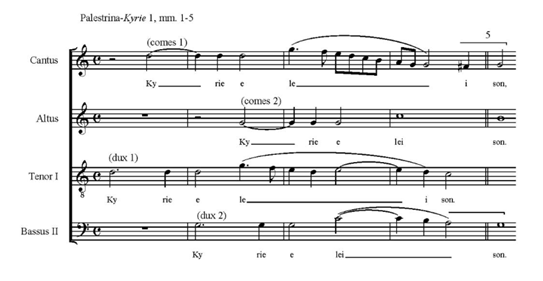
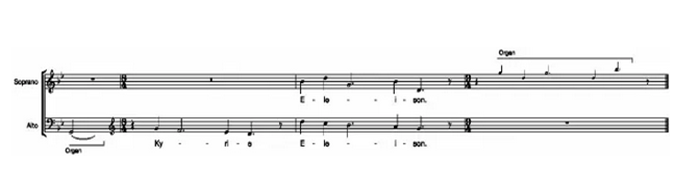
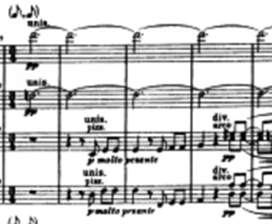
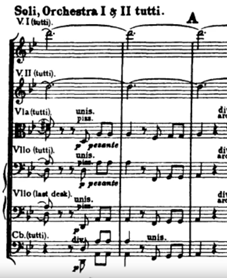
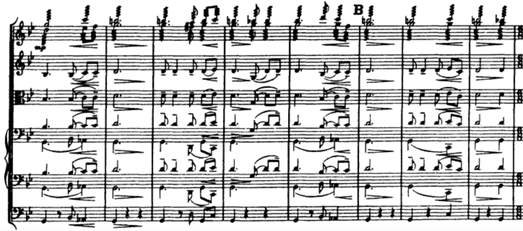
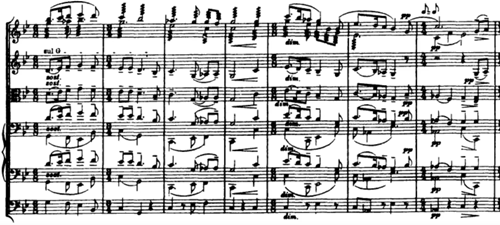
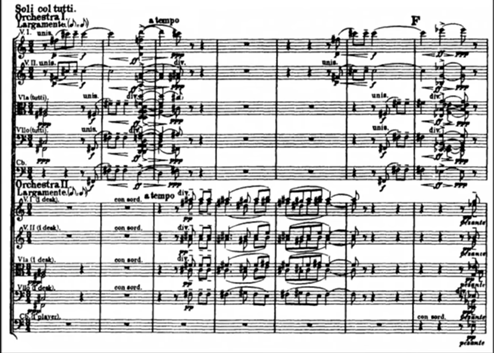
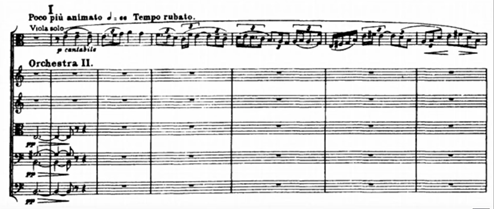
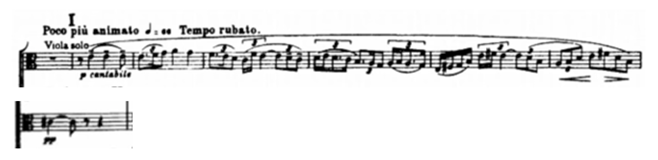
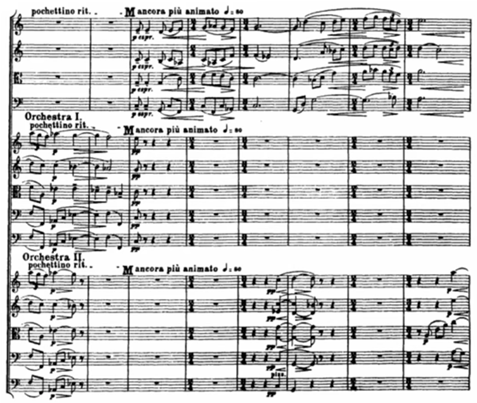
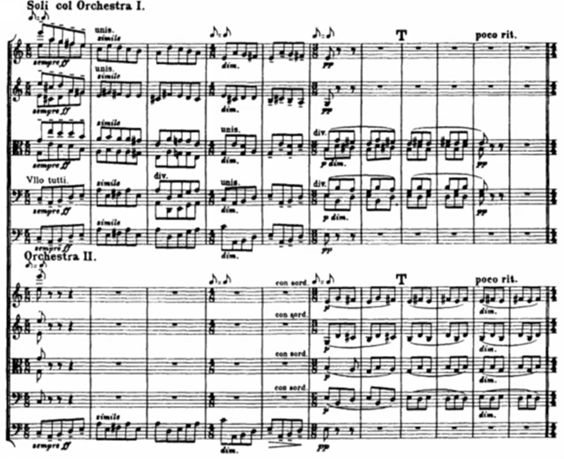

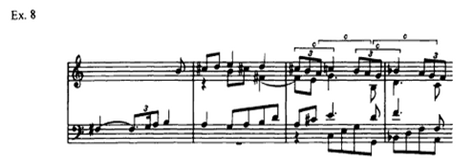
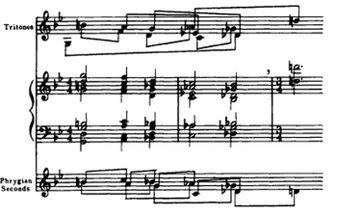
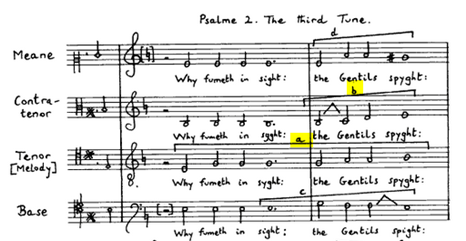
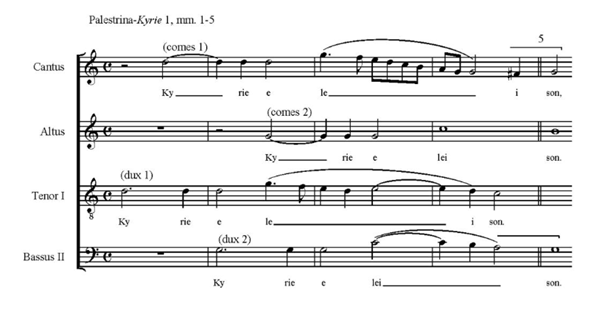
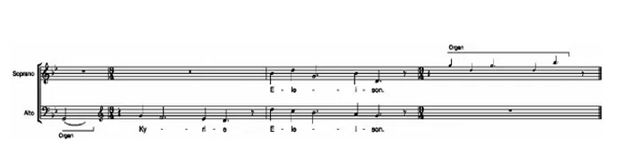
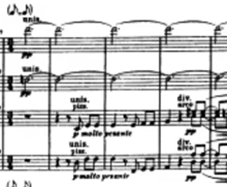
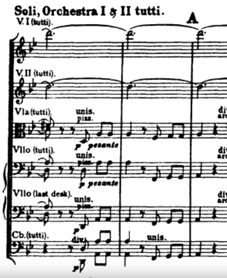
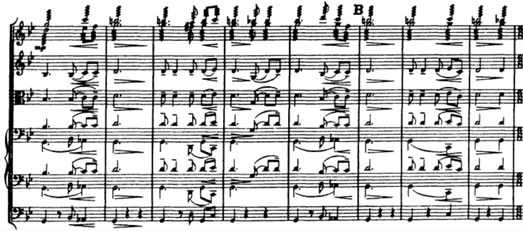
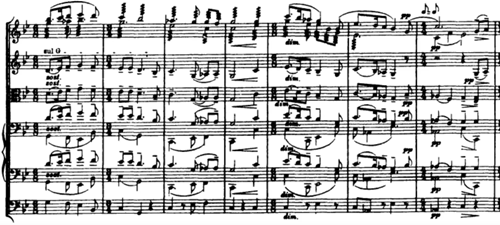
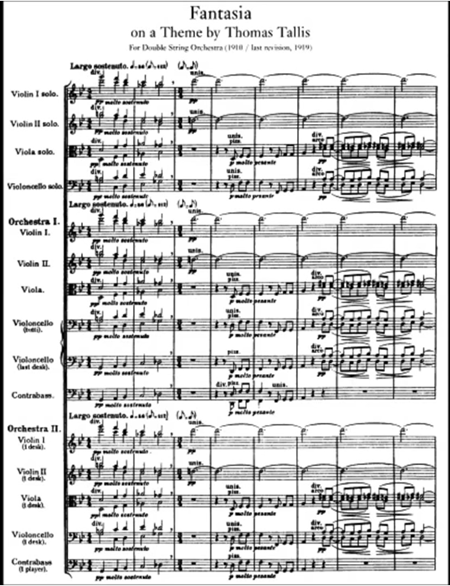
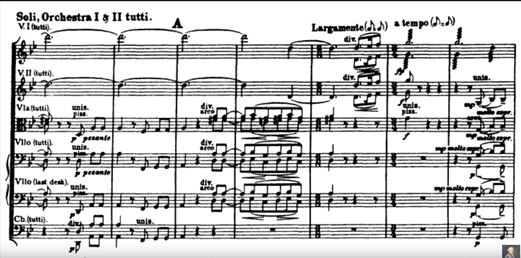
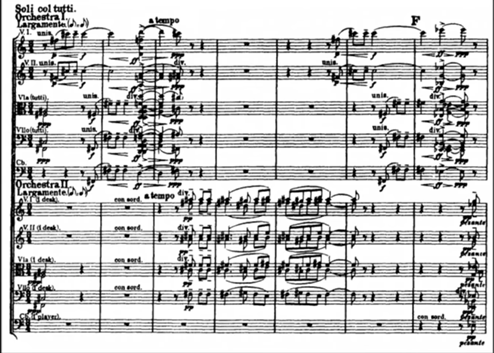
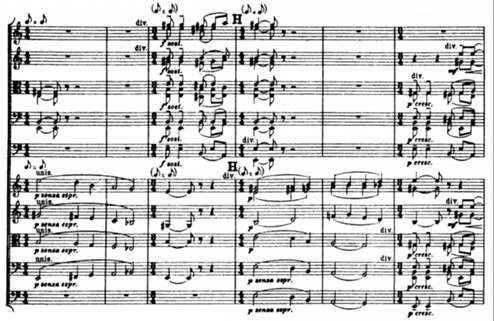
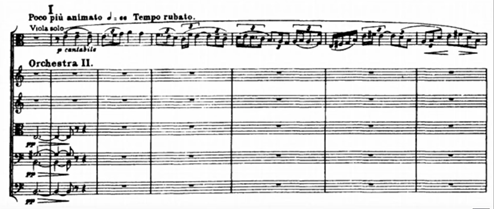
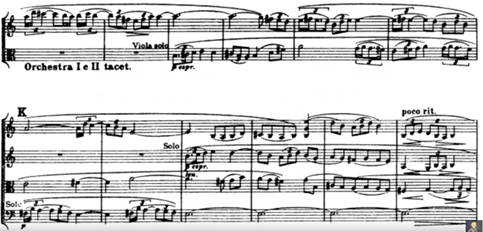
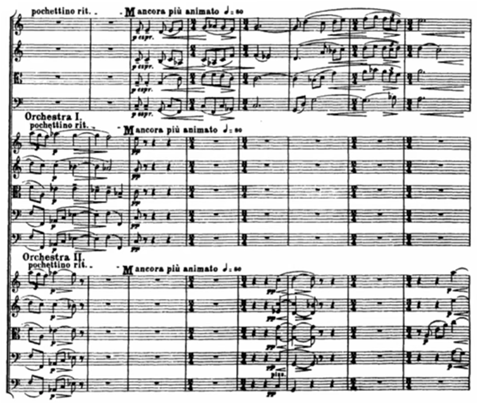
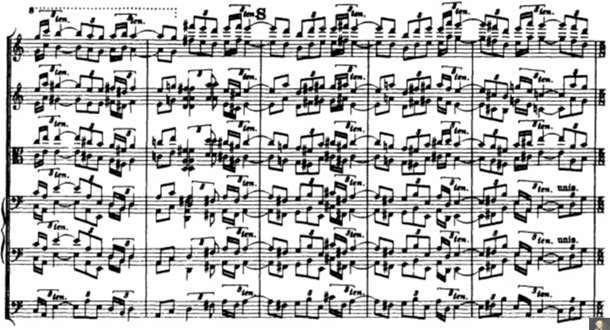
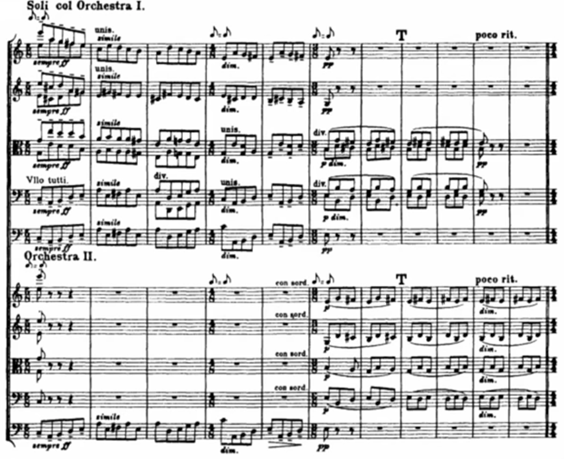
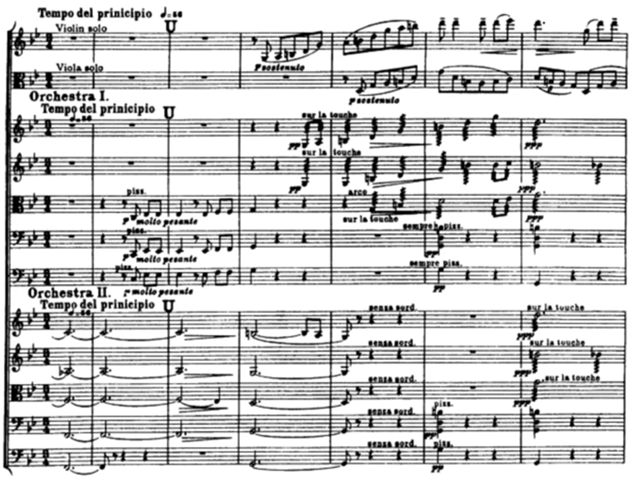
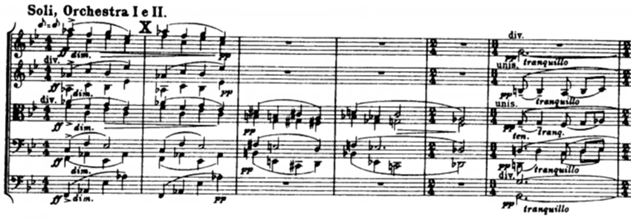
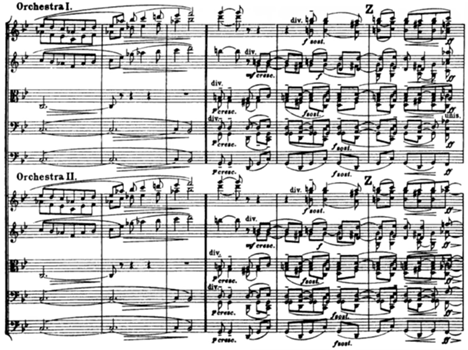
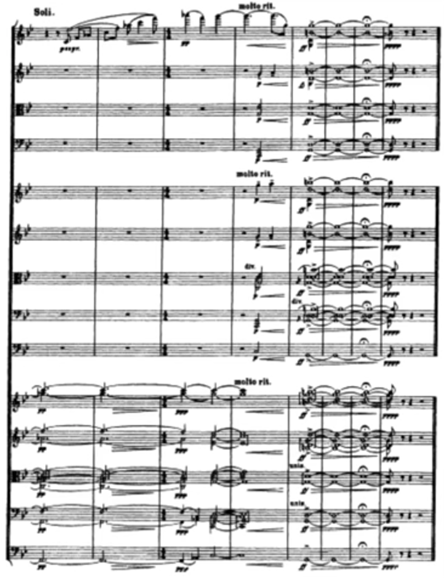
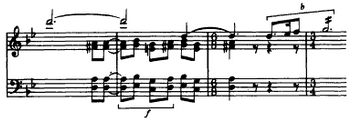
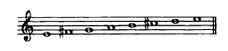
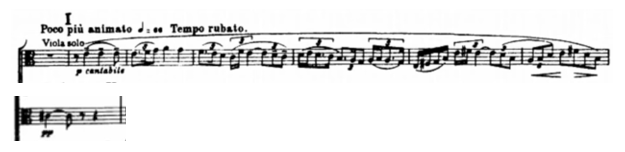
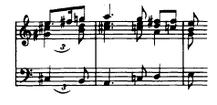

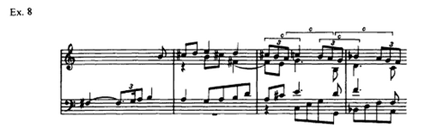
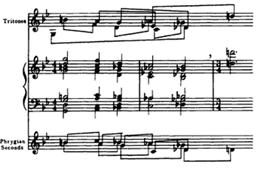
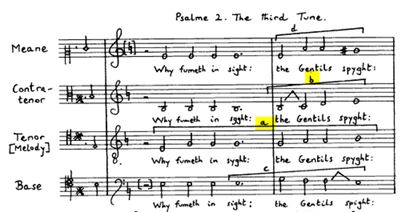
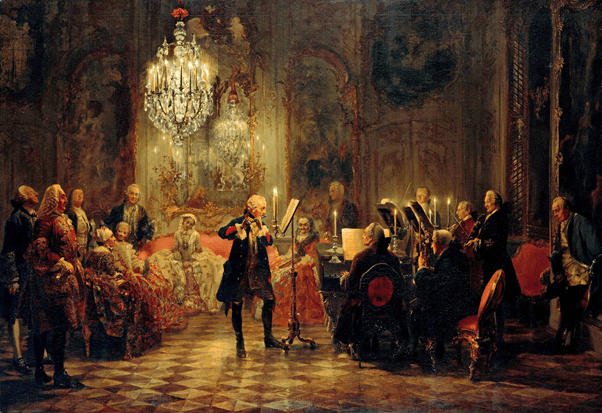
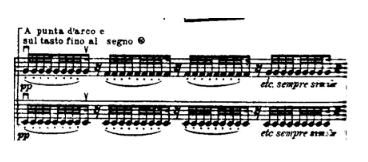
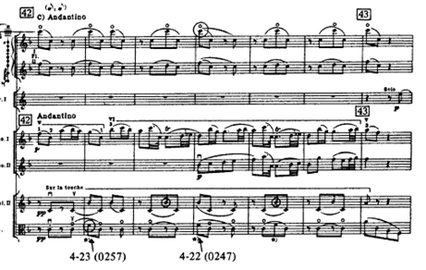
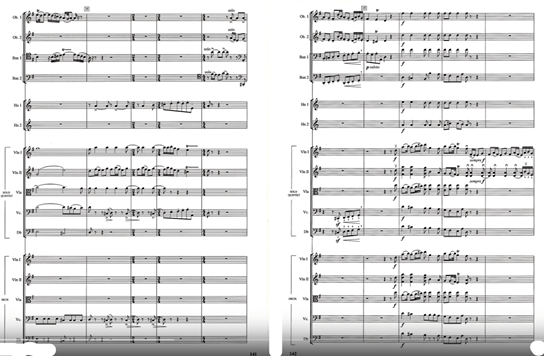
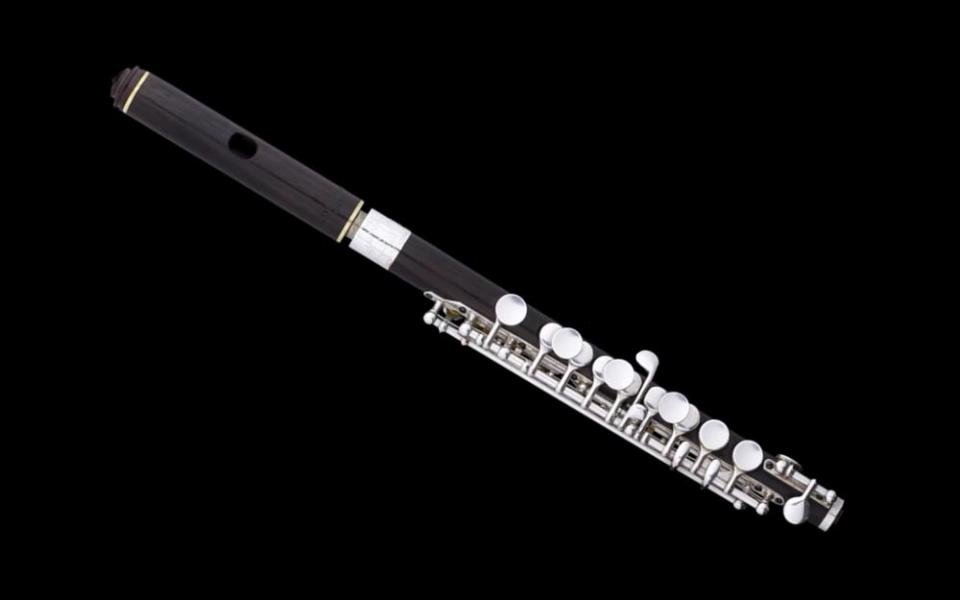
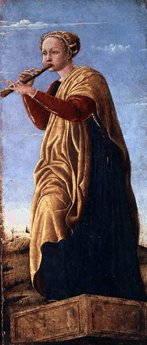
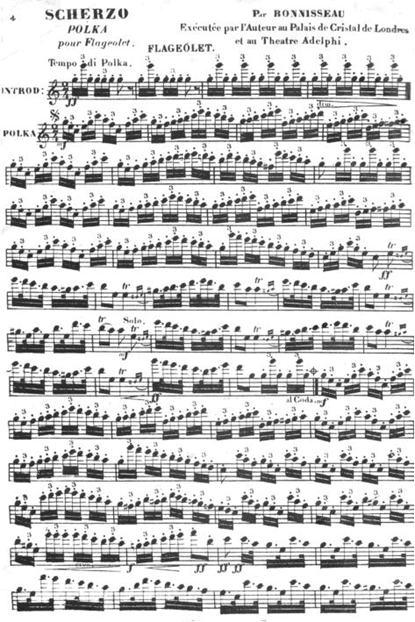
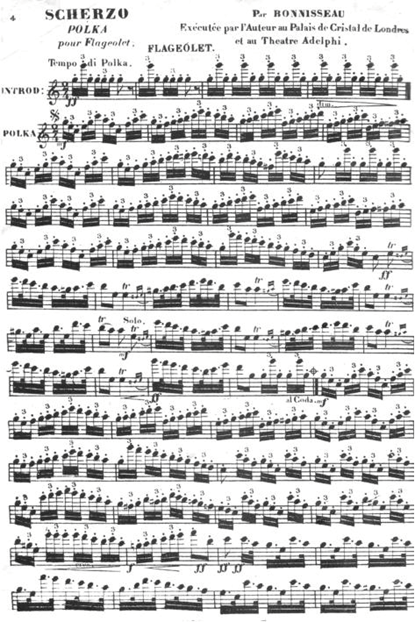
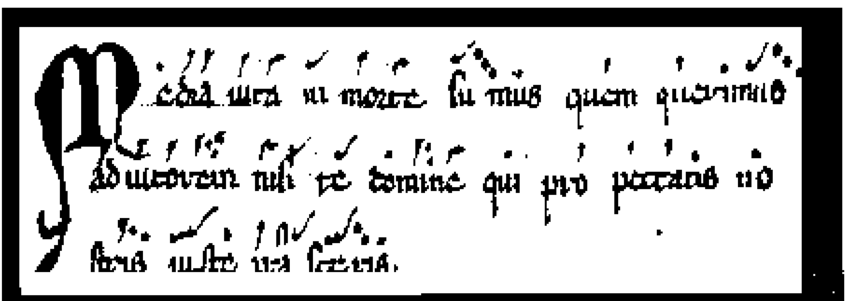
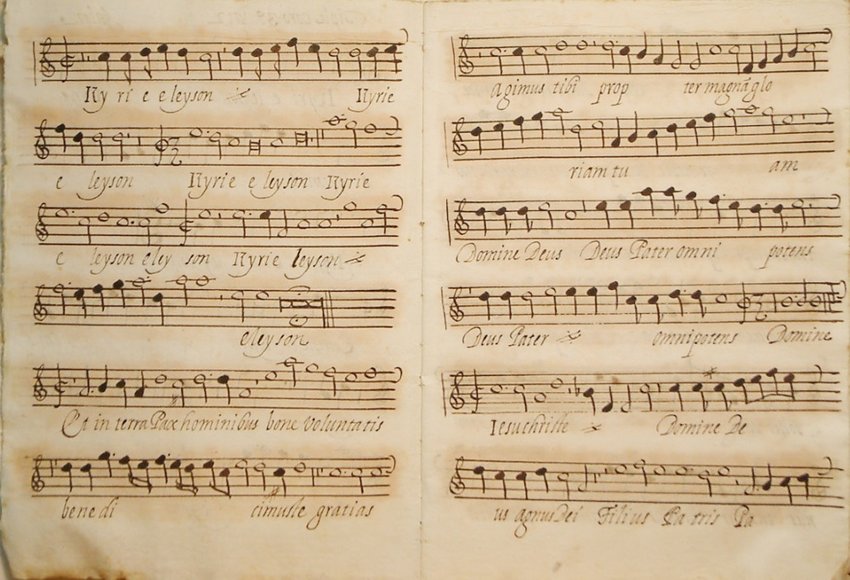
 Aname
Aname 