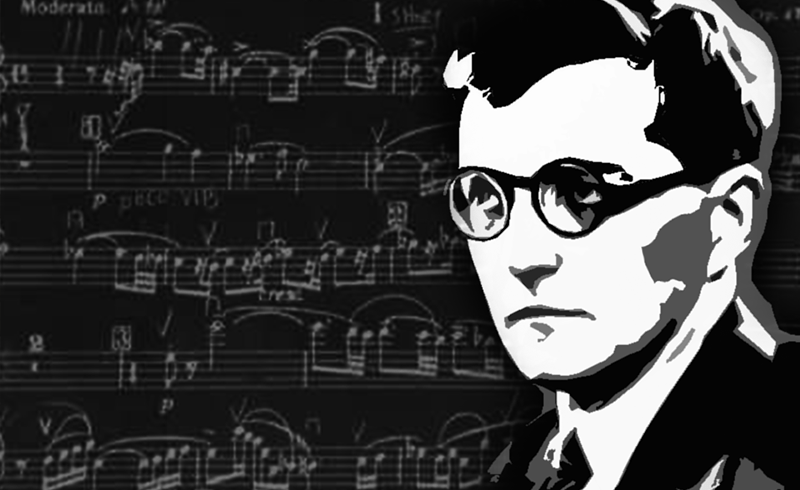
Shostakovich (12/25 September 1906 – 9 August 1975) was a Russian composer and pianist. He is regarded as one of the major composers of the 20th century. He learned piano and composition and entered the Petrograd Conservatory in 1919, at the age of 13. During the 1920s he developed a modernist style and studied the works of Schoenberg, Hindemith and Berg. A polystylist, Shostakovich developed a hybrid voice, combining a variety of different musical techniques into his works. His music is characterized by sharp contrasts, elements of the grotesque, and ambivalent tonality; the composer was also heavily influenced by the neo-classical style pioneered by Igor Stravinsky, and (especially in his symphonies) by the late Romanticism of Gustav Mahler. His 1934 Opera, Lady Macbeth of the Mtsensk District, was at first greeted with much public acclaim and seen as a model example of Soviet Realism. In 1936, however, Stalin attended a performance, disapproved of the work and left before the end. Shortly afterwards, the work was criticized in Pravda ‘Sumbur vmesto muzïki’ (‘Chaos instead of Music’) for its explicitness and dissonance (Www-oxfordreference-com.ucreative.idm.oclc.org, 2011). It was dropped from the repertory and was not seen again in Russia until its revival—as Katerina Izmaylova—in 1963. Shostakovich, fearing for his physical safety, this was the time of the Soviet show trials after all, withdrew his 4th symphony before its premier since it was in a similar style to Lady Macbeth, and started work on the 5th symphony, which was premiered on 21st November 1937. The work was an immediate success with the public and assisted with his political rehabilitation (Norris and Nice, 2011).
I listened a few versions of Shostakovich`s 5th Symphony. I compared these different recordings of the final movement in particularly the coda with its two tempo options. My favourite is the recording conducted by Rostropovich with the London Symphony Orchestra in 2005. (Spotify, 2005) This is the slowest in tempo, but the repeated unison is regal, heroic and grand. The Bernstein recording in 1959 was the fastest in tempo. (Spotify, 1959) I did not like it as I felt that the interpretation is way too hurried, especially the first part. He also does a grand ritardando at the end, which creates a dramatic mood, but it does not sound appealing. In my opinion if you are playing the coda in a faster tempo, than stay in it, like Previn did in his 1966 recording with the London Symphony Orchestra. (Spotify, 1966) The composer`s son, Maxim Shostakovich conducted the 2011 performance with the London Symphony Orchestra as well. (Spotify, 2011) His interpretation was also to choose the slower tempo.
Creating different versions (slow and fast) of the coda makes the piece interesting but it also means that not every type of interpretation fit into the music. They create a triumphant climax to the piece but the faster the tempo is it became one dimensional, clinical and technical. The slower tempo however not only attracts the listener more but highlights the triumph of the overcame difficulties.
References
Your Bibliography: Spotify. (2005). Shostakovich: Symphony No. 5. [online] Available at: https://open.spotify.com/album/59nwsMqS75TtQxTKiPiKD9 [Accessed 15 Aug. 2019].
Your Bibliography: Spotify. (1959). Bernstein’s 1959 Shostakovich 5th Symphony op.47. [online] Available at: https://open.spotify.com/album/4tXzmVVsmjA9R4uwOKxHmy?si=o-fVfqZqTQiyXwoe8hl-rg [Accessed 15 Aug. 2019].
Your Bibliography: Spotify. (1966). Shostakovich: Symphony No. 5 in D Minor, Op. 47. [online] Available at: https://open.spotify.com/album/0k8rJnNUIKLzZy3hUKUfc5 [Accessed 15 Aug. 2019].
Your Bibliography: Spotify. (2011). Shostakovich: Symphony No.5 & Festive Overture. [online] Available at: https://open.spotify.com/album/1UoQjrpzW5NWg7q5YQONfC [Accessed 15 Aug. 2019].
Your Bibliography: Www-oxfordreference-com.ucreative.idm.oclc.org. (2011). OpenAthens / Sign in. [online] Available at: https://www-oxfordreference-com.ucreative.idm.oclc.org/view/10.1093/acref/9780199579037.001.0001/acref-9780199579037-e-6164 [Accessed 15 Aug. 2019].
 Aname
Aname 