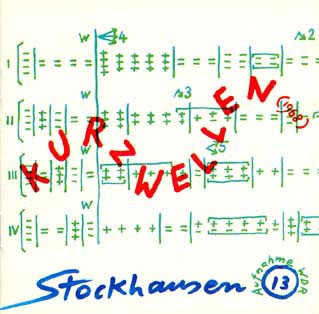
The latter half of the 1960s is often referred to as Stockhausen’s ‘intuitive’ period (Whitehouse, 2019), when he largely abandoned the systematic serial planning of his music to an increasingly improvisational approach to composition; one where the response of the performers takes precedence over the instructions to which they respond. Kurzwellen is one of a series of works dating from the 1960s which Stockhausen designated as “process” compositions. These works in effect separate the “form” from the “content” by presenting the performers with a series of transformation signs which are to be applied to material that may vary considerably from one performance to the next. The processes indicated primarily by plus, minus, and equal signs, constitute the composition. This “plus-minus” notation is summarized in the following table, which shows the effect of each symbol on the four musical parameters, register, dynamic, duration and rhythm:
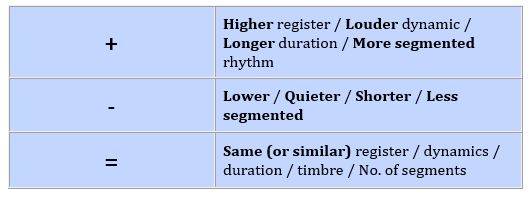
Longer or shorter duration refers to the length of an event. Changing the “segmentation” is basically changing the number of notes in a phrase without changing the melodic shape, typically by dividing long tones into several shorter ones or playing tremolos.
The performers may have extensive freedom in interpretation. For example, if a single symbol is specified, the performer can choose which parameter it will affect, the other parameters remaining unaffected (Chang, 2014).
Kurzwellen also has a few additional symbols to trigger non-spontaneous group formations (duos, trios, quartets).
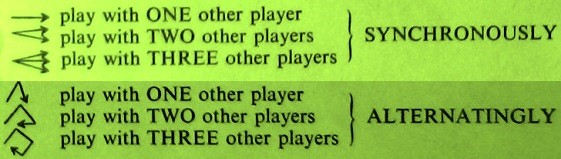
For the 3 “synchronous-signs”, a leader signals a player (or players) to rhythmically follow him. This group follows the leader in the number of events specified after the arrow symbol, while applying their own plus-minus symbols. For the alternating-signs, players take turns (in a repeating sequence) playing their events for the number specified, usually as “echoes” of the leader. After that the leader signals the group’s dissipation with a shortwave radio event.
In his earlier work titled Plus Minus (1963) Stockhausen did not employ the above notation, but instead developed a notation based on Matrix Event Squares (Chang, 2015). These are derived from pages of symbols and pages of pitch material.
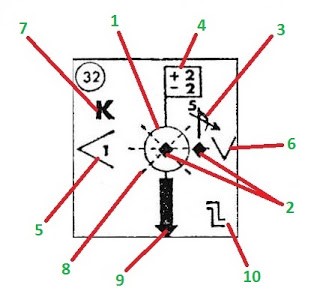
(this is vent 32, which features Character 5)
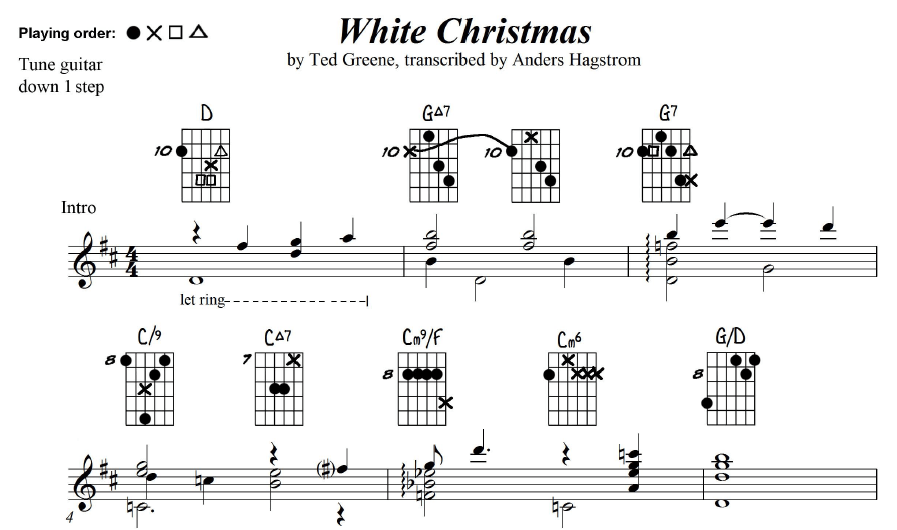
An alternative notation schemes are widely used in guitar music, including tablature, where the notation is a visual representation of the guitar’s strings with numbers to indicate the fret(s) to be held down, and chord windows, which are a visual representation of a section of the guitar fingerboard with dots to indicate the position of the fingers. This latter system has been developed further by, for example, the jazz guitarist and instructor Ted Greene (1946-2005) with use of different symbols to indicate the order in which the notes should be played. An example is shown in Figure 2. (Tedgreene.com, 2005)
References
Your Bibliography: Whitehouse, R. (2019). OpenAthens / Sign in. [online] Go-gale-com.ucreative.idm.oclc.org. Available at: https://go-gale-com.ucreative.idm.oclc.org/ps/i.do?p=ITOF&u=ucca&id=GALE|A580096843&v=2.1&it=r&sid=summon [Accessed 17 Aug. 2019].
Your Bibliography: Stockhausen, S. (2013). KARLHEINZ STOCKHAUSEN: COMPLETE LIST OF WORKS. [online] Karlheinzstockhausen.org. Available at: http://www.karlheinzstockhausen.org/complete_list_of_works_english.htm [Accessed 17 Aug. 2019].
Your Bibliography: Chang, E. (2014). KURZWELLEN. [online] Stockhausenspace.blogspot.com. Available at: http://stockhausenspace.blogspot.com/2014/10/opus-25-kurzwellen.html [Accessed 17 Aug. 2019].
Your Bibliography: Tedgreene.com. (2005). TedGreene.com – Teachings. [online] Available at: http://tedgreene.com/fromstudents/WhiteChristmas-AndersHagstrom.asp [Accessed 18 Aug. 2019].
 Aname
Aname 