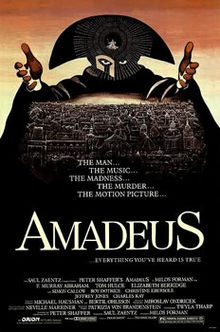
The story of the film is the relationship between two musician Antonio Salieri and Wolfgang Amadeus Mozart. Salieri was jealous of Mozart’s musical talent and achievements and how he always wanted to be like him.
The music in Amadeus is very important and revolves around the drama. The director used Mozart`s pieces in an extensive and effective way. It is not just a simple background music which serves to underline the atmosphere with grief, joy or other emotions. It naturally becomes more prominent.
The sequences from Mozart`s operas (The Abduction from the Seraglio, The Wedding of Figaro, Don Giovanni, and The Magic Flute)are closely connected with the plot. Their function is to represent the rivalry between Mozart and Salieri. Mozart use them to claim his position as the best composer in the world and Salieri to harm his rival by turning his work against him.
The elements and tunes from the operas also have a symbolic function. At the opening scene everything is dark, and we hear Salieri as he shouts Mozart`s name begging his forgiveness. The emotion of fear and desperation of this sequence supported by the dramatic opening chords of Don Giovanni.
Another way the director used the music is to illustrate what goes on in Mozart`s head. One of the examples is the scene where Mozart is composing, and we hear the music together with him. Suddenly, Constanze comes in to introduce Lorl. She has to shout to make herself heard over the sound of music playing in Mozart`s head. The music stops, and while Lorl arrives, Constanze starts to argue with Leopold. He did not participate, instead he returns to his work. Gradually music rises again while the voice of Constanze and Leopold fade away.
In another scene the director used music to express Mozart`s feelings. In these part Mozart leaves the sleeping Constanze and his work Requiem and goes to a party at Schikaneder`s cottage. He is playing and singing fragments from The Magic Flute for the guests. The problem is that he cannot overcome his guilt for having left his wife and his work for a party. Although he starts singing more and more louder, the sombre choir of Rex Tremendae gradually overshadows the joyful Magic Flute overture.
Salieri also has the talent of hearing complete music as soon as he sees the score. This features in the scene when Salieri reading Mozart`s manuscripts. While he quickly turns the pages, the audience hears passages from Mozart`s music.
Similar scene happens on the night of Mozart`s death. The dying composer dictates his unfinished work called Requiem to Salieri. As soon as the passage is written down, we can hear it in its final form. First with a single voice and instrument, then the whole ensemble. We also hear the individual parts from the Requiem at the scene when Constanze returns.
Finally, the most memorable sound elements in the film is Mozart`s giggle. It is at once unnerving and disarming, which manifests the duality of Mozart. It also echoes through the composer`s music at the final scene. Despite his hard life and early death, it is Mozart who has the last laugh.
 Aname
Aname 