Béla Bartók – Romanian Folk Dances
In this work Bartók used seven original folk tunes which he collected from different regions of Transylvania. Each piece represents a different dance form.
Joc cu Bâtă (Stick Dance) is the first piece from the set. The national identity come across by the folkloric elements. The first element is the key of the piece. It centered around A with influences of Dorian and Aeolian modes which are the most used modes in Romanian folk music.
The second element is the melody which represents a typical Romanian folkloric dance type. For example, the use of the dotted rhythms (Example 1) which reflect a dynamic dance or the sequential rhythmic material which spread over a full measure and gives us a slow folkloric dance type (Example 2).
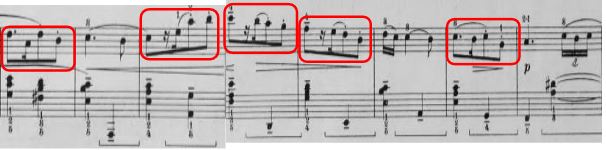
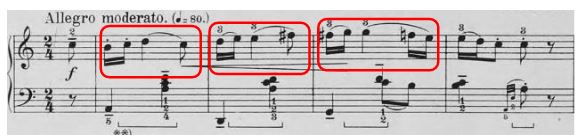
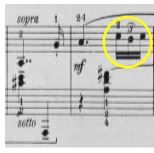
The third element is the variations and ornamentation which respecting the idea of free improvisation and variation on a theme. Free improvisation is the foundation of the Romanian folk tunes. (Example 3)
Reference
Bartok, B., 2017. Béla Bartók plays his Romanian Folk Dances No. 1, 2 & 6. [online] Youtube.com. Available at: <https://www.youtube.com/watch?v=DscctOyPzh8> [Accessed 5 February 2021].
Bartok, B., 2021. Romanian Folk Dances, Sz.56 (Bartók, Béla) – IMSLP: Free Sheet Music PDF Download. [online] Imslp.org. Available at: <https://imslp.org/wiki/Romanian_Folk_Dances%2C_Sz.56_(Bart%C3%B3k%2C_B%C3%A9la)> [Accessed 5 February 2021].
 Aname
Aname 