Based on the Oxford Companion to Music, the term musical notation can be applied to any formal indication of how sounds and silences intended as music should be produced. (Latham, 2011)
The earliest known example of a complete notated musical composition developed by the ancient Greeks. It is carved on a tombstone in Turkey and it dates around the 1st century AD. The Byzantine Empire developed the equivalent of the Western “sol-fa” scale and a form of notation based on pitches being higher or lower than the previous one. The alternative to the “sol-fa” method is the letter system (A to G) which indicates the notes of a scale. This letter system is used today.
The earliest notation was developed for plainchant around 800CE and called neumes. It contains a system of lines, dots, and squiggles as a guide to music performance. Squiggles probably derived from the accentual signs used in the Latin language.
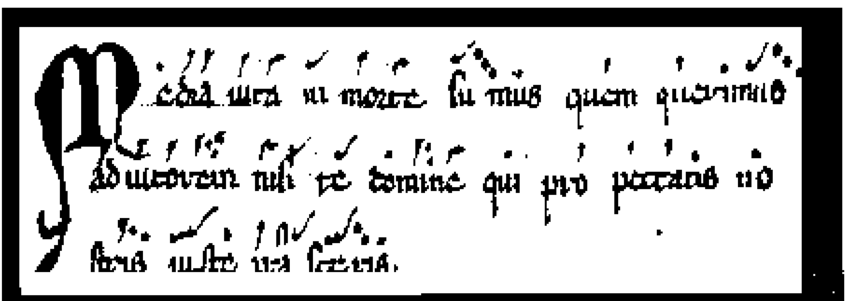
By the end of the 10th century, Guido of Arezzo (c.991-after 1033) introduced the staff with lines and spaces to represent relative pitch, and a clef to give an exact pitch. He also suggested that two different forms of the letter b be used to describe the pitches Bb and B♮ and these are the earliest known accidentals in Western music.
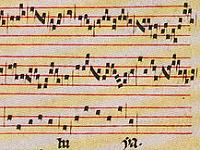
In the 13th and 14th centuries, rhythmic modes were invented to define a set of rhythmic patterns. In the Franconian or Mensural notation, the shape of the note defines its relative duration. This was the root of modern notation. Also, the minim is fully accepted as a note value and a system of graphic symbols were introduced to define time signatures.
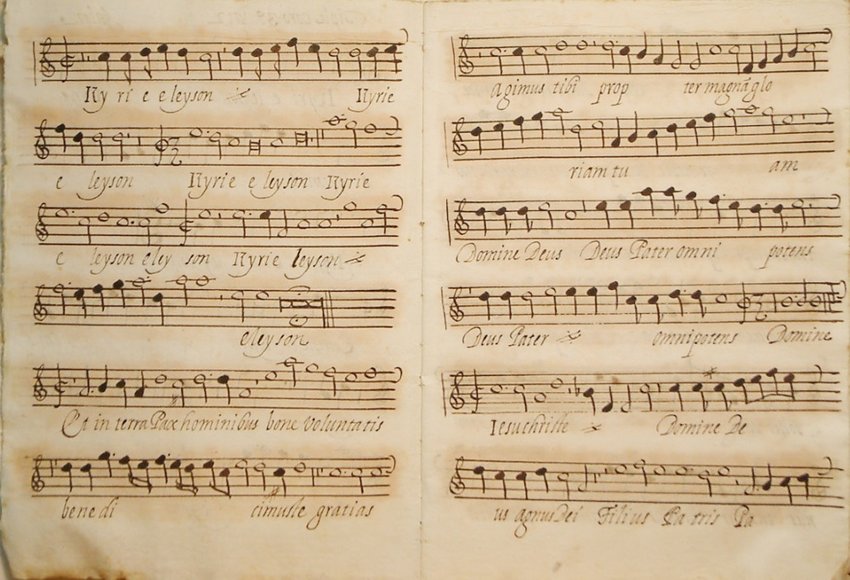
In the 15th and 16th centuries, there are several practical issues arose from the new technology of printing onto paper. To solve these problems, open note heads were used. Many details of the use of the modern instrumental music were established. The earliest extensive use of ties, slurs, and ledger lines. From the mid-17th century, bar lines arranged such a way it matched with regularly recurring accents. Natural sign ♮ is used frequently same as the sharp # and flat b signs. Composers are also use sharp `key signatures ‘as well as the flat ones which was common in the medieval period. In the 16th century, the tempo markings became consistent.
Reference
Latham, A., 2011. OpenAthens / Sign in. [online] Www-oxfordreference-com.ucreative.idm.oclc.org. Available at: <https://www-oxfordreference-com.ucreative.idm.oclc.org/view/10.1093/acref/9780199579037.001.0001/acref-9780199579037> [Accessed 10 March 2021]
Paterson, J., 1999. History of Music Notation – evolution, printing, specialisation and computers. [online] Mfiles.co.uk. Available at: <https://www.mfiles.co.uk/music-notation-history.htm> [Accessed 10 March 2021]
Bamberger, J. and Disessa, A., 2003. MUSIC AS EMBODIED MATHEMATICS: A STUDY OF A MUTUALLY INFORMING AFFINITY. [ebook] California: University of California Berkeley, p.4. Available at: <https://www.researchgate.net/publication/226679129_Music_as_Embodied_Mathematics_A_Study_of_a_Mutually_Informing_Affinity> [Accessed 10 March 2021]
Paterson, J., 1999. History of Music Notation – evolution, printing, specialisation and computers. [online] Mfiles.co.uk. Available at: <https://www.mfiles.co.uk/music-notation-history.htm> [Accessed 10 March 2021]
Pacha, A. and Calvo-Zaragoza, J., 2018. OPTICAL MUSIC RECOGNITION IN MENSURAL NOTATION WITH REGION-BASED CONVOLUTIONAL NEURAL NETWORKS. [ebook] Paris: ResearchGate, p.240. Available at: <https://www.researchgate.net/publication/327962576_Optical_Music_Recognition_in_Mensural_Notation_with_Region-Based_Convolutional_Neural_Networks> [Accessed 10 March 2021]
 Aname
Aname 