When I was choosing my assignments for submission, I focused to select works which represents different aspects of the music. This assignment is focused on music analysis where I compared Kyrie from two different Masses, than I explored Fantasia on a Theme of Thomas Tallis by Ralph Vaughan Williams.
- Similarities and differences between Giovanni Pierluigi da Palestrina and Arvo Pärt
In this essay I picked Kyrie as extracts from two Masses. The first one is Pope Marcellus Mass by Giovanni Pierluigi da Palestrina (1525-1594) and the second is Berlin Mass by Arvo Pärt (born in 1935). I will discuss the similarities and differences of these compositions and closing the essay with a conclusion.
The first difference between the two pieces is that both music scored differently. Palestrina`s work written for six acapella voices (SATTBB). Pärt originally scored the mass for soloists (SATB) and organ, then later he revised the piece for mixed choir or soloists (SATB) and string orchestra.
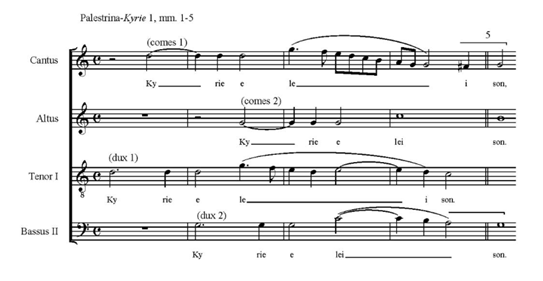
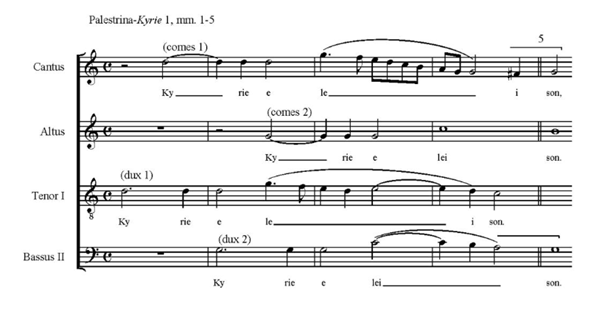
Although the score is different, the structure of the Kyrie is similar in both masses. It has three distinct sections (Kyrie eleison, Christe eleison and Kyrie eleison). The two composers use different compositional technique however both of them are influenced by Gregorian chant. Palestrina`s Kyrie consists of imitative polyphony which is based on the main motif. The basic melodies and their words are stated early in a single voice before the other layers (voices) are gradually added which represented by Example 1 where the piece begins with Tenor I followed by Cantus, than Bassus II and finally the Altus. The composer also uses imitation which also can be seen. While the work is written to six acapella voices, the announcement of the text with the motive ideas is represented by only four and the movement set up as two duets. Palestrina also uses a contrapuntal texture and perfect intervals in Tenor I (D rises to G by perfect 4th, then descends to C by perfect 5th). (Gutmann, 1998) (Moore, 2006)
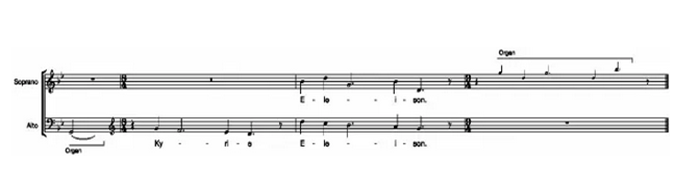
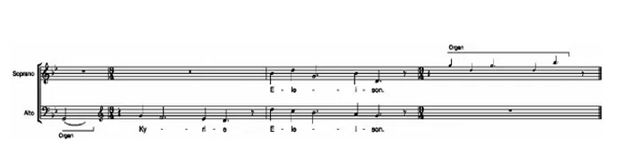
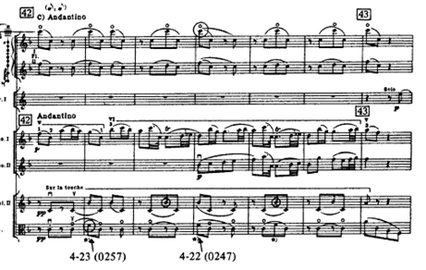
Pärt is using the tintinnabuli method which is characterized by two types of voice. The first of which arpeggiates the tonic triad and the second of which moves diatonically in stepwise motion. Example II shows the complete tintinnabulating passage in measures 2-4 between the soprano voice and organ. After the establishment of the first tintinnabulating chord B in the soprano line, Pärt brings the tintinnabulating line into the organ by an octave higher and continue the process he started in the soprano. The two voices can be described as scalic and arpeggiated. I also observed, that Pärt using notes in a way which creates dissonance between tintinnabulating voices and melodic voices.(Forrestal, 2011)
Palestrina uses the same time signature with similar rhythms throughout his piece but Pärt constantly changes the time signature and stressing syllabus by augmentation of rhythm to create a leaning forward motion. Also, there is a punctuating period for the orchestra after each line of the text sang by the choir.
The Christe eleison in both masses are in contrast with Kyrie. Palestrina used simple and lighter structure with more rests and slightly more transparent part. It brings homophonic texture by pairs of voices answering each other before the fuller texture is exposed. Pärt `s piece is characterized by the presentation of two melodic idea.
I enjoyed listening both masses. Although both pieces are written for a mass setting, the composers own techniques make them individual. In my opinion these methods create an overall texture which is slow, meditative, and entrancing on its unique way.
Word: 544
References
Gutmann, P., 1998. Classical Notes – Classical Classics – Palestrina’s Missa Papae Marcelli, By Peter Gutmann. [online] Classicalnotes.net. Available at: <http://www.classicalnotes.net/classics4/palestrina.html> [Accessed 5 June 2020]
Arvopart.ee. n.d. Biography – Arvo Pärt Centre. [online] Available at: <https://www.arvopart.ee/en/arvo-part/biography/> [Accessed 7 June 2020]
Forrestal, J., 2011. TWO TANGLED GOLDEN THREADS: ARVO PÄRT, HIS TINTINNABULATIONTECHNIQUE, AND HIS BERLINER MESSE. [ebook] Boston, United States: Boston University, pp.21-24. Available at: <https://www.academia.edu/1800969/Two_Tangled_Golden_Threads_Arvo_P%C3%A4rt_his_Tintinnabulation_technique_and_his_Berliner_Messe> [Accessed 7 June 2020]
Moore, M., 2006. Missa Papae Marcelli: A Comparative Analysis Of The Kyrie And Gloria Movements Of Giovanni Pierluigi Da Palestrina And An Adaptation By Giovanni Francesco Anerio. [ebook] Texas, United States: University of North Texas, pp.13-38. Available at: <https://digital.library.unt.edu/ark:/67531/metadc5257/m1/1/> [Accessed 7 June 2020]
2) Fantasia on a Theme of Thomas Tallis by Ralph Vaughan Williams
In this essay I chose Fantasia on a Theme of Thomas Tallis by Ralph Vaughan Williams. I begin with a brief introduction about the composition which followed by an analyzation where I describe the ways in the earlier material has been used and also identify new materials. Finally, I finish my essay with a conclusion where I summarise my findings.
In 1567 Thomas Tallis contributed nine tunes for Archbishop Parker`s Psalter. Why fum`th in sight (Psalm 2) is the third psalm tune and it is given the title Third Mode Melody because it written in Phrygian mode. Between 1904 and 1906 Ralph Vaughan Williams was asked to edit the music for The English Hymnal when he came across Tallis`s metrical psalm tunes. He used this theme as the basis of his piece called Fantasia on a Theme of Thomas Tallis. It was composed in 1910 and first performance was on 10 September at Gloucester Cathedral for the Three Choirs Festival. He revised the work twice, in 1913 and 1919.
After listening Thomas Tallis`s psalm, I found the piece simple, lacks a regular time signature but still it is in the double common metre. This type of metre is wildly used in English psalmody and hymnody. It also uses the unique colour of the Phrygian mode. I think the beauty of the tune, the balance and its construction must have affected Vaughan Williams deeply. The composer incorporates the past to reassert the present. The base of Vaughan Williams`s composition is the old church mode, the Elizabethan fantasy which is an instrumental form. It derives from the contrapuntal nature of madrigal with several related themes in independent sections.
While Tallis`s composition written for voices, Vaughan Williams scored for an extended string orchestra which divided into three groups. Orchestra I, Orchestra II (smaller group), and a string quartet.
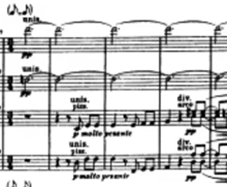
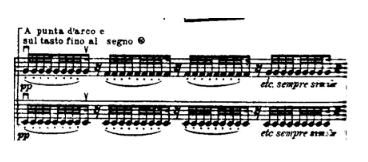
The Fantasia uses Tallis`s psalm as a main theme (subject) which we can hear in its full form in mm. 15-31. The composer applied this subject in several ways such as a response to another theme, as a transition from one theme to another or as an approach to or departure from a climax, and as a theme in its own. Vaughan Williams also breaks up the hymn into subthemes. For example, A1. A rising theme which begins with an identifying minor third interval. Example 1 shows this interval plucked in the lower strings at the beginning of the piece.
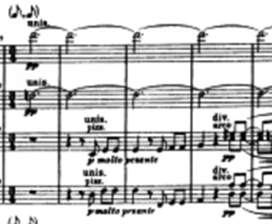
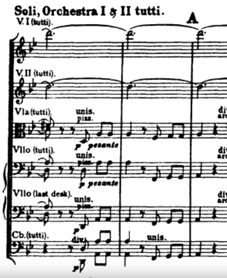
A 2. An answering phrase which has the same rhythm as A 1, and it is also used in the lower strings (Example 2).
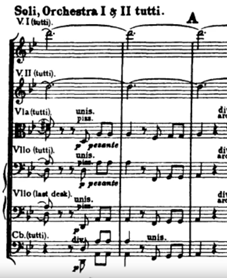
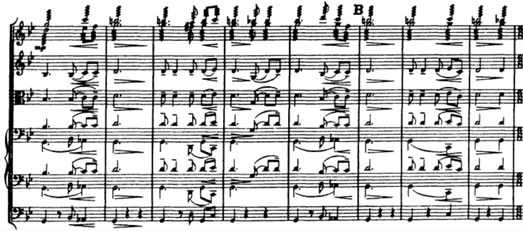
A 3. A rising and craving phrase with dotted rhythm in triple time in Phrygian mode (Example 3).
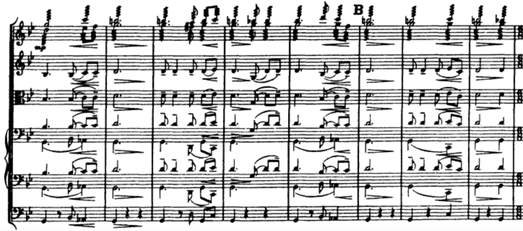
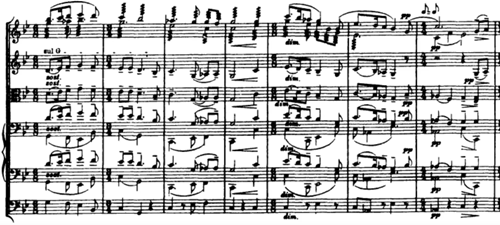
A4. Another phrase which contain dotted rhythm in triple time but generally the pitch moves down. This phrase moves as a lively dance and usually appear at climaxes and soft at the quieter parts (Example 4).
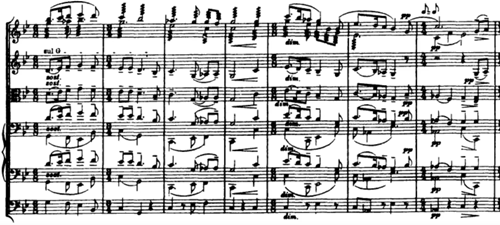
In the introduction we can experience a sway motion feeling. It created by the low strings where the A1 plucked slowly in the low strings (bar 4) which answered by quavers connected with slur (bar 6) under the held note from the high strings. In the first episode Vaughan Williams alternates the A2 with the sway (Example 5).
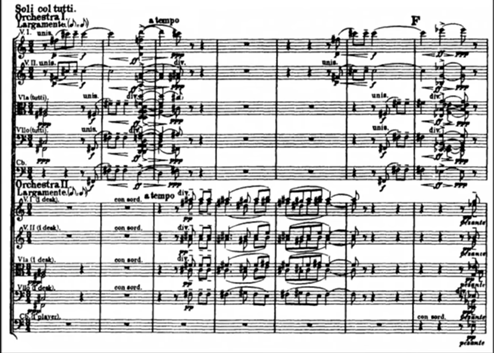
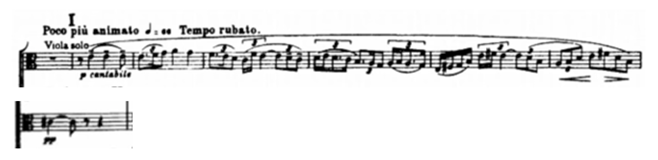
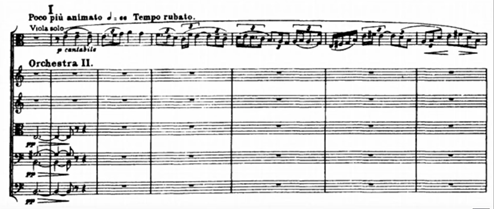
In the second episode of the Fantasia the A3 is exploded. Example 6 represents this where the solo viola plays a variation of A3. The melodic material is based closely on Tallis`s tune, which we can see on the first three notes of the solo viola melody. They are reflected from the repeated notes which occur in the first two strains and also at the end of Tallis`s hymn. It gives the part a rhapsodic feeling.
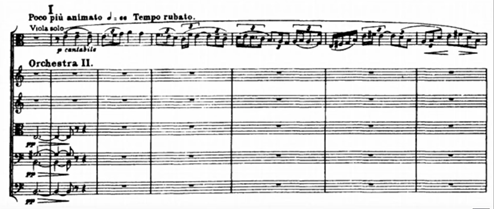
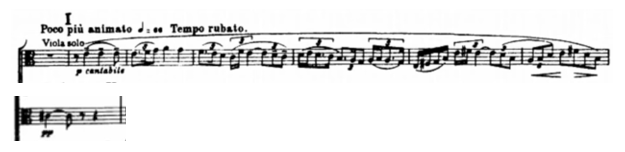
In the viola solo, the composer tended to use F# and C# to avoid F♮ and C♮. However, the C♮ of the Phrygian mode appears which gives Lydian sound to the piece. (Example 7)
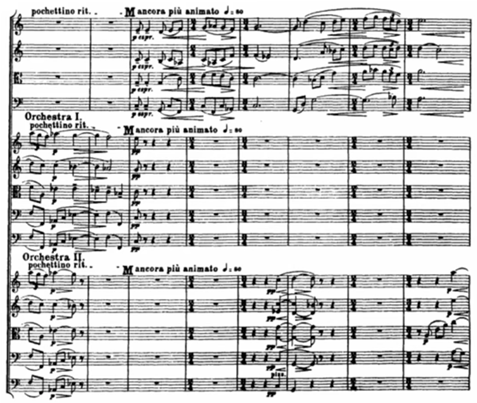
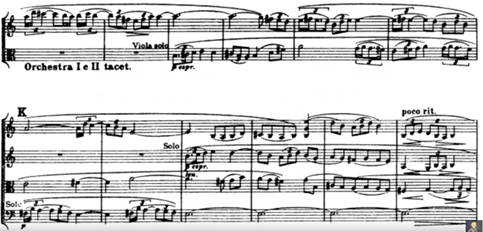
After the solo, we can hear the A3 subtheme in a polyphonic style played by the string quartet. The third episode is the major climax of the work. The “swaying” subject extended and brings to a new melodic path with annotations played by the string quartet (Example 8).
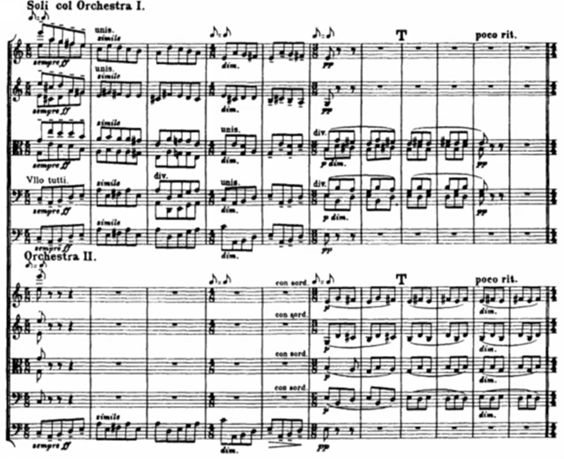
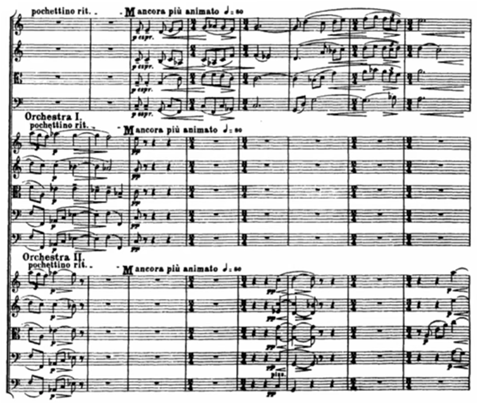
In the fourth episode (transition) the “sway” subject starts again but this time the composer mainly uses two notes (Example 9).
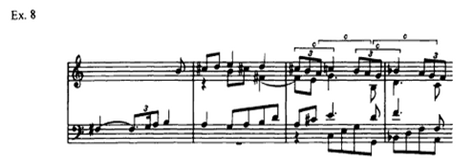
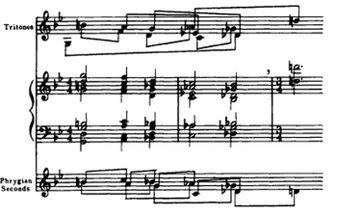
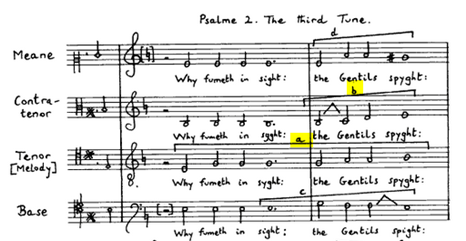
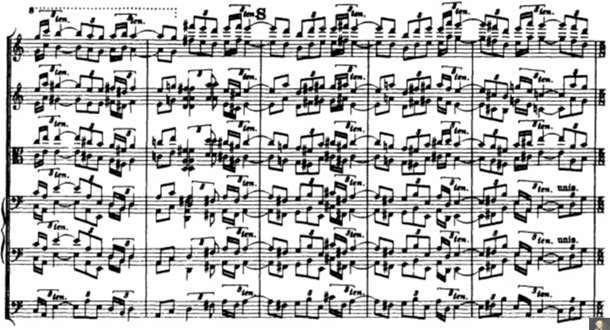
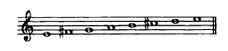
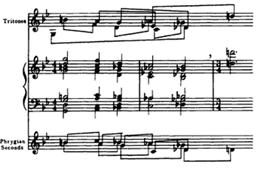
Vaughan Williams starts the Fantasia by giving the attention to tritones, the melodic progressions and the Phrygian flat seconds. In his outer sections, he used various elements of the Phrygian mode which he contrasted with elements of the Dorian (occasionally Lydian) in the rhapsodic centre of the piece. For shifting tonalities, the composer uses two prominent features in Tallis`s harmony, the semitone and the tritone. For example, between E and I where we can see the exploration of these harmonic features used as roots of chords and as tonalities. Tritones and semitones are also incorporate in the harmonic relationships. For example, while the composer preserves the minor third and seventh of the Phrygian mode, the piece sounds as major second above the tonic and dominant pitches instead of Phrygian minor (Dorian mode after letter S). He also builds on the semitonal relationship between C♮ and C# and extend it by using phrase (Example 10, a) from Tallis`s tune in a retrograde inversion (Example 10, b).

The composer used new ways when he combined melodic figures. For example, letter H where the composer used a version of his opening chords transposed down by a minor third (Example 11). The inversion reflected by the use of the phrases from the original material by using phrase a in the bass line and phrase b in the top line (Example 12).
The Fantasia shows that Vaughan Williams were understood the structure and modality of Tallis work. He was able to isolate the vital features from the hymn and recreated them in his composition. Tallis tune is simple and ecclesiastical which Vaughan Williams elevated by the richness and sweetness of the strings. The strings also creating quiet soundscape with shimmering colours and echoes while the parallel fifths heighten a sense of awe and mystery. The piece brings us to a beautiful musical journey which use a simple hymn with new voice and new sense of direction.
Word: 1122
Reference
Doe, P. and Allinson, D., 2020. Tallis [Tallys, Talles], Thomas. Oxford University Press, [online] Available at: <https://www.oxfordmusiconline.com/grovemusic/view/10.1093/gmo/9781561592630.001.0001/omo-9781561592630-e-0000027423?rskey=JYgHVd&result=1> [Accessed 19 June 2020].
Ottaway, H. and Frogley, A., 2001. Vaughan Williams, Ralph. Oxford University Press, [online] Available at: <https://www.oxfordmusiconline.com/grovemusic/view/10.1093/gmo/9781561592630.001.0001/omo-9781561592630-e-0000042507?rskey=gHcrZ3&result=2> [Accessed 19 June 2020]
Pike, L., 1984. Tallis: Vaughan Williams: Howells: Reflections On Mode Three. [ebook] Cambridge: Cambridge University Press, pp.2-13. Available at: <https://www.jstor.org/stable/945078?read-now=1&seq=1#page_scan_tab_contents> [Accessed 20 June 2020].
Atlas, A., 2010. On the Structure and Proportions of Vaughan Williams’s Fantasia on a Theme by Thomas Tallis. Journal of the Royal Musical Association, [online] 135(1), pp.115-144. Available at: <https://www-jstor-org.ucreative.idm.oclc.org/stable/43741608?pq-origsite=summon&seq=3#metadata_info_tab_contents> [Accessed 19 June 2020]
Graham, A., 2012. Interregnum: An Original Work Incorporating Archaic Compositional Elements, With A Study Of “Fantasia On A Theme By Thomas Tallis” By Ralph Vaughan Williams. Degree of Doctor of Arts. UNIVERSITY OF NORTHERN COLORADO
Tallis, T., 1986. Thomas Tallis – Third Tune From Abp. Parker’s Psalter (1567). Available at: <https://www.youtube.com/watch?v=p0AuHYNj8qQ> [Accessed 19 June 2020].
Williams, R., 2015. Vaughan Williams – Fantasia On A Theme By Thomas Tallis. Available at: <https://www.youtube.com/watch?v=qIhZbvlCjY0&t=111s> [Accessed 20 June 2020]
Reflective Account
In this reflective account, I will describe my journey of the last part of this course and highlight the parts that I found it particularly interesting and challenging.
The last part of the course was a full discovery of the music from the Baroque and Renaissance era. The journey began with the introduction of early instruments. During the research I discovered new instruments which I was not familiar with. The biggest issue was to narrow down the number of instruments and information to the blog.
This was followed by another exercise which actually showed how these instruments work within a musical composition. The only difficulty was while the exercises required live concert, I had to use recorded one due to the present situation with Covid19. The internet was a great tool for this, and I found an ensemble who represented early music (instrumental and singing) in a great way.
Introducing of Baroque forms was also a great exercise. It extended my knowledge about different terms which used in this period. To deepen this understanding, I focused on these terms throughout listening to different pieces and also gathered information about the circumstances which these works were written.
The musical patronage exercise was interesting. I do not like this subject as unfortunately the art section is affected by politics and economics. Although there are funding out there, getting them is difficult.
The last part of the course improved my knowledge and view about the different elements that affect the music such as dissonance, intellectual and philosophical movements. It was also interesting to see how the handwritten manuscript turned into a printed form and how they distributed the printed works.
The final exercise was summary of this course and also it was an introduction to the assignment. I gained more practice by describing a chosen composer`s life, work, his musical innovations, and his influence on modern composers.
Another challenging part was the assignment. First it was difficult to gather information about my chosen composer Tallis. Second, the word count. I found it difficult to keep the required number, so I had to focus on to keep only the relevant information. Following my tutor advice, I wrote more details with explanation. I also supported my findings with score evidence which I left out from my previous assignment. I also kept focusing on my academic writing and my grammar. I asked for help proof reading to avoid grammatical errors.
During my studies, I tried to gather evidence from a wide range of sources. I avoided Wikipedia and focused on more reliable sources. Most of my research was based on internet resources as unfortunately the Libraries are closed. I also made sure that my referencing is in a correct form.
In the last feedback I had an issue with my listening log. I followed the course material and completed the required exercises and posted them on my blog. I hope this way my listening log is in a correct form and fulfil the requirements.
Word: 496
Reflection on Tutor Feedback for Assignment Five
Mass Essay
The tutor`s feedback was very positive and inspiring. Although the assignment was good, I still had a couple issues.
The main problem was the length of the essay. Unfortunately, my word count was over the required number, so I had to edit down my content. I also featured my own interpretation of the music more prominently. Another problem was the terminology of tintinnabulation, which I corrected and made clearer the description.
Vaughan Williams Essay
As with the previous essay, I had to remove some parts of the content. I tighten up the points and supported them with some examples. I also gave more space to my own interpretation as requested by my tutor.
Other issue was the limited resources I used to the essay, so I made sure I use more versatile materials when I re visited this work.
My listening log was much more developed than the previous ones, but my tutor made me aware that I need much more focus on my own responses to the music. I corrected this by wrote up more entries.
Assignment 5
- Similarities and differences between Giovanni Pierluigi da Palestrina and Arvo Pärt
In this essay I picked Kyrie as extracts from two Masses. The first one is Pope Marcellus Mass by Palestrina and the second is Berlin Mass by Arvo Pärt. After the brief introduction of the composers and the Masses I will discuss the similarities and differences of these compositions and closing the essay with a conclusion.
Giovanni Pierluigi da Palestrina (1525-1594) was an Italian Renaissance composer. He was a master of contrapuntal composition and a major representative of the 16th century conservative approach to church music during the Roman Catholic Counter Reformation. Missa Papae Marcelli or Pope Marcellus Mass is the most popular piece of Palestrina which he composed while he was working in the Vatican to his second papal employer Marcellus II. He completed his work in 1561 and published in 1567. The piece is a prime example of Renaissance polyphonic choral music. (Madrigal | vocal music, 2020)
Arvo Pärt (born in 1935) is an Estonian composer of classical and religious music. He created a new compositional style called tintinnabuli. Berliner Messe (or Berlin Mass) was composed for the 90th German Catholics Days in Berlin May 1990 and first performed at St. Hedwig`s Cathedral on 24 May 1990. Later the composer re wrote the piece and the second premier with the new setting was in December 1991, in Erlangen, Germany. (Biography – Arvo Pärt Centre, n.d.)
Kyrie is described as a short responsive prayer which begins with the Greek words Kyrie eleison (Lord have mercy). It is the first part of the Roman Catholic Mass or any other Christian liturgies. The text is Latin. (Kyrie dictionary definition | Kyrie defined, 1996)
Both pieces scored differently. Palestrina`s work written for six acapella voices such as soprano, alto, two tenor and two basses. However, Pärt originally scored the mass for soloists (SATB) and organ, than later he revised the piece for mixed choir or soloists (SATB) and string orchestra.
The Kyrie in both masses has three distinct sections which follows the structure of the text Kyrie eleison, Christe eleison and Kyrie eleison. The two composers use different compositional technique however both of them are influenced by Gregorian chant. Palestrina`s Kyrie consists of imitative polyphony which is based on the main motif. This means that the basic melodies and their words are stated early in a single voice before the other layers (voices) are gradually added. For example, the first part of the Kyrie (Example 1) where the piece begins with Tenor I than Cantus joins in which followed by Bassus II and finally the Altus. The composer also uses imitation which also can be seen at the first part of the Kyrie. While the work is written to six acapella voices, the announcement of the text with the motive ideas is represented by only four and the movement set up as two duets. (Gutmann, 1998) (Moore, 2006)
Pärt is using the tintinnabuli method which is characterized by two types of voice. The first of which arpeggiates the tonic triad and the second of which moves diatonically in stepwise motion. For example this technique is displayed in the Kyrie by the sopranos and tenors sing only notes of a triad chord and their lines move by leaps and the altos and tenors start each phrase on a note which is not in the triad and their lines move only stepwise. Example II shows the complete tintinnabulating passage in measures 2-4 between the soprano voice and organ. After the establishment of the first tintinnabulating chord B in the soprano line, Pärt brings the tintinnabulating line into the organ by an octave higher and continue the process he started in the soprano. (Forrestal, 2011)
Palestrina uses a contrapuntal texture and uses perfect intervals. For example, in the opening of the Kyrie the Tenor I starts the piece on D than rises to G by a perfect four and finally it descends to C by perfect fifth. Pärt using notes to create dissonance between tintinnabulating voices and melodic voices.
While Palestrina uses the same time signature with similar rhythms throughout his piece, Pärt constantly changes the time signature and stressing syllabus by augmentation of rhythm to create a leaning forward motion. Also, in the Berlin Mass there is a punctuating period for the orchestra after each line of the text sang by the choir.
The Christe eleison in both masses are in contrast with Kyrie. Palestrina used simple and lighter structure with more rests and slightly more transparent part. It brings homophonic texture by pairs of voices answering each other before the fuller texture is exposed. Pärt `s piece is characterized by the presentation of two melodic idea.
After listening to both masses I cannot chose my favourite as I enjoyed both. Although both pieces are written for a mass setting, the composers own techniques make them individual. In my opinion these methods create an overall texture which is slow, meditative, and entrancing on its unique way.
References
Encyclopedia Britannica. 2020. Madrigal | Vocal Music. [online] Available at: <https://www.britannica.com/art/madrigal-vocal-music> [Accessed 5 June 2020]
Yourdictionary.com. 1996. Kyrie Dictionary Definition | Kyrie Defined. [online] Available at: <https://www.yourdictionary.com/kyrie> [Accessed 5 June 2020]
Gutmann, P., 1998. Classical Notes – Classical Classics – Palestrina’s Missa Papae Marcelli, By Peter Gutmann. [online] Classicalnotes.net. Available at: <http://www.classicalnotes.net/classics4/palestrina.html> [Accessed 5 June 2020]
Arvopart.ee. n.d. Biography – Arvo Pärt Centre. [online] Available at: <https://www.arvopart.ee/en/arvo-part/biography/> [Accessed 7 June 2020]
Forrestal, J., 2011. TWO TANGLED GOLDEN THREADS: ARVO PÄRT, HIS TINTINNABULATIONTECHNIQUE, AND HIS BERLINER MESSE. [ebook] Boston, United States: Boston University, pp.21-24. Available at: <https://www.academia.edu/1800969/Two_Tangled_Golden_Threads_Arvo_P%C3%A4rt_his_Tintinnabulation_technique_and_his_Berliner_Messe> [Accessed 7 June 2020]
Moore, M., 2006. Missa Papae Marcelli: A Comparative Analysis Of The Kyrie And Gloria Movements Of Giovanni Pierluigi Da Palestrina And An Adaptation By Giovanni Francesco Anerio. [ebook] Texas, United States: University of North Texas, pp.13-38. Available at: <https://digital.library.unt.edu/ark:/67531/metadc5257/m1/1/> [Accessed 7 June 2020]
2) Fantasia on a Theme of Thomas Tallis by Ralph Vaughan Williams
In this essay I chose Fantasia on a Theme of Thomas Tallis by Ralph Vaughan Williams. I begin with a brief introduction about the composition of both pieces and the circumstances and influences which helped the composition process. This was followed by an analyzation where I describe the ways in which the earlier material has been used and also identify new material that Vaughan Williams built in his composition. Finally, I finish my essay with a conclusion where I summarise my findings.
Thomas Tallis (1505-1585) was a Tudor organist and composer who is considered one of the greatest English composers of sacred music. His style encloses the reformation service music and polyphony and was largely responsible for introducing into English music. (Thomas Tallis | English composer, 2020)
Ralph Vaughan Williams (1872-1958) was an English composer and founder of the nationalist movement in English music. His works were strongly influenced by Tudor music and English folk song. (Ralph Vaughan Williams | British composer, 2020)
In 1567 Thomas Tallis contributed nine tunes for Archbishop Parker`s Psalter. Why fum`th in sight (Psalm 2) is the third psalm tune and it is given the title Third Mode Melody because it written in Phrygian mode. Between 1904 and 1906 Ralph Vaughan Williams was asked to edit the music for The English Hymnal when he came across Tallis`s metrical psalm tunes. He used this theme as the basis of his piece called Fantasia on a Theme of Thomas Tallis. It was composed in 1910 and first performance was on 10 September at Gloucester Cathedral for the Three Choirs Festival. He revised the work twice, in 1913 and 1919.
Thomas Tallis`s psalm is simple. It lacks a regular time signature but still it is in the double common metre which is wildly used in English psalmody and hymnody. It also uses the unique colour of the Phrygian mode which includes a semitone step above the tonic and dominant pitches. The beauty of the tune, the balance and its construction must have affected Vaughan Williams very deeply. The composer incorporates the past to reassert the present unlike his colleague Stravinsky who created artistic tension between two eras by keeping past procedures and present distinct. The base of Vaughan Williams`s composition is the old church mode, the Elizabethan fantasy. This Elizabethan fantasy is an instrumental form which derives from the contrapuntal nature of madrigal with several related themes in independent sections.
While Tallis`s composition written for voices, Vaughan Williams scored for an extended string orchestra which divided into three groups. Orchestra I, Orchestra II (smaller group), and a string quartet.
The Fantasia uses Tallis`s psalm as a main theme (subject) which the composer applied in several ways. As a response to another theme, as a transition from one theme to another or as an approach to or departure from a climax, and as a theme in its own. Vaughan Williams also breaks up the hymn into subthemes. For example, A1. A rising theme which begins with an identifying minor third interval. Example 1 shows this interval plucked in the lower strings at the beginning of the piece.
A 2. An answering phrase which has the same rhythm as A 1, and it is also used in the lower strings (Example 2).
A 3. A rising and craving phrase with dotted rhythm in triple time in Phrygian mode (Example 3).
A4. Another phrase which contain dotted rhythm in triple time but generally the pitch moves down. This phrase moves as a lively dance and usually appear at climaxes and soft at the quieter parts (Example 4).
In the introduction of the piece (Example 5) the A1 plucked slowly in the low strings in bar 4 which answered by quavers connected with slur (bar 6) under the held note from the high strings. These quavers give the sequence a sway motion feeling. From bar 9 the low strings pluck out A2 which followed by another sway motion from bar 11. The introduction part closes with a rising sway motion (bar 13) which leads to a shortened A3 (bar 14).
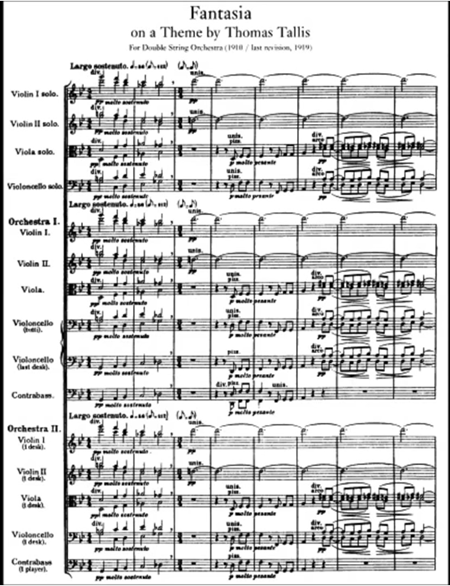
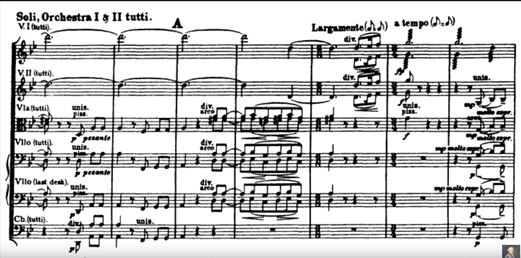
The introduction is followed by a full statement (bar 15 in Ex 5) where Tallis all themes sound in their full forms. In the first episode A2 and A3 explored by first the A2 alternate with the sway (Example 6, a) than A3 (Example 6, b).
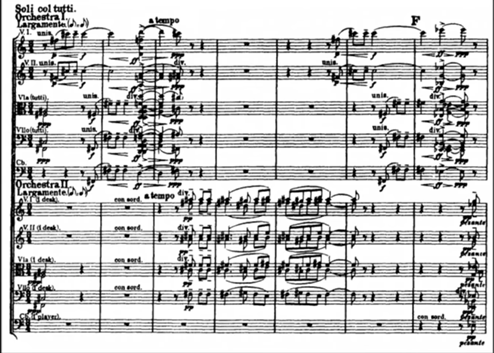
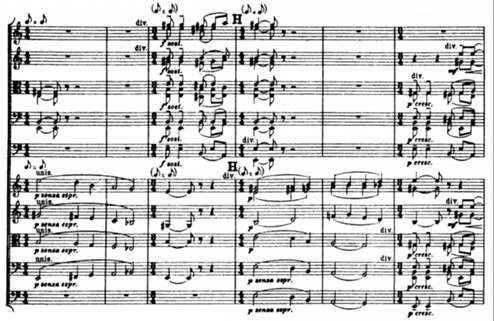
Next part of the Fantasia is the second episode where A3 exploded. Example 7 shows an example of this where the solo viola plays a variation of A3. The melodic material is based closely on Tallis`s tune, which we can see on the first three notes of the solo viola melody. They are reflected from the repeated notes which occur in the first two strains and also at the end of Tallis`s hymn. It gives the part a rhapsodic feeling.
After the solo, the piece merges with the sway motion which followed by a sudden statement of A3. This subtheme played by the string quartet in a polyphonic style until the end of the second episode (Example 8).
In the third episode we arrive to the major climax of the work. The “swaying” subject extended and brings to a new melodic path with annotations played by the string quartet (Example 9).
This followed by a section where all instruments begin the exploration and brings the piece to a climax culminating in A3 (Example 10).
Next part in the composition is the fourth episode. The “sway” subject starts again but this time the composer mainly uses two notes (Example 11). The fourth episode is a transition which leading to the Restatement part.
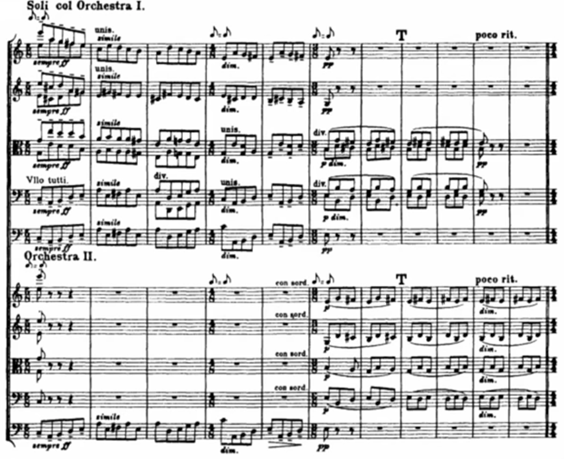
In the Restatement the lower strings begin to pluck Tally’s hymn (A1) which supported with a soft sound played by the Orchestra II. The solo violin and viola duet come in with theme A2, A3 and “sway” (Example 12). Finally, all instruments join together to play the A4 theme (Example 13).
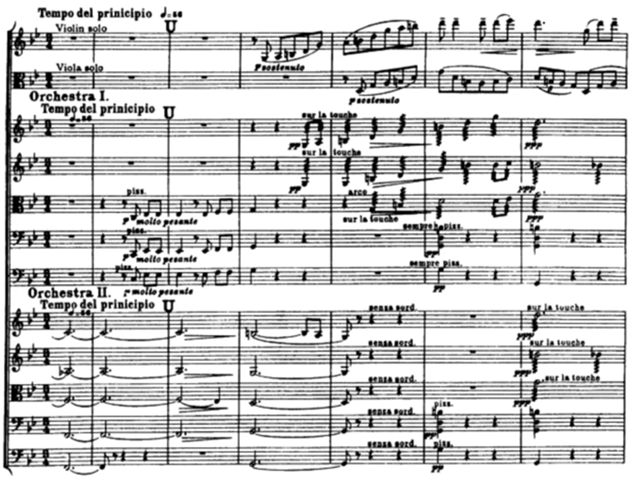
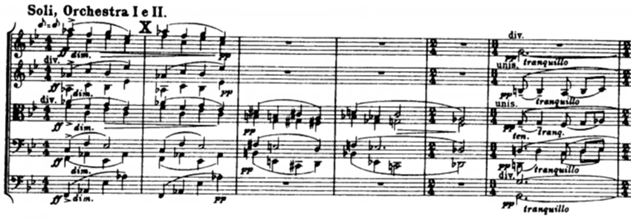
The final part of the piece is Coda where the “sway” theme carried by the string until the work closes with a short benediction (Example 14 a, b).
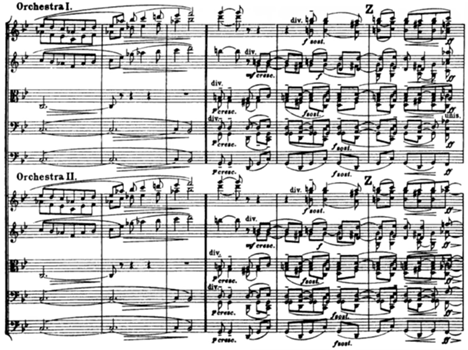
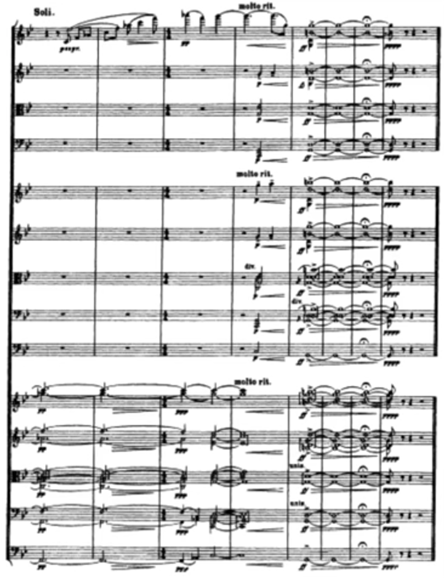
Vaughan Williams starts the Fantasia by giving the attention to three things, the tritones, the melodic progressions and the Phrygian flat seconds.
Example 14 shows the parallel fifth technique which derives from the Phrygian material. The use of semitone above the pitches I and V in the D major chord with E flat cause contrasting effect.
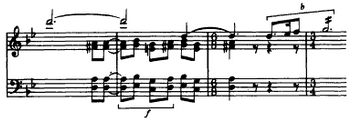
For shifting tonalities, the composer uses two prominent features in Tallis`s harmony, the semitone and the tritone. For example, between E and I where we can see the exploration of these harmonic features used as roots of chords and as tonalities.
In his outer sections, Vaughan Williams used various elements of the Phrygian mode which he contrasted with elements of the Dorian (occasionally Lydian) in the rhapsodic centre of the piece. Tritones and semitones are also incorporate in the harmonic relationships. For example, while the composer preserves the minor third and seventh of the Phrygian mode, the piece sounds as major second above the tonic and dominant pitches instead of Phrygian minor. Example 15 shows the mode transposed to E.
Example 16 shows the section which leads to the central part. The composer tended to use F# and C# to avoid F♮ and C♮. However, the C♮ of the Phrygian mode appears (Example 17). This example also shows the coincidence of C♮ and F# which gives Lydian sound to the piece.
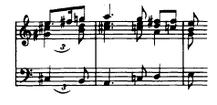
Vaughan Williams builds on the semitonal relationship between C♮ and C# and extend it by using phrase C (Example 18) from Tallis`s tune in a retrograde inversion (Example 19).

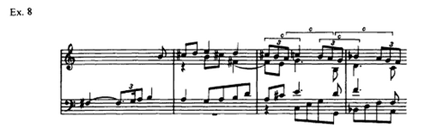
The Dorian mode also appears just after the letter S where the composer retained the minor third and seventh of the Phrygian mode. It gives the piece a major sound instead of the Phrygian minor.
Vaughan Williams also used new ways when he combined melodic figures. For example, just after letter F, figure f (at the top) is placed above the inversion of c. Other example can be found at letter H where the composer used a version of his opening chords (Example 20) transposed down by a minor third. The inversion reflected by the use of the phrases from the original material by using phrase a in the bass line and phrase b in the top line (Example 21).
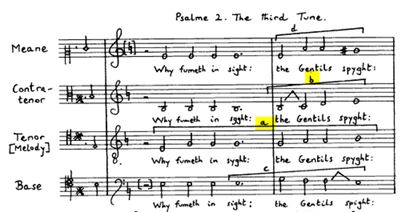
The Fantasia shows that Vaughan Williams were understood the structure and modality of Tallis work. He was able to isolate the vital features from the hymn and recreated them in his composition. Tallis tune is simple and ecclesiastical which Vaughan Williams elevated by the richness and sweetness of the strings. The strings also creating quiet soundscape with shimmering colours and echoes while the parallel fifths heighten a sense of awe and mystery. The piece brings us to a beautiful musical journey which use a simple hymn with new voice and new sense of direction.
Reference
Encyclopedia Britannica. 2020. Thomas Tallis | English Composer. [online] Available at: <https://www.britannica.com/biography/Thomas-Tallis> [Accessed 10 June 2020].
Encyclopedia Britannica. 2020. Ralph Vaughan Williams | British Composer. [online] Available at: <https://www.britannica.com/biography/Ralph-Vaughan-Williams> [Accessed 10 June 2020]
Pike, L., 1984. Tallis: Vaughan Williams: Howells: Reflections On Mode Three. [ebook] Cambridge: Cambridge University Press, pp.2-13. Available at: <https://www.jstor.org/stable/945078?read-now=1&seq=1#page_scan_tab_contents> [Accessed 20 June 2020].
Williams, R., 2015. Vaughan Williams – Fantasia On A Theme By Thomas Tallis. Available at: <https://www.youtube.com/watch?v=qIhZbvlCjY0&t=111s> [Accessed 20 June 2020]
Reflective Account
In this reflective account, I will describe my journey of the last part of this course and highlight the parts that I found it particularly interesting and challenging.
The last part of the course was a full discovery of the music from the Baroque and Renaissance era. The journey began with the introduction of early instruments. During the research I discovered new instruments which I was not familiar with. The biggest issue was to narrow down the number of instruments and information to the blog.
This was followed by another exercise which actually showed how these instruments work within a musical composition. The only difficulty was while the exercises required live concert, I had to use recorded one due to the present situation with Covid19. The internet was a great tool for this, and I found an ensemble who represented early music (instrumental and singing) in a great way.
Introducing of Baroque forms was also a great exercise. It extended my knowledge about different terms which used in this period. To deepen this understanding, I focused on these terms throughout listening to different pieces and also gathered information about the circumstances which these works were written.
The musical patronage exercise was interesting. I do not like this subject as unfortunately the art section is affected by politics and economics. Although there are funding out there, getting them is difficult.
The last part of the course improved my knowledge and view about the different elements that affect the music such as dissonance, intellectual and philosophical movements. It was also interesting to see how the handwritten manuscript turned into a printed form and how they distributed the printed works.
The final exercise was summary of this course and also it was an introduction to the assignment. I gained more practice by describing a chosen composer`s life, work, his musical innovations, and his influence on modern composers.
Another challenging part was the assignment. First it was difficult to gather information about my chosen composer Tallis. Second, the word count. I found it difficult to keep the required number, so I had to focus on to keep only the relevant information. Following my tutor advice, I wrote more details with explanation. I also supported my findings with score evidence which I left out from my previous assignment. I also kept focusing on my academic writing and my grammar. I asked for help proof reading to avoid grammatical errors.
During my studies, I tried to gather evidence from a wide range of sources. I avoided Wikipedia and focused on more reliable sources. Most of my research was based on internet resources as unfortunately the Libraries are closed. I also made sure that my referencing is in a correct form.
In the last feedback I had an issue with my listening log. I followed the course material and completed the required exercises and posted them on my blog. I hope this way my listening log is in a correct form and fulfill the requirements.
Word: 496
Tutor reports
 Aname
Aname 