Exercise: The Classical opera

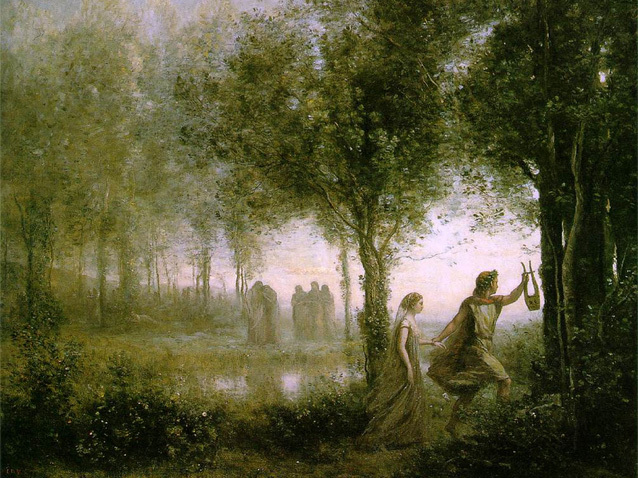
Orfeo ed Euridice (Orfeo ed Euridice, 2021)

Christoph Willibard Gluck (1714-1787) was a German classical composer. In February 1761 Ranieri Calzabigi brought his libretto Orfeo and Euridice into Vienna. The piece caught Gluck`s friends’ attention and they brought the two together. Orfeo and Euridice was the first of Gluck`s three reform operas. The major influence in the development of Gluck`s reformist ideology was the Essay on the Opera (1755) which written by Francesco Algarotti. Orfeo and Euridice was first performed in Vienna on 5th October 1762.

The opera is an interpretation of the myth of Orpheus, who is the godfather of opera itself. He was the son of a Muse and Oeagrus, a king of Thrace (other versions give Apollo). He was more than a mortal but less than a god. He received the gift of music from his Muse mother. The opera is set in an idealized Greek countryside and in the mythological underworld.

The opera has three acts.

In act one nymphs and shepherds lament the death of Euridice at her grave who was bitten by a snake. When Euridice `s husband Orfeo left alone, he took an oath to rescue Euridice from the underworld. The god of love Amore appears and allow him to descend into the land of dead to rescue Euridice. To make this journey difficult, Orfeo cannot look at Euridice nor explain why looking is forbidden. If Orfeo breaks these rules, he will lose her forever. The first act finishes with Orfeo agreeing to the rules and his journey begins.

Act two begins with Hades gates where furies and ghosts try to deny Orfeo`s passage to the underworld. When finally, they softened by Orfeo`s lament, he allowed to pass through to the Elysian Fields. Orfeo is moved by the beauty of the landscape. Heroes and heroines brought Euridice to him and he took her away without looking at her as he promised earlier.

In act three Orfeo leads Euridice toward the upper world. He is keeping his promise and forbidden to look at her. Euridice panics as she was afraid of a life without the love of Orfeo. In desperation he turns to her and she dies again. Orfeo hit by a grief and he wonders how he will live without his love Euridice. He decides he kill himself. Amore appears and stays Orfeo`s hand, then in response to Orfeo`s deep love and devotion, Amore revives Euridice for the second time. The tree returns to Earth. The opera finishes with a celebration at the Temple of Love, where Orfeo, Euridice, Amore, the nymphs and the shepherds are all celebrating the power of love.

The main characters of the opera are Orfeo, Euridice, Amore, shepherds, shepherdesses, nymphs, demons, Furies, happy spirits, heroes and heroines, Chorus, and dancers.

I choose to review the 1982 production of Orfeo and Euridice. The opera performed on the Glyndebourne Opera Festival. It is available on YouTube (Gluck – Orfeo ed Euridice).

This production directed by Peter Hall and it was outstanding. Elisabeth Speiser played Euridice and her performance was excellent. Amor played by Elizabeth Gale. Although I liked her voice, I thought her performance sometimes lacking. During her aria with Orfeo, she looked like more as a doll than a god. My favourite was Janet Baker as Orfeo. She shows a unique variety of vocal colours and ability of acting simply but with force. I particularly enjoyed her aria Che faro senza euridice. Her singing style is very natural and her acting is impeccable.

The production is a traditional one. I thought the costumes are excellent and perfectly reflect the period and characters. The scenery is simple with only present what is needed. With the use of the lighting, it also represents flawlessly the different scenes. The London Philharmonic provide excellent music which is clean and not overpowering. The video quality is a little but blurred.

Gluck – Orfeo ed Euridice (Gluck – Orfeo ed Euridice, 2012)

Reference

www-oxfordreference-com.ucreative.idm.oclc.org. 2008. OpenAthens / Sign in. [online] Available at: <https://www-oxfordreference-com.ucreative.idm.oclc.org/view/10.1093/acref/9780195309072.001.0001/acref-9780195309072-e-190&gt; [Accessed 13 February 2021]

Montalvao, R., 2012. Gluck – Orfeo ed Euridice (Leppard). [image] Available at: <https://www.youtube.com/watch?v=EENw_ptgGcg&gt; [Accessed 15 February 2021]

2021. Orfeo ed Euridice. [image] Available at: <https://www.opera-online.com/en/items/works/orfeo-ed-euridice-de-calzabigi-gluck-1762&gt; [Accessed 15 February 2021]

2012. Gluck – Orfeo ed Euridice. Available at: <https://www.youtube.com/watch?v=EENw_ptgGcg&gt; [Accessed 15 February 2021]

Research point: History of music publishing to 1900

This is a research about the history of music publishing up to 1900, with emphasis on the classical era.

The first examples of music printing were the Constance Gradual in 1473 in Germany and the Roman Missal of Ulrich Hahn in 1476. Hahn`s method influenced other European printers and spread all over Europe and later by 1500, in England. In the late 15th century, Ottaviano Petrucci created a three-impression process where each page was printed three times, first with staves, then notes, and finally text. On 15 May 1501 he published his first music called Harmonice musices odhecaton (known as Odhecaton). Later, he simplified this to two impressions, creating extremely high standards. In 1527/8 in Paris a bookseller Pierre Attaignant was influenced by Petrucci`s innovation and improved it by creating a single impression method. He produced an oblong quarto partbook of Chansons nouvelles which reflected this important technical development. His method reduced time and costs. He also became the first music publisher to operate on a large scale. In 1551/2 after Attaignant`s death, a composer Robert Ballard took over the printing business and developed a distinctive music type. In the 17th century his firm – run by his descendants – published the first orchestral scores.

Copper plate engraving methods were developed by the late 1500s and became influential throughout Europe. It fully established itself by the beginning of 18th century alongside the music type printing method. Later, copper plates were replaced with pewter ones, albeit at the sacrifice of some quality. From the mid-17th century to the mid-18th century the two main music publishers in England were Playfords and Walshes. Playford printed from music type and published music which was suitable for taverns, music clubs and theaters. They also printed for both amateurs and professionals. Wals used engraving at the beginning but later it turned to pewter plates and punches. Although the company was among the most influential publishers in Europe their main focus was commerce. Around this time John Heptinstall introduced a new procedure called `the new tied note` where he used round note heads and grouping quavers and semiquavers by beams.

In the mid-1740s Breitkopf developed the `mosaic` system and afterwards it was used for many major publications of the Classical repertory. Breitkopf developed a way to create large number of copies with a cheap price and be able to distribute widely. With his business partner G. C. Härtel established Leipzig as the centre of music publishing in Europe. The increasing number of composers by the Viennese school and the public resulted the opening of new publishing houses such as Schott (Mainz), Simrock (Bonn) and Artaria (Vienna). By this time, the engraving technique was widely used which brought down the cost of music printing and in the later 19th century it helped the mass copies of the scores.

Music publishing provided the composers with a new income as well as honor and fame. Although the financial reward was little the wide distribution provided that their music reaches a wide audience. There was no legislation for copyright protection and there was an issue of privacy. These problems had a negative impact, as they limited the amount of earning that a composer could expected.

During the Classical era, the emerging middle class had an interest in home and amateur music making. Pianos at home became increasingly popular. Many amateur musicians were involved in choral societies and brass bands as well as the increasing number of public concerts and a demand for study scores created a great demand for printed music. The extent of this increased demand is staggering. In the 1770s, the typical catalogue of a music publisher would contain a few hundred works. by 1820 this would be in the tens of thousands. In addition to compositions, there was also a demand for method books and music journals.

The following references were consulted for the preparation of this research point:

 Latham, A., 2011. OpenAthens / Sign in. [online] Www-oxfordreference-com.ucreative.idm.oclc.org. Available at: <https://www-oxfordreference-com.ucreative.idm.oclc.org/view/10.1093/acref/9780199579037.001.0001/acref-9780199579037-e-5360&gt; [Accessed 10 February 2021].

Reyna, R., 2021. Learn About The History Of Music Printing. [online] Music Printing History. Available at: <https://musicprintinghistory.org/&gt; [Accessed 10 February 2021].

Scott, D., 2012. Chapter 2. The Growth of the Market for Domestic Music. [online] Victorianweb.org. Available at: <https://victorianweb.org/mt/dbscott/2.html&gt; [Accessed 10 February 2021].

Franz Krommer – Partita in E flat Op 45 No 1

F.V. Kramář – Krommer Partita Op.45 No.1 (Krommer, 2016)

Franz Krommer (1759-1831) was a Czech composer of classical music, although today he is mostly recognized for his music for woodwinds. His wind Partitas are authentic symphonies scored for pairs of oboe, clarinets, bassoons, and horns. He also uses double bass or contrabassoon to establish the bass line. In Op. 45 No. 2 he extends the instruments with a trumpet. In the earlier version of Partita in E flat the composer created a true double horn concerto with wind accompaniment. Krommer`s music mixes formal creativity with folk-influenced melodies and demonstrates an exceptionally high standard of performance. It has the qualities of charm, wit and sophistication.

Partita in E flat has four movements. In the first movement the tonic/dominant accompaniment is alternating and there are lyrical melodies can be heard above the accompaniment.

In the second movement the three-note motif and a chromatic line gives a Romantic feature to the piece.

The third movement is in a minuet form and it has a three beat in a bar pulse.

The fourth movement is in a Rondo from. It contains a melody which reoccurs and features a three note repeated note pattern.

Reference

Krommer, F., 2016. F.V. Kramář – Krommer Partita Op.45 No.1. Available at: <https://www.youtube.com/watch?v=GDnskZlkxbA&gt; [Accessed 7 February 2021].

Exercise: The folk tradition

Bújj, bújj zöld ág (Hegyi, 2021)

Bújj, bújj, zold ág is a Hungarian folk song which based on folk traditions. My earliest memory of this song is from my childhood. My parents and other family members sang for me. Later I also introduced to this song when I attended to playschool. The teachers used this tune to teach music rhythm and memorizing songs. As I grow up, I taught this piece first to my cousins’ children than when I was trained as a teacher. Thankfully, this folk song is a base of the Hungarian music education, so I do not think it will die out.

Folk songs generally have a simple text and form, and they are associated with the lives of people. They are also often having a socially significant message. Traditionally they are passed between people through an oral tradition but there is musicologists like Kodály and Bartók who collected and recorded these folk songs. A folk song can be associated with a particular political or social movement, for example Ha én rózsa volnék. This song written by János Bródy and sang by Zsuzsa Koncz. The lyrics were embedding the possibility of multiple interpretations but in reality, it was criticizing the communist regime. This song with other similar pieces became so popular, that they turned the increasingly crowded events to implicit protests.

Bújj, bújj, zold ág has a short melody and contains 14 bars. The song has two phrases with a repeated section in the second part from bar 9-12.

Bújj,bújj,zöld ág,

Zöld levelecske…

Nyitva van az aranykapu,

Csak bújjatok rajta.

Rajta, rajta

Leszakadt a pajta,

Benn maradt a macska.

Reference

Hegyi, M., 2021. Bújj, bújj zöld ág (Gyerekdalok és mondókák, rajzfilm gyerekeknek). Available at: <https://www.youtube.com/watch?v=7hO9K5xdmYo&gt; [Accessed 5 February 2021].

Bródy, J., n.d. életút. [online] Brody.mediastorm.hu. Available at: <http://brody.mediastorm.hu/elet.htm&gt; [Accessed 5 February 2021].

Exercise: Expressing national identity Part 2

Ralph Vaughan Williams – English Folksong Suite

Ralph Vaughan Williams – English Folksong Suite (Williams, 2021)

When considering appropriate aspects of “Englishness” to be reflected in a choice of idiomatic English music, I settled on folk tunes and the piece called English Folksong Suite written by Ralph Vaughan Williams.

The composer not only appreciated British landscapes and heritage, but he was also sentimental about Britain`s musical history.  In 1923 Ralph Vaughan Williams composed the English Folk Song Suite for wind orchestra. It consists of three movements which based on main British folk songs from the Norfolk and Somerset regions of England. These folk songs bring different stories and emotions.

He first movement is an English march, and it contains three folk songs; Seventeen Come Sunday (played by the woodwinds and strings), Pretty Caroline (solo clarinet), and Dives and Lazarus (lower instruments). The first two folk songs are about military men falling in love with and marrying, beautiful women. The mood of the two songs is creating a contrast. The first is bouncy and jovial while the second is legato and cantabile. Also, the irregular phrasing of the melody adds to the syncopated quirkiness of the march. The third folk song of this movement is Dives and Lazarus. The story of this tune is Lazarus repeatedly begs Dives, a rich man, for food but is denied. To portray the antagonism of the event, the composer set a firm duple meter melody in the low brass against a rigorous triple meter accompaniment in upper winds.

The second movement is an Intermezzo and begins with My Bonnie Boy (solo oboe). The melody interrupted by Green Bushes which is more upbeat and dance-like than the slow, emotional opening. Both folk songs deal with love betrayed. My Bonny Boy is set in the F dorian mode, which features the folk roots in the music. The mood shifts slightly to the folk song Green Bushes which is in a playful scherzando style.

The third movement uses four different folk songs dealing loosely with unattainable love. First folk song is Blow Away the Morning Dew (clarinet solo) describes a country boy attempting to seduce a girl who quickly outwits him. Second folk song is High Germany (led by lower instruments) and it is about a young English woman’s lover and her three brothers being called off to war in Germany. Third folk song is a modified version of The Trees They Do Grow High, and it brings the story of a young woman who has been wed by her father to a much younger boy. The final folk song is John Barleycorn which is an allegory representing the harvesting and cultivation of barley.

Reference

Williams, R., 2021. English Folk Song Suite. Available at: <https://www.youtube.com/watch?v=D0sC4xbyT5c&gt; [Accessed 5 February 2021]

Encyclopedia Britannica. 2021. Ralph Vaughan Williams | British composer. [online] Available at: <https://www.britannica.com/biography/Ralph-Vaughan-Williams&gt; [Accessed 5 February 2021]

Williams, R., 2021. English Folk Song Suite (Vaughan Williams, Ralph) – IMSLP: Free Sheet Music PDF Download. [online] Imslp.org. Available at: <https://imslp.org/wiki/English_Folk_Song_Suite_(Vaughan_Williams%2C_Ralph)&gt; [Accessed 5 February 2021]

Exercise: Expressing national identity

Béla Bartók – Romanian Folk Dances

(Bartok, 2017)

In this work Bartók used seven original folk tunes which he collected from different regions of Transylvania. Each piece represents a different dance form.

Joc cu Bâtă (Stick Dance) is the first piece from the set. The national identity come across by the folkloric elements. The first element is the key of the piece. It centered around A with influences of Dorian and Aeolian modes which are the most used modes in Romanian folk music.

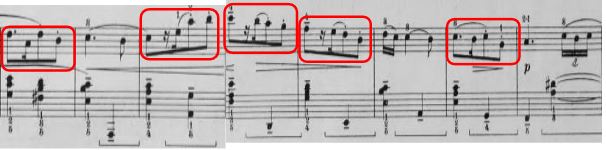
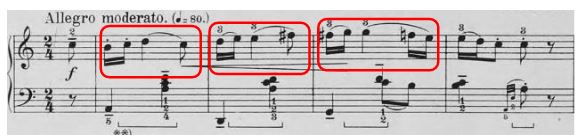
The second element is the melody which represents a typical Romanian folkloric dance type. For example, the use of the dotted rhythms (Example 1) which reflect a dynamic dance or the sequential rhythmic material which spread over a full measure and gives us a slow folkloric dance type (Example 2).

Example 1. Bela Bartok Romanian Folk Dances Sz. 56, Stick Dance mm.1-4. (Bartok, 2021)
Example 2. Bela Bartok Romanian Folk Dances Sz. 56, Stick Dance, mm. 18-25. (Bartok, 2021)

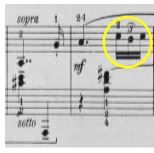
The third element is the variations and ornamentation which respecting the idea of free improvisation and variation on a theme. Free improvisation is the foundation of the Romanian folk tunes.  (Example 3)

Example 3. Bela Bartok Romanian Folk Dances Sz. 56, Stick Dance, mm. 16-17. (Bartok, 2021)

Reference

Bartok, B., 2017. Béla Bartók plays his Romanian Folk Dances No. 1, 2 & 6. [online] Youtube.com. Available at: <https://www.youtube.com/watch?v=DscctOyPzh8&gt; [Accessed 5 February 2021].

Bartok, B., 2021. Romanian Folk Dances, Sz.56 (Bartók, Béla) – IMSLP: Free Sheet Music PDF Download. [online] Imslp.org. Available at: <https://imslp.org/wiki/Romanian_Folk_Dances%2C_Sz.56_(Bart%C3%B3k%2C_B%C3%A9la)&gt; [Accessed 5 February 2021].

Wolfgang Amadeus Mozart – Harmoniemusik zu Le Nozze Di Figaro

Mozart Harmoniemusik from ‘The Marriage of Figaro” (Mozart Harmoniemusik from ‘The Marriage of Figaro” (1/2) Zefiro Ensemble, n.d.)

Wolfgang Amadeus Mozart (1756-1791) was one of the greatest Austrian composers in the history of Western music. (Sadie, 2020)

In the 18th century it was common practice to hear excerpts from famous operas and ballets. Harmoniemusik is a wind ensemble without percussion. A major characteristic is that the main instruments were used in pairs. This particular piece is an arrangement of the major themes from Mozart`s opera called The Marriage of Figaro. This transcription has its own texture and flavour that is different than the original. It offers a representation of the bright, varied, virtuosic, melodious, and grand music of the opera reflected through a wind ensemble. The wind instruments also perfectly portrayed the emotionally charged human voice, just as Mozart imagined in his opera. This is an example how popular operatic pieces were taken out of the opera house and played to a new audience.

Reference:

Sadie, S., 2020. Wolfgang Amadeus Mozart | Biography, Facts, & Works. [online] Encyclopedia Britannica. Available at: <https://www.britannica.com/biography/Wolfgang-Amadeus-Mozart&gt; [Accessed 7 March 2020]

n.d. Mozart Harmoniemusik From ‘The Marriage Of Figaro” (1/2) Zefiro Ensemble. Available at: <https://www.youtube.com/watch?v=USJslsQhS-c&gt; [Accessed 7 March 2020]

Franz Joseph Haydn – String Quartet in B flat major, Op. 1 No. 1

Franz Joseph Haydn (1732-1809) was an Austrian composer of the Classical Period. He helped establish the forms and styles for the string quartet and the symphony. (Landon, 2020)

J. Haydn – Hob III:1 – String Quartet Op. 1 No. 1 in B flat major (Haydn, 1751)

String quartet in B flat major was composed between 1757-1759. The fourth movement is the second minuet and trio within the composition. It has a vigorous rhythmic drive. While I was listening this composition, I discovered a strong feeling of three beats. The first beat is strong, the second is lighter and the third beat leads toward to the next first beat. This sequence gives a sense of formality to the dance form. There are two voices can be heard in the piece, which imitates each other. The trio features an elegant melody with an occasional chromatic slide, played over an accompaniment of repeated chords.

Reference:

Landon, H., 2020. Joseph Haydn | Biography, Compositions, & Facts. [online] Encyclopedia Britannica. Available at: <https://www.britannica.com/biography/Joseph-Haydn&gt; [Accessed 2 March 2020]

Haydn, F., 1751. J. Haydn – Hob III:1 – String Quartet Op. 1 No. 1 In B Flat Major. Available at: <https://www.youtube.com/watch?v=FXCYeGovsOw&gt; [Accessed 2 March 2020]

Research Point: Wagner, Anti-Semitism and Nazism

Richard Wagner - Wikipedia
Richard Wagner (Richard Wagner, 2021)

Wilhelm Richard Wagner (1813-1883) was a German dramatic composer and theorist whose operas and music had a revolutionary influence on the Western music. (Cooke, 2020)

Wagner lived during an era of widespread anger towards Jews in Europe because their economic liberalism. The 1873 stock market crash and agricultural crisis further deepened this anger, so it is not surprising that many Germans showed antagonism. Wagner himself blamed the Jews for the materialism and reactionary values that occupy Europe`s spiritual development. But he was not the only composer who shared this view against Jews. Chopin, Liszt, and Mussorgsky are also made comments that could be regarded as anti-Semitic. Wagner became involved with the underground nationalist movement, and with the idea of social regeneration, he joined to the German revolution between 1848-49. He wrote a number of articles advocating revolution and he also took part in the Dresden uprising of 1849. After all of this, it is not unusual that his dramatic works would contain anti-Semitic thoughts.

In 1850, he wrote an essay the Das Judentum in der Musik (Judaism in Music), in which he stated that Jews are not capable of true creativity. According to Wagner, “the Jewish artist can only speak in imitation of others, make art in imitation of others, he cannot really speak, write or create art in his own”. (Richard Wagner, 2020) Wagner`s antisemitism underpins not only his philosophy but his music as well. American academic Marc Weiner compared the corporeal images in Wagner`s dramatic works against the background of 19th century racist imagery. He found several elements that associated with Jews in the 19th century, such as the elevated, nasal voice (Jewish stench), the hobbling gait, the ashen skin colour, and the deviant sexuality. It is clear that these images were drawn from anti-Semitic platitude of Wagner`s time. (Can we forgive Wagner? | The Guardian | guardian.co.uk, 2000)

We cannot miss another fact from Wagner. Wagner was not, as we understand the term, a Nazi. Wagner died in 1883 and Hitler was born in 1889. Wagner was clearly a significant influence on Adolf Hitler. Hitler became passionate about Wagner from the age of 12. In 1924 he claimed that his vision of future Germany was manifest in the composer`s music. After he become the Chancellor of Germany in 1933, the Wagner Society promoted its idol`s music as symbolizing a solution to the threat of Bolshevism and Jewry, as well as being the purest representation of the glory of the Germanic race. (Burton-Hill, 2014)

In contradiction with Wagner`s anti-Semitic view, he added to Das Judentum in der Music when it was republished (this time with his own name on the title page) in 1869. In a theatrical language he is suggesting that Jews should rid themselves of their Judaism. This explains why Wagner offered to take Hermann Levi, a Jew conductor to have him baptized a Christian. He also maintained close personal relationships with many Jews.

Whatever the people thoughts, Wagner`s significance to music is undeniable. Although his impact to Hitler cannot be denied and he reflect a nationalistic world view in his works, they cannot legitimately be described as Nazi music. Also, it is more than likely that if Wagner had not written Judaism in Music, we would not find his music anti-Semitic. Art is a form of self-expression which influenced by many things, in Wagner`s case the evolved situation in the economy. Audiences should except that and should approach music with an open mind as one thing for sure Wagner created most complex, rich, and enigmatic dramatic figures as well as some of his most haunting and beautiful music.

References:

Cooke, D., 2020. Richard Wagner | Biography, Compositions, Operas, & Facts. [online] Encyclopedia Britannica. Available at: <https://www.britannica.com/biography/Richard-Wagner-German-composer&gt; [Accessed 4 October 2019]

Holocaustmusic.ort.org. 2020. Richard Wagner. [online] Available at: <http://holocaustmusic.ort.org/politics-and-propaganda/third-reich/wagner-richard/&gt; [Accessed 12 January 2020]

Theguardian.com. 2000. Can We Forgive Wagner? | The Guardian | Guardian.Co.Uk. [online] Available at: <https://www.theguardian.com/friday_review/story/0,3605,345459,00.html&gt; [Accessed 10 January 2020]

Burton-Hill, C., 2014. Is Wagner’s Nazi Stigma Fair?. [online] Bbc.com. Available at: <https://www.bbc.com/culture/article/20130509-is-wagners-nazi-stigma-fair&gt; [Accessed 10 January 2020]

2021. Richard Wagner. [image] Available at: <https://www.bbc.co.uk/teach/ten-pieces/classical-music-richard-wagner-ride-of-the-valkyries-ks3/zfk8jty&gt; [Accessed 27 September 2020]

Gioachino Rossini (1792-1868) – The Thievish Magpie

Rossini – La Gazza Ladra (The Thieving Magpie): Overture (Rossini, 1817)

The Thievish Magpie is an overture from the opera semiseria, or melodrama called La gazza ladra which composed in 1817. The story is about a servant girl who accused of stealing a spoon which actually the magpie of the title did. The maidservant sentenced to death for her crime. Rossini`s overture evokes the image of the opera`s main subject, the devilishly clever, thief magpie.

The overture opens with a few intensifying rolls on the snare drum. This adds a military colour to the piece and also represents one of the characters who is returning home from the war as a hero. Later this effect by the snare drum has different meaning. This time it symbolizes the march of the young maidservant to the scaffold. At the beginning we can hear a brief, almost mournful chord played by the horns than drifting away before the magpie arrives. The following section comprises an elegant and silly melody shared between the woodwinds and the violins. It feels as a conversation with one another and as if one section is eluding the other. This melody continues to build until it reaches an almost dark climax. After the climax, the theme repeats again louder and bigger until it bursts by the snare drum and crash cymbals. Rossini introduced an opera which designated a melodrama, that shades a comic element with darker overtones. The opera sustains a fine balance between funny and tragic. (Causson, 2020)

Reference:

Rossini, G., 1817. Gioachino Rossini (1792-1868) – The Thievish Magpie. Available at: <https://www.youtube.com/watch?v=CJiiBq8UnIY&gt; [Accessed 4 October 2019]

Causson, J., 2020. Gioachino Rossini | Italian Composer. [online] Encyclopedia Britannica. Available at: <https://www.britannica.com/biography/Gioachino-Rossini&gt; [Accessed 4 October 2019]