The exercise was to listen early music preferably on a live concert. Due to the present situation this was not possible. I visited the website of The National Centre for Early Music where I found several recordings from previous events. I listened a few performances and I choose a group called Rumorum. Their concert was broadcasted from NCEM on 30th March 2019 as part of the REMA Conference.
Based on Collins dictionary early music is a broad musical ear in the history of Western art music. It includes the Middle Ages, Renaissance and sometimes the Baroque and early Classical periods. For early music, the approach to musical performance is emphasizing the use of period instrument, historically researched scores and playing techniques. (Early music definition and meaning | Collins English Dictionary, 2020)
Rumorum is a musical group which formed in 2015 by medieval performance students at the Schola Cantorum Basiliensis in Switzerland. The highly trained musicians bring medieval music to the modern concert stage with informed compositions and stylistic improvisations into their performances. Their repertoire is a mixture of instruments and voices. (About, n.d.)
The concert title called Medieval music for voice and instruments. The music was chosen from a variety of pieces written to instruments, solo voices, and instruments with vocals. The concert opened with Principio di Virtú by Anonymous. This is a 14th century Italian dance music from the Trecento period. There is not too much information about this work. Based on F. Alberto Gallo`s research – who was professor of medieval and renaissance music at the University of Bologna – the piece probably composed for the celebrations of the marriage of Isabella, daughter of King John II of France and Giangaleazzo Visconti of Pavia in 1360. By this marriage he became prince of Vertus in Champagne and was known as the “Conte di Virtú”. (Duffin, 2000)
After the opening song, the group continued the medieval journey with various pieces such as Tandernaken, O Rosa Bella, Ballade, and compositions by Machaut.
Tandernaken was a popular Middle Dutch song between 1430-1510. The story is about two girls who are having a conversation about love affairs at the Rhine bank in Andernach, Germany. While they are talking with each other, one of the girls’ lover listening them from a distance.
O Rosa Bella is the title of two popular 15th century chansons composed by Johannes Ciconia and then originally attributed to John Dunstable, but now to John Bedyngham. The text is based on a poem written by Leonardo Giustiniani (1300-1446). The story is about a man who is in love and dies of love again and again for the same woman. He begs this beautiful rose of a woman to have mercy and not allow him to die. (Dickey, 2020)
Guillaume de Machaut (1300-1377) was a medieval French poet and composer. He was one of the leading French composers of the Ars Nova musical style of the 14th century. He was also the last French poet who think of the lyric and its musical setting as a single entity. (Guillaume de Machaut | French poet and musician, 2020)
Rumorum also used period instruments to their performance such as Harp which is an ancient instrument dating back to the Sumerian civilization, Lute which introduced into Europe by the Moors when they invaded Spain in the 8th century, Rebec which originated around the 10th century, Flute which dates back to ancient Rome, Viola d`arco and Clavisimbalum which is an early keyboard instrument and ancestor of the harpsichord.
The concert took place in a beautiful small church which was perfect for this type of music. The repertoire with the period instruments well represented the medieval era. I really enjoyed the performance as the lovely setting with the varied program and the beautiful sound brought the listeners to an excellent journey in the Medieval times.
Ncem.co.uk. 2020. NCEM – The National Centre For Early Music – Early Music Online. [online] Available at: <http://www.ncem.co.uk/?idno=1673> [Accessed 27 May 2020]
Caslabs.case.edu. 2020. Early Music Instrument Database – Ross Duffin | CWRU. [online] Available at: <https://caslabs.case.edu/medren/> [Accessed 27 May 2020]
Music is a universal language and part of our everyday life. Musical instrument is a device for producing a musical sound and it is almost universal components of human culture. It has been used from the earliest times for different purposes such as dances, rituals, work, medicine, and entertainment. The earliest instruments were made or from natural objects such as bones, shells, wood, skin etc. These instruments gradually evolved into more complex forms. (Musical instrument – Classification of instruments, 2020), (Shurkin, 2012)
The shawm first appeared in the 13th century and it became the most important instrument by the end of the Middle Ages. The instrument used in dance bands, ensembles, and court ceremonies.
Alto Shawm (Shawm – Instruments of the world, 2020)
The shawm`s body made from a single piece which ended in a flared bell shape. It is a loud, double-reed wind instrument which is the ancestor of the oboe. Like the oboe, it is conically bored only its bore, bell and finger holes are wider, and it has a wooden disk to support the lips. It produces sound by the vibration of a column air. Unfortunately, the sahwm created such a loud noise, that it was impossible to use it indoors so the oboe was made to replace it.
(Lodico, 2016)
Musicians in different places used different techniques and styles for example the circular breathing technique which allowed the musician to play continuously on the instrument without any pauses. The early use of shawm was in court and civic music. From the 15th century until the beginning of the 19th century every British town had a band called Waiters. They were trained musicians who were originally member of the night watchmen and wakemen in places such as castles, camps, towns etc. (Duffin, 2020)
Shawn – ‘Saltarello’ by David Munrow (The Early Music Consort Of London – Instruments Of The Middle Ages And Renaissance, 1976)
The British musician and early music historian David Munrow bring alive the Medieval court life with his piece called Saltarello. The music is written in the 14th century and the shawm which is the solo instrument accompanied by tambourine, timpani, and trumpet. The title Saltarello is a term use to a Medieval and Renaissance court dance as well as folk dance of present-day Rome. The music well reflects this term as during listening I can imagine a castle where people gathered for dinner and after the delicious food they enjoy of good music and dance. (Saltarello | dance, 2020)
Viol
The Cipher for Viola da Gamba by Caspar Netscher (Dutch ca.1635-1684)
The Viol, also called viola da gamba is a bowed, stringed instrument. It mostly used in chamber music in the 16th until the 18th century. The viol has the same tuning as the Renaissance lute, which is six strings (instead of four) and the fingerboard which is fitted with frets (tied strands of gut). The sound holes are traditionally shaped like the letter “C” instead of “f” and the bow is held underhanded with the palm facing upwards. Viol characterized by sloping shoulders, deep ribs, thin flat backs, and a vertical playing position. The bottom of the instrument was sitting on the knee or held between the legs. The breadth of the bridge was arched which gave the bow separate access to each string. This property with the position of the bow hand (palm uppermost) encouraged the musicians to smooth playing style. The viol made in three sizes such as treble, tenor and bass, with the bottom string tuned to d, G (or A) and D. Later there were two other size made, such as violone and the double bass viol which often turned an octave below the bass. The vibration of the strings produces sound. A bowed string vibrates and moves in a circular motion that produces the fundamental tone, while the vibration produces overtones like a rippling wave. This complex movement of the string is transmitted to the body by the bridge. (Viol (Renaissance) – Early Music Instrument Database, 2020) (Viol | musical instrument, 2020)
(Johannes SCHENCK, Sonata XII (d-Moll) , Allegro-Presto, 2013)
Marin MARAIS: Grand Ballet (Suite en la mineur IIIè Livre)
Viol music was popular in Europe and especially in England. For example, Henry VIII (ca. 1540) engaged a complete consort of Italian players. In France, the bass viol was more popular as a solo instrument. In Germany, the viol was used both solo and chamber music. Composers incorporated the instrument in their pieces for example Heinrich Schultz in his sacred music, Buxtehude in his cantatas and sonatas, JS Bach used the viol as an obligato instrument in his sacred works, Telemann, and C.P.E. Bach in their chamber music. At the second half of the 16th century the viol acquired a significant repertory for ensemble, solo bass, lyra viol and small bass viol (viola bastarda). One of the significant players was Martin Marais (1656-1728). He was not only a composer but a celebrated virtuoso of the viola da gamba. Also Johann Schenck (1660-1712, Dutch) and C.F. Abel (1723-1787, German) were both great viol players. (About the Viol, 2020)
Carl Friedrich Abel (1723-1787): Arpeggio for solo viola da gamba (Abel, 2010)
Crumhorn
Left: Lorenzo Costa’s painting, The Triumph of Death, 1488–90. This complex painting is a biblical scenes with crowds, animals, air-borne saints, angels and figures of death. Right: The small detail in the bottom right corner of a seated vielle player and, on his right, a small child holding a crumhorn. (Pittaway, 2016)
The name refers to the letter “J” shape and comes from an old German word meaning “curved horn”. Similarly to the modern oboe or bassoon, the crumhorn or Krummhorn is a double reed wind instrument but the difference is that the reed is not held between the lips. It encased in a wooden capsule at the top of the instrument. It`s fingering system is similar than the recorder. The crumhorn works like the bagpipe by using the wind pressure in the chamber around the reed to start it vibrating. Because the reed is not controlled directly, the instrument has a limited range (just over an octave) and also the sound is softer due to the cylindrical bore. The tone is reedy and nasal. The instrument was made in a range of sizes and pitches for example great bass or sopranino. It was really difficult to play well.
Crumhorns were flourished between the 15th until the 17th century. It was more popular in Europe such as Germany, Italy, France and England. The first record of the instrument came from the 15th century court of Albrecht Achilles of Ansbach (reigned 1440–1486) in Germany and it called Krummpfeyffen which means curved pipes. Also the first image is from an Italian painter Lorenzo Costa who illustrated crumhorn on his painting called The triumph of death (1488-90). (Crumhorn | musical instrument, 2020)
A “Salterello” for Solo Crumhorn (Early Renaissance Music – A “Salterello” for Solo Crumhorn, 2008)
Crumhorns were played for religious, court entertainments, royal and municipal occasions. There are no examples of any musician either owing or playing a crumhorn in any country who was not either a professional court or municipal musician or a member of the aristocracy. For example musicians who were employed by the town council to perform at official occasions, weddings, baptisms, royal visits etc. In England they called them waits, in Germany stadtpfeifers and in Italy piffari. They had exclusive right to provide official music within the boundaries of the town or city. (Crumhorn (Renaissance) – Early Music Instrument Database, 2020)
Sackbut
Shawm band. Fresco (detail, ca.1503). Pinturichio. Fresco over the door to the Piccolomini Library within Siena Cathedral (Sackbut (Renaissance) – Early Music Instrument Database, 2020)
The word sackbut is from the old French verbs sacquer and bouter which describe the pulling and pushing arm motion of the player. It is an early trombone, invented in the 15th century probably in Burgundy. It has thicker walls than the modern trombone which gives a softer tone. It`s bell also narrower. It is a low-pitched wind instrument sounded by lip vibration against a cup mouthpiece. It has an extendable slide that can increase the length of the instrument`s tubing. Sacbuts were made in tenor, alto and bass sizes.
Adam Woolf Introduces the Sackbut (Adam Woolf Introduces the Sackbut, 2015)
Its earliest use was in an ensemble where it was a regular member of the shawm band. It was also used to accompany voice and as a solo instrument. Despite the property of the instrument (wide range of dynamics or dramatic compass) and its ability to be played the sackbut did not become a regular member of the orchestra until the early 19th century.
O vos omnes – Tomás Luis de Victoria (1548-1611) (The English Cornett and Sackbut Ensemble, 2020)
Dulcimer
Dulcimer. Birth of Christ (detail, 1512) by Jacob van Oostzanen. Naples, Museo e Gallerie Nazionali di Capodimonte. (Dulcimer (Medieval) – Early Music Instrument Database, 2020)
The name dulcimer comes from the Latin and Greek words dulce and melos which means sweet tune. Dulcimer is a late medieval stringed instrument and it is similar looking than the psaltery. The difference is that the strings of the dulcimer were struck with little hammers rather than being plucked. The earliest evidence of the dulcimer can be found on a 12th century ivory book-cover made in Byzantium. It contains a typical trapiziform instrument with lateral strings. No other dulcimer representation is found until the middle of the 1400’s, when the instrument was introduced to western Europe. After the introduction dulcimers were found in Germany, Italy, Poland, Hungary, Bohemia, Flanders, northern France, and England.
Dulcimers often had one or two bridges over which the strings crossed providing the opportunity for more pitches because the performer could strike a sound on each side of the bridge. In the 15th century images we can see that dulcimers had single courses of six to nine strings and were played on the lap or on a table. They used hammers which held between the index and middle fingers. A century later, the multiple bridges were more common with between eight and twelve double courses. Sometimes they used a neck strap which helped for portability. The soundboards of the instrument were commonly decorated. (Dulcimer | Musica Antiqua, 2020)
European dulcimers are hackbrett in the Alpine, the cimbalom in Hungary, the tambal in Romania, santouri in Greek, sanṭūr in Persia and Yanggin in China. These instruments have two or more strings for each note which stretched across a flat, usually trapezoidal sound box. They pass over one and under the other of two long bridges, sloping alternately to right and left to facilitate rapid playing with the light beaters.
The pianoforte is also a dulcimer where the keyboard mechanism operates the beaters. One of its immediate predecessors was the pantaleon, which is a 5-foot (1.5-metre) or longer dulcimer from the early 18th century.
The dulcimer from the United States (Appalache) is called zither which is a narrow folk instrument with three to five metal strings running over a fretted fingerboard, which is set centrally along the dulcimer’s entire length. The player’s right-hand strums with a small stick or quill, and the left hand stops one or more strings to provide the melody.
Because the dulcimer range it can be used for many different types of music. At the beginning the instrument used in folk music and in concerts. Later it appeared in jazz, blues, ragtime, Cajun, gospel and even rock and roll. (Dulcimer | musical instrument, 2020)
Lukács Miklós – Zöld az erdő (Lukács Miklós – Zöld az erdő (cimbalom), 2012)
Clavichord
Clavichord made by Christian Kintzing in 1763 Neuwied, Germany (Clavichord, 2000)
The name clavichord comes from the Latin word clavis which means key and the Greek word chorda which means string. It was invented in the early 14th century. One of the earliest references to the instrument can be found in England in an expense record of Elizabeth of York, Queen of Henry VII, dated in August 1502.
The clavichord is a European stringed rectangular keyboard instrument that was used from the late Middle Ages through the Renaissance, Baroque and Classical eras. It mostly used as a practice instrument and for composition as it was easy to keep in tune, but it was not loud enough for larger performances. The instrument produces sound by striking brass or iron strings with small metal blades called tangents. Vibrations are transmitted through the bridge to the soundboard. The clavichord was one of the piano`s ancestry. (Clavichord (Renaissance) – Early Music Instrument Database, 2020)
Clavichord, Italy, late 16th or early 17th century Watch My Cows by by Luis de Narváez (1538) (Museum of Fine Arts, Boston, 2016)
Clavichords can be fretted or unfretted. In fretted instruments each string could produce three or four different pitches. In unfretted ones each note has its own pair of strings. Clavichords were usually fretted until the early 18th century, after that they were frequently unfretted. In the early 15th century the range of the instrument was around four octaves, but in the 18th century it increased to five octaves or more. Because the clavichord was primarily used to learn, to practice and to compose on there were no music written specifically for this instrument before the mid-18th century. After there were a large number of music composed in Germany where the clavichord was still common. At first clavichord was used of home concerts. At home it was ideal instrument for solo keyboard music and instrumental accompaniment. Today clavichords are played by musicians who enthusiast by Renaissance, Baroque and Classical music. The firs leading musicians who exposed clavichord were Christopher Hogwood (English conductor, harpsichordist, writer, and musicologist) and Thurston Dart (English musicologist, conductor, and keyboard player). The instrument also used in other genres of music in the form of clavinet which is an electric clavichord that uses a magnetic pickup to produce a signal for amplification. There are several musicians used this instrument in their work for example Stevie Wonder Higher Ground or Superstition, Guy Sigswoth with Bjork, in All Is Full of Love, Tori Amos in Little Amsterdam, Oscar Peterson in Porgy And Bess, Keith Jarreth in his album called Book of Ways where he plays a series of clavichord improvisations, Paul McCartney (Beatles) in For No One and Rick Wakeman in The Battle. (What is a… Clavichord? | Definition and History | Classical-Music.com, 2016) (Durfee, 2020)
Oscar Peterson (clavichord) & Joe Pass (guitar) de “Porgy and Bess”: “I Loves You, Porgy” (Oscar Peterson (clavichord) & Joe Pass (guitar) de “Porgy and Bess”: “I Loves You, Porgy”, 2013)
Casson, A., 2019. Cantigas De Santa Maria For Singers. [online] Cantigas de Santa Maria for Singers. Available at: <http://www.cantigasdesantamaria.com/> [Accessed 14 May 2020]
Duffin, D., 2020. Early Music Instrument Database – Ross Duffin | CWRU. [online] Caslabs.case.edu. Available at: <https://caslabs.case.edu/medren/> [Accessed 15 May 2020]
The Early Music Consort Of London – Instruments Of The Middle Ages And Renaissance. 1976. Directed by D. Munrow. UK: EMI Records Ltd.
This exercise was about how to listen and approach Mozart`s piece called Flute Concerto in G, written for Wendling in Mannheim in 1778.
Mannheim was an important center of music in the 18th century. Karl Theodor, the Elector of the Palatinate organized festivals, opera performances and masked balls. He created a revolutionary court which attracted the best musicians. Karl became the Director of Instrumental Music in 1778 and he established the best orchestra in Europe. He implanted discipline and uniform technique in the players. The Mannheim style contains certain melodic features, use of dynamic contrasts, homophonic textures, slow rates of harmonic change and solo passages for woodwind and horns.
The Flute Concerto No. 1 in Gmajor, K. 313 was written by Wolfgang Amadeus Mozart in 1778. This concerto was commissioned by the Dutch flautist Ferdinand De Jean in 1777, whom Mozart met via Johann Baptist Wendling, a virtuoso solo flutist of the Mannheim orchestra. The piece is scored for a standard string orchestra, plus two flutes and two horns, and is arranged in a three-movement (fast-slow-fast) cycle – first movement Allegro maestoso, second movement Adagio and third movement Rondo form.
Although I have some practice at following a score, I found it much easier after I familiarized myself with the piece. After the second listening I was able to follow the music without difficulties. It also added to the enjoyment. Beside listening the beautiful piece, I gained an inside view of the composer`s work which gave me a better understanding about the music and its structure.
Most of the elements described above were clearly present in the music of the Mannheim school. First there are solo passages for woodwind as this piece written for flute and it plays the leading role. We can also hear the opening bar returns like a refrain at each structurally important point. Also, we can discover dramatic musical narrative and dynamic changes of powerful effect. Following Mozart’s score for the flute concerto we can hear the different melodic ideas being introduced one by one and then confronted with each other, revealing their similarities or contrasting traits before they are brought to resolution. These variety of melodic patterns form the basis of the dialogue between the solo instrument and the orchestra. Mozart’s beautiful flute concerto is a revolution of the musical trends of his age.
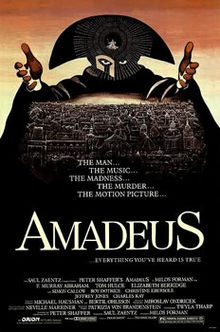
The story of the film is the relationship between two musician Antonio Salieri and Wolfgang Amadeus Mozart. Salieri was jealous of Mozart’s musical talent and achievements and how he always wanted to be like him.
The music in Amadeus is very important and revolves around the drama. The director used Mozart`s pieces in an extensive and effective way. It is not just a simple background music which serves to underline the atmosphere with grief, joy or other emotions. It naturally becomes more prominent.
The sequences from Mozart`s operas (The Abduction from the Seraglio, The Wedding of Figaro, Don Giovanni, and The Magic Flute)are closely connected with the plot. Their function is to represent the rivalry between Mozart and Salieri. Mozart use them to claim his position as the best composer in the world and Salieri to harm his rival by turning his work against him.
The elements and tunes from the operas also have a symbolic function. At the opening scene everything is dark, and we hear Salieri as he shouts Mozart`s name begging his forgiveness. The emotion of fear and desperation of this sequence supported by the dramatic opening chords of Don Giovanni.
Another way the director used the music is to illustrate what goes on in Mozart`s head. One of the examples is the scene where Mozart is composing, and we hear the music together with him. Suddenly, Constanze comes in to introduce Lorl. She has to shout to make herself heard over the sound of music playing in Mozart`s head. The music stops, and while Lorl arrives, Constanze starts to argue with Leopold. He did not participate, instead he returns to his work. Gradually music rises again while the voice of Constanze and Leopold fade away.
In another scene the director used music to express Mozart`s feelings. In these part Mozart leaves the sleeping Constanze and his work Requiem and goes to a party at Schikaneder`s cottage. He is playing and singing fragments from The Magic Flute for the guests. The problem is that he cannot overcome his guilt for having left his wife and his work for a party. Although he starts singing more and more louder, the sombre choir of Rex Tremendae gradually overshadows the joyful Magic Flute overture.
Salieri also has the talent of hearing complete music as soon as he sees the score. This features in the scene when Salieri reading Mozart`s manuscripts. While he quickly turns the pages, the audience hears passages from Mozart`s music.
Similar scene happens on the night of Mozart`s death. The dying composer dictates his unfinished work called Requiem to Salieri. As soon as the passage is written down, we can hear it in its final form. First with a single voice and instrument, then the whole ensemble. We also hear the individual parts from the Requiem at the scene when Constanze returns.
Finally, the most memorable sound elements in the film is Mozart`s giggle. It is at once unnerving and disarming, which manifests the duality of Mozart. It also echoes through the composer`s music at the final scene. Despite his hard life and early death, it is Mozart who has the last laugh.
Beethoven`s piano sonata is one of his best-known compositions. He originally called his sonata as Sonata Quasi Una Fantasia, which means sonata almost like a fantasy. The name Moonlight Sonata was given by a German music critic and poet Ludwig Rellstab. He described the sonata`s opening movement with an effect of moonlight shining upon Lake Lucerne.
The sonata was completed in 1801. The title “Moonlight sonata” gives a sense that this is a romantic piece, a love song dedicated to his 17-year-old piano student, Countess Giulietta Guicciardi. But the inspiration came from a scene of Mozart`s Don Juan, where the main character Don Juan kills the commander. This gives a darker, a more funeral feel. This piece is also written in C# minor. Beethoven noted this in one of his first manuscripts, indicating it as an influence. The dark sense was also supported by the fact that the piece was written in the time period when the composer started losing his hearing and also his music style was changing and evolving.
One of the examples that Beethoven`s work was evolving was the sonata`s form. He did not follow the traditional fast – slow – fast pattern. Instead he opened with a slow movement, which followed by a medium and closed with a fast movement.
The first movement is one that most people are familiar with. The movement as a whole is quiet and sombre. It contains mainly piano (soft) and pianissimo (very soft) with a few crescendos (gradually loud) and a couple of forte (loud) moments but it never grows too loud.
Throughout the movement there are rhythmic ostinatos, which is a short, constantly repeated rhythmic pattern. In this piece this is a triplet which is a group of three notes played or sung in the time normally taken by two notes (Musicterms.artopium.com, 2018). It gives a rolling feeling, almost like a swaying movement. Also, we have the melody line which is sitting on the rolling triplets. It gives a feeling of little lights shining through the pitch-black lover notes.
The first movement is in a modified sonata form. It starts with an exposition which consists of two themes. A theme or may sometimes be called the subject consists of a recognizable melody or a characteristic rhythmic pattern. It is followed by a development section, where the melody dropped, and the notes run up and down. He did not follow the common harmonic progression and rules of sonata form. This gives an improvisational and free feeling to the piece. Next is the recapitulation section which is the repeat of the exposition with a little key modification. Finally, the movement closes with a coda. The coda is another word for ending and brings the movement to a close.
Franz Liszt described the second movement as a “flower between two chasms”. The second movement contains a minuetto and trio. The minuetto and trio is an A-B-A form (A = minuet; B = trio) in a moderate triple meter that is often the third movement of the Classical sonata cycle. (Musicterms.artopium.com, 2018) This movement is also unusual because both the minuetto part andthe trio part are in the same key which is Db major. Generally, the composers will change the keys, but Beethoven kept it really simple. The key of the first and third movements are C# minor which is actually the exact same note as Db. We call these keys enharmonic, meaning they are different names for the exact same note on the piano. The reason that the composers choose to write in Db major instead of C# major is because it is easier to play. The same goes for writing in C# minor versus Db minor.
The third movement is like the first movement. It is written in sonata form and contains exposition, development, recapitulation and coda. It starts similarly, except with some twists and turns. For example, the development section is on a major chord. The mood is dark and heavy like the first movement, except this time it’s loud and fast and exciting. The powerful sound of this movement is not achieved by loud notes rather a few well-chosen accents in the quiet playing (with the odd, short fortissimo section) that makes it have impact.
My chosen instruments are the piccolo, the Bass clarinet and the Cor Anglais. These are all part of the auxiliary instruments of the orchestra. Piccolo was evolved from the military transverse flute of the Middle Ages and went through a rapid innovation during the 18th century. In 1832 a Munich flutist Theobald Boemh invented a mechanism which used to the piccolo as well. The instrument first used by Wolfgang Amadeus Mozart in his work called The Magic Flute in 1791. The role of the piccolo is to add color and shading to the sound of the orchestra and occasionally even as a solo instrument. (Vsl.co.at, 2002)
In the late 18th century two instrument makers began developing clarinets in the bass register. In Paris, Gilles Lot created the “basse-tube” with several keys and a compass of more than three octaves. In Dresden, Heinrich Grenser created a bass clarinet (”Klarinettenbass”) which nine keys and a range down to a written Bb3 (which meant that the lowest sounding note was either Ab4 or Ab3).
The modern bass clarinet created by Adolphe Sax with 22 keys and an entirely straight tube in the 1830s. He also added a reflector which was designed to conduct the vibrations from the downward-pointing bell into the auditorium.
The bass clarinet first used in the opera called Les Huguenots, composed by Giacomo Meyerbeer in 1836. Franz Liszt and Richard Wagner were also among the first composers who made regular use of the bass clarinet, raising it to the status of a standard orchestra instrument.
The bass clarinet role in the orchestra is to play bass voice and solo pieces with a somber and solemn character. It is also perfectly capable of producing humorous and comical effects. (Vsl.co.at, 2002)
The contrabassoon, which also known as the double bassoon, is the contrabass instrument in the woodwind section. It is the deepest instrument in the orchestra with the contrabass tuba. The oldest surviving contrabassoon which dates from 1714 can be found in Leipzig and inscribed “Andreas Eichentopf in Northausen 1714”. The first four-part contrabassoon made in London by Thomas Stanesby in 1727. The first four keys model made by his son in 1739 and it can be found in the National Museum of Ireland in Dublin.
The modern contrabassoon created by Adam and Wilhelm Heckel in 1877. Richard Wagner was the first who was convinced by the quality of its tone and he used it in his Parsifal in 1882. At the beginning of the 20th century the instrument was further improved by Wilhelm Heckel. In France the firm of Buffet-Crampon also produced a French model in 1906 which differs mainly in terms of the key work. These technical improvements helped gain popularity to the contrabassoon, received new tasks as a solo instrument and found its way into chamber music.
In the orchestra the contrabassoon plays those parts that were written for the contra-bass sarrusophone, a widely used instrument that had been scored for particularly by composers in France and Spain such as Camille Saint-Saëns, Claude Debussy and Maurice Ravel. (Vsl.co.at, 2002)
I was listening to some music by two well-known saxophonist, John Coltrane and Charlie Parker. The Jazz style was not new for me although I do not know too many pieces. During my research I discovered two music which I learned while I was studying and performing, and they are also well known by many people.
The first piece was My favourite things from The Sound of music musical, which first staged in 1959 and later they adapted this musical into a film in 1965. (The Sound of Music Salzburg, 2020). This version played by John Coltrane.
The second piece was Summertime from the opera called Porgy and Bess. The jazz inspired song is a lullaby and it is the most covered song on the world. (Eno.org, 2020). This version played by Charlie Parker.
I really enjoyed listening these pieces. John Coltare and Charlie Parker approach these songs in a unique way. The freedom of Jazz including the flawless play and improvisation gives this music a new version. Although both musicians use the main melody, Coltare brings more improvisation into his play.
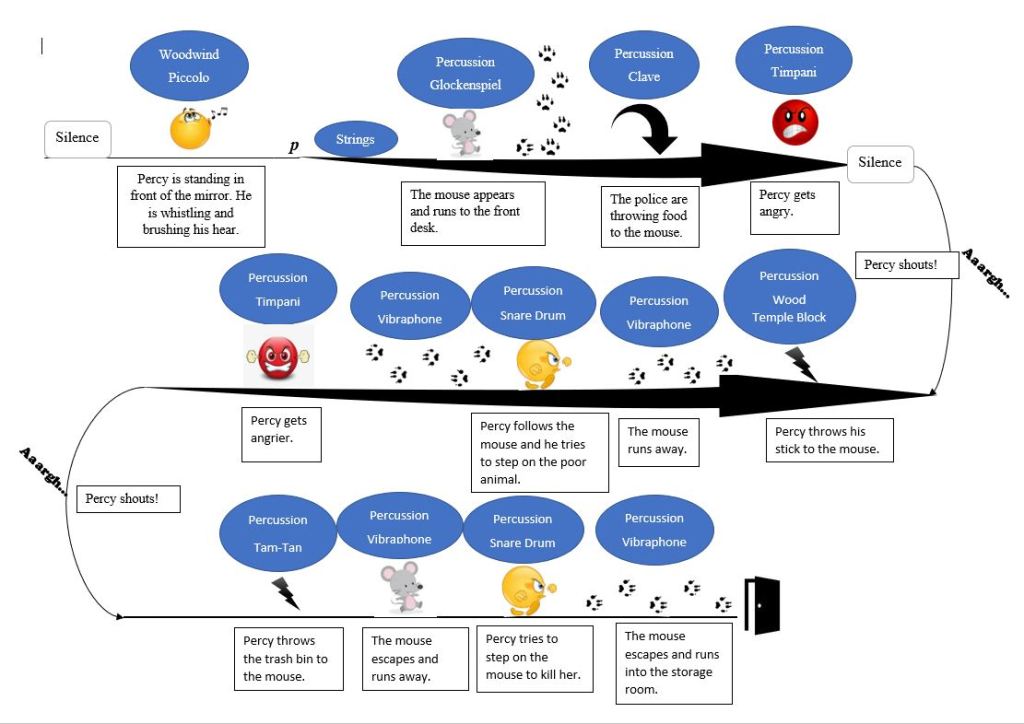
I chose to create a graphic score to accompany the “Percy Chasing the Mouse” scene from the 1999 film “The Green Mile”. (YouTube, 2019)
The Green Mile is a 1999 American fantasy crime drama film written and directed by Frank Darabont and adapted from Stephen King’s 1996 novel of the same name. It tells the story of death row supervisor Paul Edgecombe’s (Tom Hanks) encounter with John Coffey, an unusual inmate who displays inexplicable healing and empathetic abilities.
Percy
Wetmore is a particularly cruel and arrogant guard who makes the atmosphere on
E block violent and unpredictable. While he takes pleasure in beating and
humiliating weaker individuals, he deeply fears humiliation himself.
There is a typical day in the hallway of the Green
Mile. Percy`s whistling brakes the silence while he is brushing his hair. Suddenly
a mouse appears from nowhere and runs to the front desk where guards are eating
their lunch. They starting to throw some food to the mouse. Percy quietly but
angrily watching the events when suddenly he shouts and throws his stick to the
mouse. The animal escapes and runs away but Percy follows her. While he tries
to overrun the poor little animal, he grabs a trash bin and throws to the
mouse. He missed her and the mouse runs away and disappears in the storage
room.
The percussion are required to take the main role. They create the sound of different activities in the scene such as running, stepping and throwing objects. They also represent the anger as emotion. The strings provide the various back noises and the dynamics are indicated by the thickness of the line on the score.
Graphic Score of the scene “Percy Chasing the Mouse”
References:
Your Bibliography: YouTube. (2019). The Green Mile (1999) – Percy Chasing the Mouse. [online] Available at: https://www.youtube.com/watch?v=Uo26kWC4nY8 [Accessed 18 Aug. 2019].
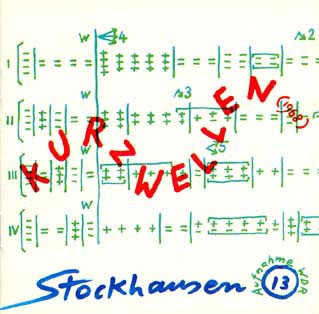
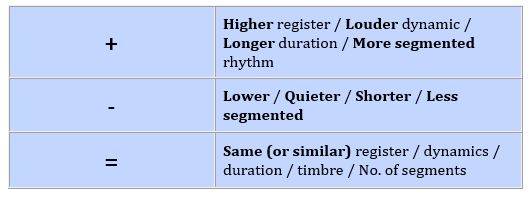
The latter half of the 1960s is often referred to as Stockhausen’s ‘intuitive’ period (Whitehouse, 2019), when he largely abandoned the systematic serial planning of his music to an increasingly improvisational approach to composition; one where the response of the performers takes precedence over the instructions to which they respond. Kurzwellen is one of a series of works dating from the 1960s which Stockhausen designated as “process” compositions. These works in effect separate the “form” from the “content” by presenting the performers with a series of transformation signs which are to be applied to material that may vary considerably from one performance to the next. The processes indicated primarily by plus, minus, and equal signs, constitute the composition. This “plus-minus” notation is summarized in the following table, which shows the effect of each symbol on the four musical parameters, register, dynamic, duration and rhythm:
Longer or shorter duration refers to the length
of an event. Changing the “segmentation” is basically
changing the number of notes in a phrase without changing the melodic shape,
typically by dividing long tones into several shorter ones or playing tremolos.
The performers may have extensive freedom in interpretation.
For example, if a single symbol is specified, the performer can choose which
parameter it will affect, the other parameters remaining unaffected (Chang,
2014).
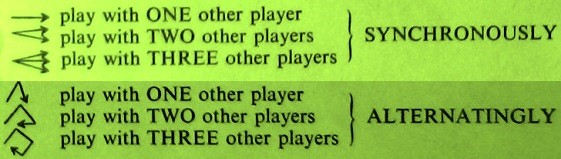
Kurzwellen also has a few additional symbols to trigger non-spontaneous group formations (duos, trios, quartets).
For the 3 “synchronous-signs”, a leader signals a
player (or players) to rhythmically follow him. This group follows the leader
in the number of events specified after the arrow symbol, while applying their
own plus-minus symbols. For the alternating-signs, players take turns (in
a repeating sequence) playing their events for the number specified, usually as
“echoes” of the leader. After that the leader signals the
group’s dissipation with a shortwave radio event.
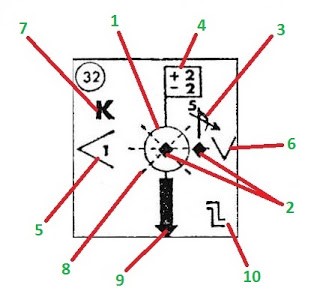
In his earlier work titled Plus Minus (1963) Stockhausen did not employ the above notation, but instead developed a notation based on Matrix Event Squares (Chang, 2015). These are derived from pages of symbols and pages of pitch material.
1 square box is 1 Event (this is vent 32, which features Character 5)
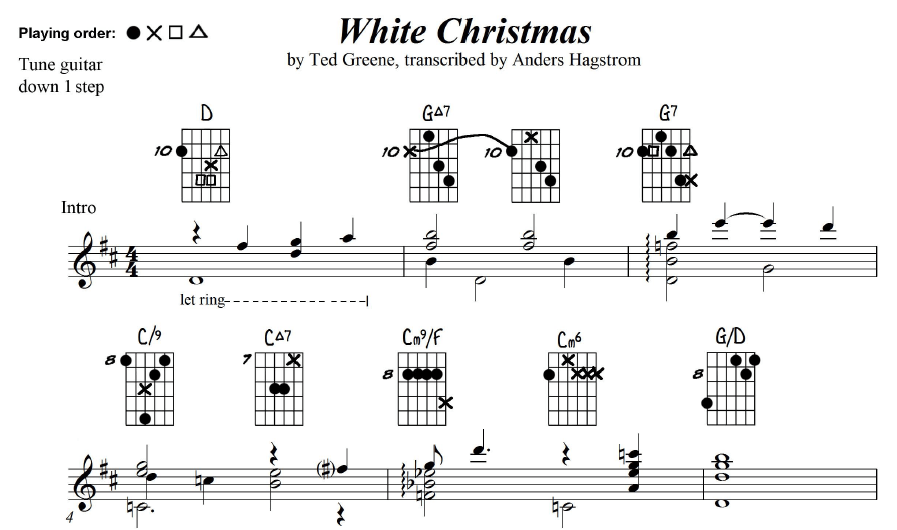
An alternative notation schemes are widely used in guitar music, including tablature, where the notation is a visual representation of the guitar’s strings with numbers to indicate the fret(s) to be held down, and chord windows, which are a visual representation of a section of the guitar fingerboard with dots to indicate the position of the fingers. This latter system has been developed further by, for example, the jazz guitarist and instructor Ted Greene (1946-2005) with use of different symbols to indicate the order in which the notes should be played. An example is shown in Figure 2. (Tedgreene.com, 2005)
Steve Reich and Brad Lubman perform Clapping Music
I listened to Clapping Music by Steve Reich (YouTube, 2015). There are two performers in this piece who are repeatedly
clapping the following rhythm:
The instrument choice is very interesting as it brings
the listener back to the beginning of music history, where people used the simplest
tools to create music. I can hear the original motif clearly in spite of the
interference from the other player.
This music has a polyrhythmic effect. It began as a
unison where the two performers clapping the same rhythm. After several
repeats, one player advances by a quaver and repeats the process until
eventually the two rhythms coincide again. When the pattern shifts, a series of
interlocking rhythms emerge, creating great variety. Furthermore, there is a
sense of balance in the whole piece, between the resulting variations, as they
create and release rhythmic tension. The other performer remains playing the
pattern without shifting.
This piece does not lack musical interest. First, Clapping Music constitutes a synthesis and a refinement of Reich’s ideas through a piece with very few elements, but very well combined. Secondly, it enjoys a profound metrical ambiguity (something very common to Reich’s pieces) as well as a great deal of interlocking rhythmic patterns.
References
Your
Bibliography: YouTube. (2015). Steve Reich & Wolfram Winkel – Clapping Music
(Scrolling). [online] Available at: https://www.youtube.com/watch?v=hH1j06bMHDQ
[Accessed 16 Aug. 2019].




 Aname
Aname 