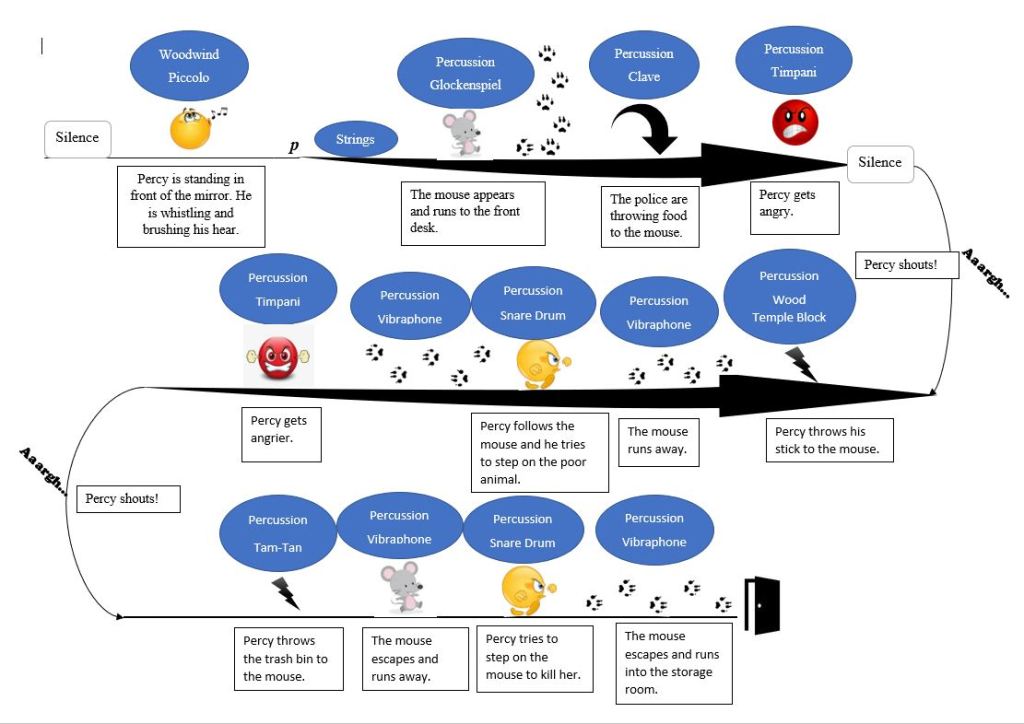
I chose to create a graphic score to accompany the “Percy Chasing the Mouse” scene from the 1999 film “The Green Mile”. (YouTube, 2019)
The Green Mile is a 1999 American fantasy crime drama film written and directed by Frank Darabont and adapted from Stephen King’s 1996 novel of the same name. It tells the story of death row supervisor Paul Edgecombe’s (Tom Hanks) encounter with John Coffey, an unusual inmate who displays inexplicable healing and empathetic abilities.
Percy
Wetmore is a particularly cruel and arrogant guard who makes the atmosphere on
E block violent and unpredictable. While he takes pleasure in beating and
humiliating weaker individuals, he deeply fears humiliation himself.
There is a typical day in the hallway of the Green
Mile. Percy`s whistling brakes the silence while he is brushing his hair. Suddenly
a mouse appears from nowhere and runs to the front desk where guards are eating
their lunch. They starting to throw some food to the mouse. Percy quietly but
angrily watching the events when suddenly he shouts and throws his stick to the
mouse. The animal escapes and runs away but Percy follows her. While he tries
to overrun the poor little animal, he grabs a trash bin and throws to the
mouse. He missed her and the mouse runs away and disappears in the storage
room.
The percussion are required to take the main role. They create the sound of different activities in the scene such as running, stepping and throwing objects. They also represent the anger as emotion. The strings provide the various back noises and the dynamics are indicated by the thickness of the line on the score.
Graphic Score of the scene “Percy Chasing the Mouse”
References:
Your Bibliography: YouTube. (2019). The Green Mile (1999) – Percy Chasing the Mouse. [online] Available at: https://www.youtube.com/watch?v=Uo26kWC4nY8 [Accessed 18 Aug. 2019].
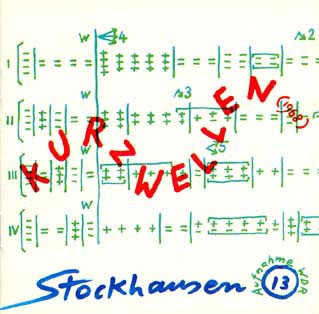
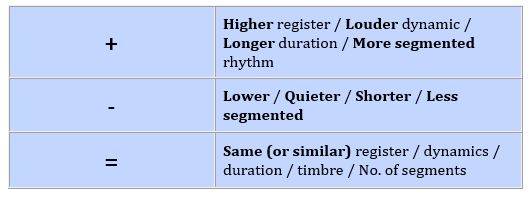
The latter half of the 1960s is often referred to as Stockhausen’s ‘intuitive’ period (Whitehouse, 2019), when he largely abandoned the systematic serial planning of his music to an increasingly improvisational approach to composition; one where the response of the performers takes precedence over the instructions to which they respond. Kurzwellen is one of a series of works dating from the 1960s which Stockhausen designated as “process” compositions. These works in effect separate the “form” from the “content” by presenting the performers with a series of transformation signs which are to be applied to material that may vary considerably from one performance to the next. The processes indicated primarily by plus, minus, and equal signs, constitute the composition. This “plus-minus” notation is summarized in the following table, which shows the effect of each symbol on the four musical parameters, register, dynamic, duration and rhythm:
Longer or shorter duration refers to the length
of an event. Changing the “segmentation” is basically
changing the number of notes in a phrase without changing the melodic shape,
typically by dividing long tones into several shorter ones or playing tremolos.
The performers may have extensive freedom in interpretation.
For example, if a single symbol is specified, the performer can choose which
parameter it will affect, the other parameters remaining unaffected (Chang,
2014).
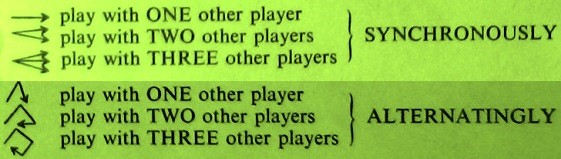
Kurzwellen also has a few additional symbols to trigger non-spontaneous group formations (duos, trios, quartets).
For the 3 “synchronous-signs”, a leader signals a
player (or players) to rhythmically follow him. This group follows the leader
in the number of events specified after the arrow symbol, while applying their
own plus-minus symbols. For the alternating-signs, players take turns (in
a repeating sequence) playing their events for the number specified, usually as
“echoes” of the leader. After that the leader signals the
group’s dissipation with a shortwave radio event.
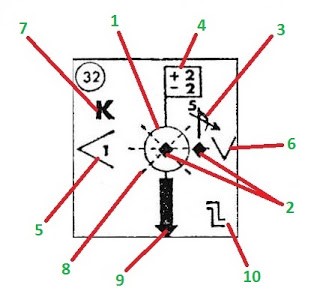
In his earlier work titled Plus Minus (1963) Stockhausen did not employ the above notation, but instead developed a notation based on Matrix Event Squares (Chang, 2015). These are derived from pages of symbols and pages of pitch material.
1 square box is 1 Event (this is vent 32, which features Character 5)
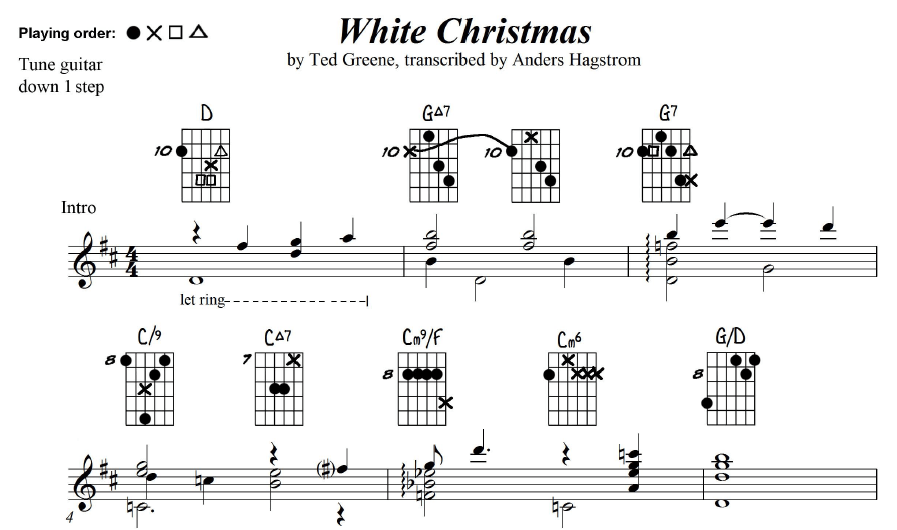
An alternative notation schemes are widely used in guitar music, including tablature, where the notation is a visual representation of the guitar’s strings with numbers to indicate the fret(s) to be held down, and chord windows, which are a visual representation of a section of the guitar fingerboard with dots to indicate the position of the fingers. This latter system has been developed further by, for example, the jazz guitarist and instructor Ted Greene (1946-2005) with use of different symbols to indicate the order in which the notes should be played. An example is shown in Figure 2. (Tedgreene.com, 2005)
Steve Reich and Brad Lubman perform Clapping Music
I listened to Clapping Music by Steve Reich (YouTube, 2015). There are two performers in this piece who are repeatedly
clapping the following rhythm:
The instrument choice is very interesting as it brings
the listener back to the beginning of music history, where people used the simplest
tools to create music. I can hear the original motif clearly in spite of the
interference from the other player.
This music has a polyrhythmic effect. It began as a
unison where the two performers clapping the same rhythm. After several
repeats, one player advances by a quaver and repeats the process until
eventually the two rhythms coincide again. When the pattern shifts, a series of
interlocking rhythms emerge, creating great variety. Furthermore, there is a
sense of balance in the whole piece, between the resulting variations, as they
create and release rhythmic tension. The other performer remains playing the
pattern without shifting.
This piece does not lack musical interest. First, Clapping Music constitutes a synthesis and a refinement of Reich’s ideas through a piece with very few elements, but very well combined. Secondly, it enjoys a profound metrical ambiguity (something very common to Reich’s pieces) as well as a great deal of interlocking rhythmic patterns.
References
Your
Bibliography: YouTube. (2015). Steve Reich & Wolfram Winkel – Clapping Music
(Scrolling). [online] Available at: https://www.youtube.com/watch?v=hH1j06bMHDQ
[Accessed 16 Aug. 2019].
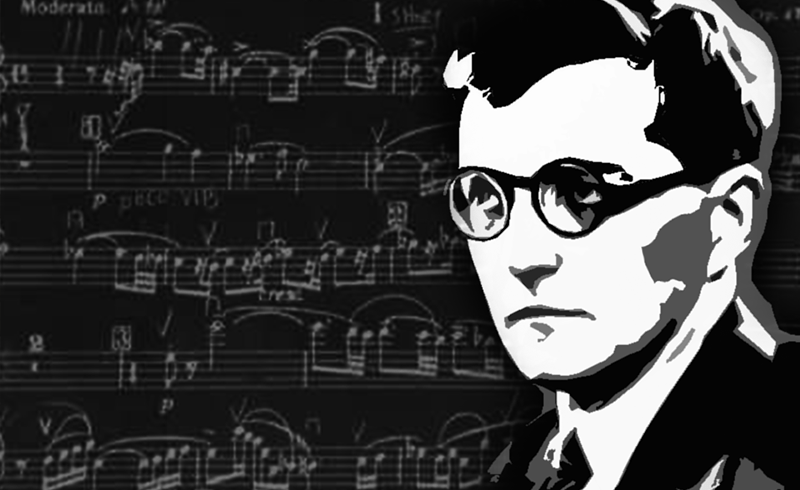
Shostakovich (12/25 September 1906 – 9 August 1975) was a Russian composer and pianist. He is regarded as one of the major composers of the 20th century. He learned piano and composition and entered the Petrograd Conservatory in 1919, at the age of 13. During the 1920s he developed a modernist style and studied the works of Schoenberg, Hindemith and Berg. A polystylist, Shostakovich developed a hybrid voice, combining a variety of different musical techniques into his works. His music is characterized by sharp contrasts, elements of the grotesque, and ambivalent tonality; the composer was also heavily influenced by the neo-classical style pioneered by Igor Stravinsky, and (especially in his symphonies) by the late Romanticism of Gustav Mahler. His 1934 Opera, Lady Macbeth of the Mtsensk District, was at first greeted with much public acclaim and seen as a model example of Soviet Realism. In 1936, however, Stalin attended a performance, disapproved of the work and left before the end. Shortly afterwards, the work was criticized in Pravda ‘Sumbur vmesto muzïki’ (‘Chaos instead of Music’) for its explicitness and dissonance (Www-oxfordreference-com.ucreative.idm.oclc.org, 2011). It was dropped from the repertory and was not seen again in Russia until its revival—as Katerina Izmaylova—in 1963. Shostakovich, fearing for his physical safety, this was the time of the Soviet show trials after all, withdrew his 4th symphony before its premier since it was in a similar style to Lady Macbeth, and started work on the 5th symphony, which was premiered on 21st November 1937. The work was an immediate success with the public and assisted with his political rehabilitation (Norris and Nice, 2011).
I listened a few versions of Shostakovich`s 5th Symphony. I compared these different recordings of the final movement in particularly the coda with its two tempo options. My favourite is the recording conducted by Rostropovich with the London Symphony Orchestra in 2005. (Spotify, 2005) This is the slowest in tempo, but the repeated unison is regal, heroic and grand. The Bernstein recording in 1959 was the fastest in tempo. (Spotify, 1959) I did not like it as I felt that the interpretation is way too hurried, especially the first part. He also does a grand ritardando at the end, which creates a dramatic mood, but it does not sound appealing. In my opinion if you are playing the coda in a faster tempo, than stay in it, like Previn did in his 1966 recording with the London Symphony Orchestra. (Spotify, 1966) The composer`s son, Maxim Shostakovich conducted the 2011 performance with the London Symphony Orchestra as well. (Spotify, 2011) His interpretation was also to choose the slower tempo.
Creating different versions (slow and fast) of the coda makes the piece interesting but it also means that not every type of interpretation fit into the music. They create a triumphant climax to the piece but the faster the tempo is it became one dimensional, clinical and technical. The slower tempo however not only attracts the listener more but highlights the triumph of the overcame difficulties.
Benjamin Britten (22 November 1913 – 4 December 1976)
was an English composer, conductor and pianist. He was a central figure of the
20th century British classical music, with a range of works
including opera, other vocal music, orchestral and chamber pieces.
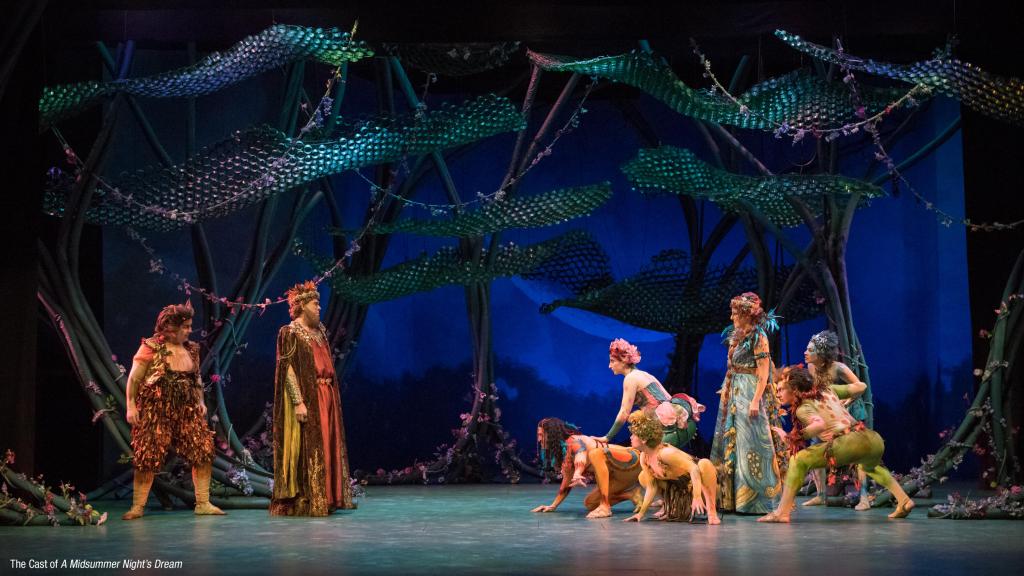
The Midsummer Night`s Dream written under a year. The Jubilee Hall in Aldeburgh was undergoing a complete refurbishment and to celebrate its opening which took place on the 1960 Aldeburgh Festival a new opera needed. Because of the short time Britten and Peter Pears choose Shakespeare`s play as a libretto. Although Britten was suffering of depression and several health issues, he completed his music in time. The opening was threatened by Alfred Deller, the first Oberon fearing he was not prepared properly for an acting in an opera as the director John Cranko was inexperienced with opera. Eventually everything came together and the opera`s first performance took place on 11th of June 1960, in the now beautifully renewed Jubilee Hall in Aldeburg. The opera entered the general operatic repertory and has become one of the most frequently performed operas written since the second world war.
A Midsummer Night`s Dream is a flexible piece. In one
way it is an evening of sheer enchantment, a traditional fairy tale with plenty
of comedy. On another it is a psychological treasure trove, purity, madness and
cruelty crashing against each other to riveting effect. The music is filled with
musical homage and satire, from Baroque through Schoenberg, referencing many
classic works particularly in the riotous play within a play of “Pyramus and
Thisbe”. The diverse and lively range of characters divide into three groups,
each with a largely separate plot as in Shakespeare`s play. The rustics being
given folk-like “simple” music, the lovers a more romantic sound world and the
fairies being represented in a very ethereal way.
The opera opens with a chorus, played by boy sopranos. The introduction of a chorus of boy fairies means that the opera becomes greatly concerned with the theme of purity. Britten also pays attention to the play`s central motif: the madness of love.
Oberon argues with Tytania over a young changeling
boy, then he sends Puck to find a magical flower which makes anyone fall in
love with the next person they see. Next we meet Lysander, Hermina, Demetrius
and Helena. They are variously chasing into the woods and form something of a
love chain. Now we meet our third and final group, the six “mechanicals” or
“rustics “basically working-class men. They are preparing to perform a play for
the wedding of Theseus (Duke of Athens) to Hippolyta (Queen of the Amazons).
Lost and totally exhausted Hermia and Lysander fall asleep in the woods, when
Puck appears and thinking he has found Demetrius, he sprinkles the juice on
Lysander. Helena wakes up Lysander who instantly fell in love with her. Nearby,
Tytania fell asleep and Oberon appears and places the juice on her eyes.
The mechanicals meet later that same day for a
rehearsal. They begin but soon they are spotted by Puck who decides to work
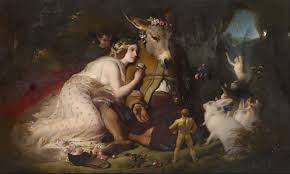
some mischief and he turns Bottom`s head into a donkey causing the other
mechanicals to flee in fear. Left alone Bottom sings to himself awakening the nearby
Tytania, who instantly fell in love with him. Oberon found out that Demetrius
is chasing Hermia, so he drips the juice on Demetrius eyes after he fell
asleep. Unfortunately, things get even worse when Helena wakes Demetrius up who
promptly falls in love with her. Oberon now is angry with Puck and instructs
him to sort the couples out. Puck then leads the four away through the woods,
applying the juice and antidote to them as they fall asleep.
It is nearly dawn. Oberon rouses Tytania, freeing her
from the flower`s spell. The four lovers awaken, finally happily paired off.
Bottom`s head returned normal, so he thinks it was only a dream. The other
mechanicals who have been searching for Bottom come across him as he announces
that their play is to be performed at court.
We leave the woods and arrive to Theseus and Hippolyta`s wedding day. The mechanicals deliver their ludicrous (and hilarious) Pyramus and Thisbe for the three couples. As the three couples retire to bed, Puck and the fairies return to bless the palace and its people.
I listened the following three pieces by John Cage.
John Cage – In a Landscape
I found this piece quite beautiful. The sound of the composition is soft and meditative. This piece is similar to Cage`s Dream, but the fixed gamut of tones is more extensive. Resonances are sustained throughout the composition by using both pedals.
John Cage – First Construction
I did not particularly like this piece. I hear it more as a rhythm than a melody. It also entirely random with loose timing. There are brief moments between 6-8 minutes where there seemed to be a looped pattern of playing.
John Cage – Five, for any 5 voices or instruments
There are many versions of Five. I enjoyed listening this piece. It was one of Cage`s early pieces and he specified both pitches and dynamics (but not the instrumentation). This give some musical sound to the piece and made it less random. It also has a calming effect and it is similar to chanting. The long-sustained notes connect to me on a deeply instinctual level.
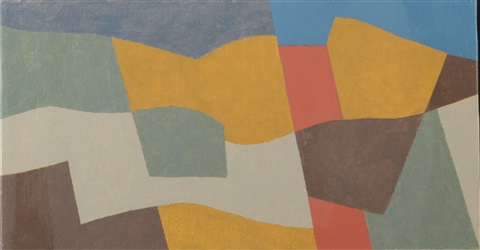
Narrow Landscape No.7 by George Dannatt
The Concise Oxford Dictionary’s definition of music is “Vocal or instrumental sounds (or both) combined
in such a way as to produce beauty of form, harmony and expression of emotion”.
My own definition of music (Project One, Part One What music means?) is: “music is a unique language and it connects people all around the world. It can be written without any limitation, so it is a perfect tool to express emotion, creativity or using it for healing”. : (McCaul, 2019)
Cage approach to music by incorporating unconventional
instrumentation affect the sound is produced and his formal structure is in
terms of units of time rather than pitch and rhythmic relationships. He uses
various objects (pennies, bolts, rubber etc) and random volumes, durations and
speed.
Beauty is a subjective term and open to interpretation, but
taken in its widest definition, some people will find these works beautiful.
All three pieces had form, harmonic content and expressed emotion. So given
this definition, I believe these works may be considered to be music.
Post war musicians often demanded more attentive
listening from their audiences. The same attention required from composers in
classical music by evoking of impressions, thoughts and feelings. In chance
music, some elements are left unspecified, use more improvisation, experiencing
each sound as it comes along. It does not convey any emotion or other
intention. Although all the elements of music are there, I think it is
also an artwork. It deliberately created to have aesthetic value. The composer
may perceive his work as an art, but other people may have different view about
the composition and it not necessarily fulfilling the definition of art.
Based on the chance and serial music that I have listened
to, there seems to be a greater focus on rhythm in chance music, with melody
virtually absent at times. Chance music has no defined musical structure
whereas serialism is based on some traditional musical elements.
At this stage of this course, I would simply be listening to
music without considering its composition system used. I think it is not
essential for understanding the work at an emotional level but such an
understanding my increase the intellectual appreciation from the listener.
It is possible to gain emotional impact from music without
understanding the underlying compositional process used. On the other hand,
understanding the music on the intellectual level creates a deeper emotional
impact.
A good example is the film music., where music contributes
to the overall emotional impact of the story, at times without even being
consciously noticed by the viewer. Another example is the church music. On the
Mass the music contributes to the emotional climax of the service. Not too many
people of the congregation would have understood the compositional process.
Emotion is created in music through the manipulation of
musical elements such as rhythm, tempo, harmony, melody, dynamics and timbre. Associations
between musical features and emotions differ among individuals. Some of the
effects are the creation and release of tension through the manipulation of
dissonance and consonance, the sadness which created by minor chords, the
ethereal emotions which created by augmented chords, and the speed and loudness
to create the sense of urgency and importance. I think chance music also create
emotional impact. It would be also interesting to see if the music would bring
out the same emotional responses from people whose cultures unexposed to
western music.
Both chance and serial music created new rules that avoided the tonal structure. Serialism has an identified music structure compared to chance music. Chance music uses unconventional instrumental and it is different each time of performance. The fact that the performance is left in the hands of the performer and random selection of rhythm and pitches applied is distracting the music.
Personally, I like this piece. The demonstration of orchestra color and his bravery to use the same melody for 15 minutes is inspiring. The piece has repeating bass line, one repeating rhythm and two melodies that alternate. One melody is relatively simple. The second melody is having an exotic feel. There is further exoticism from the use of repeated notes and syncopation. Each time either melody is heard it is given to a new combination of instruments and the accompaniment around it grows thicker and louder. At a crucial point towards the end the whole piece is transposed up a third briefly before collapsing back down to C for an enormously exciting close. Keeping the melody constant helps to listen the tone colors and blends between instruments instead of being distracted by a new counter-melody or complex harmony. The rhythmic ostinato gives the piece its distinctive ‘Spanish’ feel and it also repeats constantly.
The use of an oboe d`amore for the 5th
statement of the melody was very unusual as the instrument fell out of use
after the Baroque era and it is still relatively uncommon today.
Another important section is the 9th
statement where French horn, 2 piccolos and celesta combined to create the most
unique and interesting tone colours. It also has a difficult trombone solo.
The music has a vaguely hypnotic quality that is quite powerful.
Edgar Varése (1883-1965) was a French composer and he was one of the most innovative although he composed relatively few works. He moved to America in 1915. His first piece in America was Amériques (1918-23) which inspired by his first impressions of the noises of the city such as street noises, police cars, fire trucks, river sounds, foghorns, and skyscraper construction.
The Concise Oxford Dictionary defines music as a combination
of vocal or instrumental sounds (or both) to produce beauty of form, harmony
and expression of emotion.
This definition is needs to be developed as the innovative Ameriques brings it into a different level. Although the piece is a combination of instrumental sounds, but it is rejecting traditional concepts of melody, pulse and harmony. The combination based on movement from one sound to another. The piece has an effect to the listener as it clearly reflects the sound of the city. As I am listening to this music, I feel I am walking on the streets in Manhattan.
Carl Nielsen was a Danish composer, conductor and violinist. He was born on 9 June 1865 Sortelung and died on 3 October 1931 Copenhagen. He showed his musical talent as a child and became a military trumpeter at the age of 14. Although his symphonies, concertos and choral music are now internationally acclaimed, Nielsen`s career and personal life were marked by many difficulties often reflected in his music. The strain of his dual careers and constant separation form his wife had a negative effect on to his marriage. The separation process began in 1916 and finalized in 1919. The period between 1916 – 1922 was one of the creative times for Nielsen. The crisis in his personal life and the events of World War I strongly influenced his Fourth and Fifth symphonies.
Outside Denmark, Nielsen is most closely associated with his
six symphonies, written between 1892-1925. The works have a lot of common. They
are all just over 30 minutes long, brass instruments are a key component of the
orchestration and they all exhibit unusual changes in tonality, which heighten
the dramatic tension.
Symphony No.5 composed in Humlebaek during the winter and
spring of 1921. He dedicated the new symphony to his friends Vera and Carl
Johan Michaelsen. The piece was first performed in Copenhagen on 24 January
1922 with the composer who was conducting. It is one of the two of Nielsen`s
six symphonies which has no subtitle.
The Fifth Symphony sounded unusual and harsh which broke the
traditional view of harmony. It also has a non -customary structure, comprising
two movements instead of the common three or four which is the only time Nielsen
used this structure. It draws on the theme of contrast and opposition. The
piece described as having elements of war, a battle between the forces of order
and chaos. A snare drummer is interrupting the orchestra in its own tempo
independently as if it wants to disturb the music.
In the first movement begins slowly and calmly and brings
the drama to life in a battle between the orchestra and a snare drummer, who
silenced in the final bars. Also, there is an “evil” motif intervenes in this
movement. The side drum becomes more and more angry and aggressive, but the
nature theme grows on, peaceful and unaffected in the brass. Finally, the evil
gives way and it flees. A solo clarinet ends this movement an expression of
vegetative (idle, thoughtless) Nature.
The second movement is more active. It consists of an
explosion, a fast fugue, a sow fugue and a brief coda. The music continues with
great conflicts between instruments until the broad and calm theme in the slow
fugue.
In a statement to his student Ludvig Dolleris, Nielsen described the symphony as “the division of dark and light, the battle between evil and good”. (Schonwandt and Dausgaard, 2006)
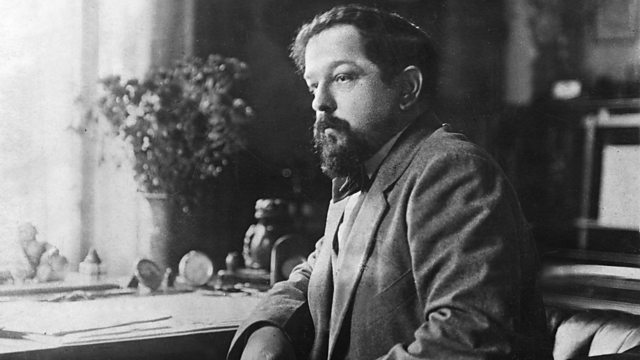
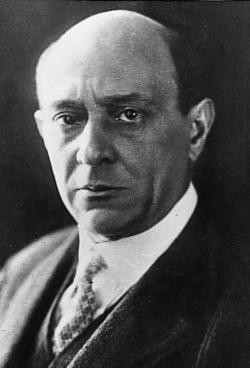
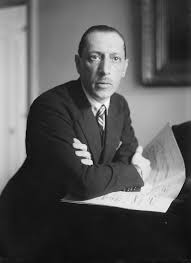
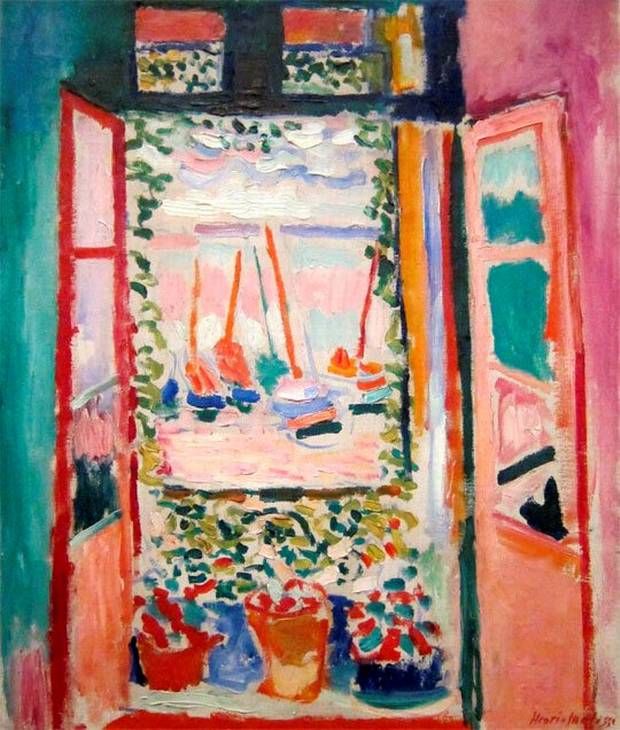
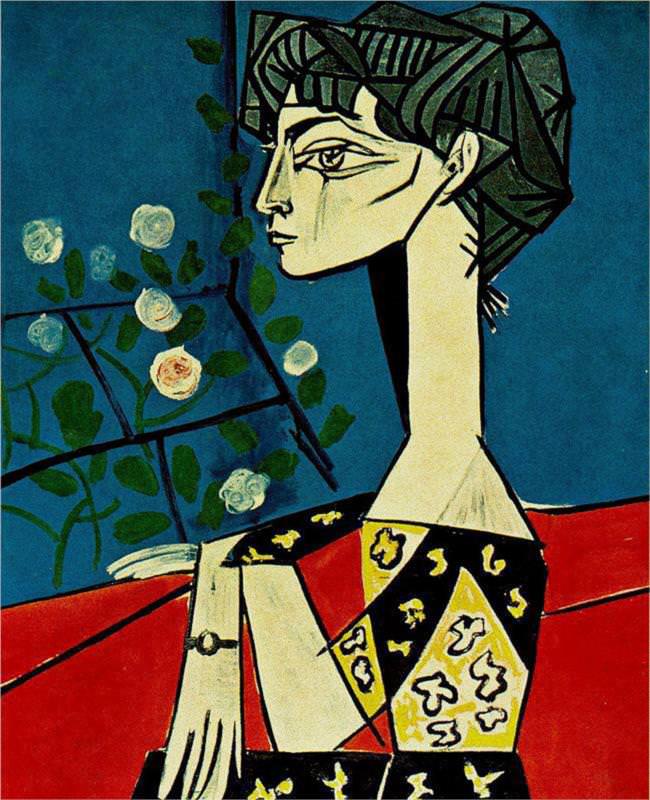
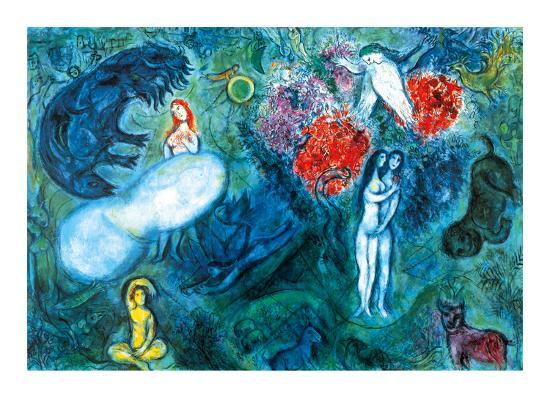
Debussy, Stravinsky and Schoenberg are revolutionized classical music by bringing their pieces into a different level. They are all different from each other, and each has something different and new to offer.
Henri Matisse, “The Open Window”, 1905. Oil on canvas. 55.3 cm x 46 cm. National Gallery of Art, Washington D.C. (Rasmussen, 2008)
Debussy`s Jeux was written to a Ballet. The theme of the
performance is an unfolding romance between three performers during a tennis
game. The Ballet performance was unsuccessful, but the music survived and
become one of the revolutionary pieces in the 20th Century music.
That title implies both the game of tennis and the game of
love, and this is a very sensual score. Debussy called it a “poème dansé” and
his “danced poem” moves from its eerie whole tone beginning to build up to the
great waltz at the climax, then dissolves into an ending that seems to flicker
out in front of us. (Dingle,
2016)
The composer uses a large orchestra with extreme subtlety. He incorporates exotic harmonies and unusual scales into his work. The score begins with a hesitate opening bars. It explores discontinuity with more than 60 changes of tempo and with its short thematic motifs. The music is predominantly scherzando mood.
Debussy – Jeux (Dutoit, 1989)Jacqueline with flowers by Picasso (Picasso, 1954)
Stravinsky’s The Rite of Spring was premiered in the same year as Jeux and became more popular. This piece also written for a ballet. The premier was unsuccessful due to the ballet performance, but the music was well received. The composer uses a very large orchestra with some unusual instruments. “The orchestration is also heavy on brass and percussion and exotic instruments such as alto flute, bass clarinet, bass trumpet, antique cymbals”. (Mangan, 2013)
Stravinsky uses unusual harmonies, folk song quotations and vibrant rhythmic patterns. He frequently varying rhythms and unusual meters but different orchestral sections play contrary and contradictory rhythms which gives a sense of rhythmic cohesion between sections. He also accents unexpected places in measures, further destabilizing any consistent or expected ordinary rhythmic flow. The composer uses short, extremely simple melodic fragments that join with other fragments, creating more complex larger components.
Stravinsky The Rite of Spring // London Symphony Orchestra/Sir Simon Rattle (Rattle, 2017)Paradise (Le Paradis) by Marc Chagall (Chagall, 1961)
Schoenberg’s Pierrot Lunaire was
written for three sets of seven poems by Albert Giraud and it scored for female
voice and a small chamber ensemble. The vocal line is performed in a
distinctive Sprechstimme style, which merges singing with speech. It is a style in which the
vocalist uses the specified rhythms and pitches, but does not sustain the
pitches, allowing them to drop or rise, in the manner of speech. (Winiarz, 2000)
Pierrot Lunaire uses a variety of classical forms and techniques, including canon, fugue, rondo, passacaglia and free counterpoint. The piece written to a small orchestra. The instrumental combinations (including doublings) vary between most movements. The entire ensemble plays together only in the 11th, 14th and final 4 settings. The composer uses seven note melodic motifs and different scoring of each movement which changes the overall sound of the ensemble.
Arnold Schönberg, Pierrot lunaire (Full) (Schönberg, 2012)
The musical features in these works broke down the usual structure which resulted an innovative piece. There are differences between the three composers as each of them have their unique way to develop their music.
Debussy
and Stravinsky both written to a large orchestra, except Stravinsky who using
exotic instruments as well. Schoenberg is different as he uses a small
orchestra with vocal.
All three composers are using unusual harmonies but the
length of the motifs, the type of scales, changing tempo, varying rhythms and
forms, and the unusual meters are different with each piece.
They also have different compositional styles which reflected by the use of the instruments and the musical elements. This create different atmosphere for each musical works.


 Aname
Aname 