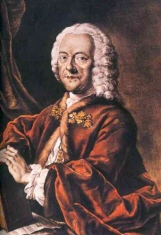
(Oron, 2005)
Georg Philipp Telemann (1681-1767) was a German Baroque composer and multi-instrumentalist. He was a contemporary of Bach and Handel and served as an important bridge between the Baroque and Classical music periods. Telemann was already a musical talent as a child mastering the violin, flute, zither, and keyboard by the age of ten and composing an opera called Sigismundus two years later. Beside his family disapproval he became a composer by almost completely self-taught in music. He entered to study law at the University of Leipzig in 1701, but eventually he chooses music as a career. During his University years he founded the Collegium Musicum (later directed by Bach) which gave public concerts, wrote operatic works for the Leipzig Theatre, became musical director of the Leipzig Opera and he was appointed organist at the Neue Kirche in 1704.
In 1705 he accepted a position as Kapellmeister to the court of Count Erdmann II of Promnitz at Sorau (now Zary, Poland). The different styles (French, Italian, Polish) and his association with the Sorau Kantor and theorist Caspar Printz, the reformist poet Erdmann Neumeister were all influenced Telemann. His career cut short by the Great Northern War in early 1706.
Between 1706-1708 he was a court Konzertmeister in charge of singers in Eisenach. During his stay he composed church cantatas, occasional pieces, orchestral and instrumental chamber music. He married to Amalie Louise Juliane Eberlin (lady-in-waiting to the Countess of Promnitz and daughter of the musician Daniel Eberlin) in 1709. His marriage ended tragically when his wife died in 1711. For changing scenery, he moved to the city of Frankfurt-am-Main and became Director of Municipal music as well as Kapellmeister of the Barfüßerkirche and St. Catherine Church. He was also appointed Kapellmeister to the Prince of Bayreuth. This position suited Telemann’s talents very well. He composed occasional music for civic ceremonies, five year-long cycles of church cantatas, oratorios, orchestral music, and a wealth of chamber music. Most of his work was published. By 1720 Telemann adopted the use of the da capo aria and also made his mark with his opera Narciso which brought to Frankfurt in 1719. He married again to Maria Catharina Textor (daughter of a Frankfurt council clerk) and became a family man.
In 1721 the composer accepted the invitation to work in Hamburg as Kantor of the Johanneum Lateinschule and as a musical director of the city`s principal churches. In 1722 he accepted the directorship of the Hamburg Opera, serving until its closure in 1738.
Between 1737 and 1738, Telemann visited Paris where he heard and impressed by an opera called Castor et Pollux which was written by a French composer Jean Philippe Rameau. The composer influence primarily was Italian and German, but after hearing this opera he incorporated the French operatic style into his vocal works.
From the 1740`s until about 1755, Telemann focused less on composition and turned his attention to study music theory. He also picked up some hobbies which shared by Handel such as gardening and cultivating exotic plants. Unfortunately, he was not lucky with his second marriage due to his wife infidelity and gambling problem which brought financial debt. The composer was saved from bankruptcy by the efforts of his friends and by the numerous successful music and poetry publications but by 1736 he was no longer living together with his wife. Telemann remained in Hamburg until his death in 1767. (Georg Philipp Telemann: a detailed biography, n.d.) (Georg Philipp Telemann | Biography & History | AllMusic, 2020)
Lukas Passion TVWV 5:29, 1944
(Telemann, 2017)
Between 1716 and 1767 Telemann wrote a series of Passions. The musical compositions reflected Christ`s Passion, the physical, spiritual, and mental suffering of Jesus from the trial until the crucifixion. The works were written and performed in German churches before Easter.
St Luke Passion was written in 1744 and in contrast to his other Passion the musical style is more modern. The Libretto was written by an unknown poet and it based on the biblical text of St. Luke (22:39-23:48), but he also contributed his own texts for all the arias and chorus. Telemann uses expressive arias and dramatic choruses. For example, Jesus dramatic aria, or the first two soprano arias which light and earthiness. He only uses chorales as an opening and as a closing which are harmonically simple. He put more emphasis on the human side of the drama. (Schroeder, n.d.) (Janes, 2018)
Uns ist ein Kind geboren, TWV 1:1452 – Cantata Cycle 1716-1717
(Telemann, 2016)
The Cantata Cycle also known as the Concertante Cycle is a series of cantatas written by Georg Philipp Telemann while he was the Director of Municipal Music in Frankfurt.
Uns ist ein Kind geboren is one of the most beautiful sacred cantatas for Christmas day. It written for solo, chorus and orchestra. The piece opens with a duet for two sopranos which based on Polish-Moravian folklore. It also features two substantial choral movements where the second choral movement defined by two horns. (Hofmann, n.d.)
References
Oron, A., 2005. Georg Philipp Telemann. [image] Available at: <https://www.bach-cantatas.com/Lib/Telemann-Georg-Philipp.htm> [Accessed 29 May 2020]
Baroquemusic.org. n.d. Georg Philipp Telemann: A Detailed Biography. [online] Available at: <http://www.baroquemusic.org/biotelemann.html> [Accessed 29 May 2020]
AllMusic. 2020. Georg Philipp Telemann | Biography & History | Allmusic. [online] Available at: <https://www.allmusic.com/artist/georg-philipp-telemann-mn0001456424/biography> [Accessed 29 May 2020]
Telemann, G., 2017. Telemann – LUKE PASSION, ORATORIO – TWV 5:29. Available at: <https://www.youtube.com/watch?v=oWmTUFdHQXY> [Accessed 29 May 2020]
Schroeder, F., n.d. Georg Philipp Telemann: Lukas-Passion Full Score | Carus-Verlag. [online] Carus-verlag.com. Available at: <https://www.carus-verlag.com/en/choir/sacred-choral-music/georg-philipp-telemann-lukas-passion-oxid.html> [Accessed 29 May 2020].
Janes, S., 2018. Boston Baroque Presents Telemann’s St. Luke Passion Of 1744. [online] Boston, MA Patch. Available at: <https://patch.com/massachusetts/boston/boston-baroque-presents-telemann-s-st-luke-passion-1744> [Accessed 29 May 2020].
Telemann, G., 2016. G. P. Telemann: Uns Ist Ein Kind Geboren (TVWV 1:1452). Available at: <https://www.youtube.com/watch?v=OtG39nzuxEs> [Accessed 29 May 2020]
Hofmann, K., n.d. Georg Philipp Telemann: Uns Ist Ein Kind Geboren Full Score | Carus-Verlag. [online] Carus-verlag.com. Available at: <https://www.carus-verlag.com/en/choir/sacred-choral-music/georg-philipp-telemann-uns-ist-ein-kind-geboren-oxid-12.html> [Accessed 29 May 2020]
 Aname
Aname 