Beethoven -5th Symphony, 1st movement: Allegro Con Brío (Beethoven, 1804)
Liszt: Faust Symphony: 1. Faust (Liszt, 1857)
The first difference between the two composition is the number of movements. Beethoven’s work consists four movements, but Liszt only wrote three. Also, these three movements are named after the three characters from Goethe`s drama (1. Faust, 2. Gretchen, 3. Mephistopheles). Beethoven’s first movement includes ten parts, such as exposition (theme 1, transition, theme 2,), development, recapitulation (theme 1, transition, theme 2) and coda. Liszt`s uses sixth themes which paints detailed pictures of the character`s emotions, psychology, and personality.
The opening of the two composition are similarly unique. Beethoven opens his symphony with four notes played by the lower strings and clarinet which repeated a step lower. The notes are filled with suspense (spiccato) which gives the music a lighter and airier tune that build up to the repetition of the notes. This time these notes are slightly altered so it is a little less grand sounding. Liszt`s opening motive uses all twelve notes of the chromatic scale which returns in various places in the movement.
Both symphonies are in sonata form, except Liszt extended his work with an introduction and a coda. Liszt also uses the relatively new additions to the orchestra such as harp, trombones, and tuba.
In the first theme Beethoven uses crescendo and ascension which gives a light texture and juxtaposed with the timpani drums. He also uses imitations and sequences to expand the theme. Liszt applies a double octave (second violins brought up to G#, two octaves above the opening note Ab) which formed by two enharmonic notes. This represents the distance between heaven and earth.
The tone of Beethoven`s second theme is more jubilant and happier. It employs flutes, piccolo and the upper strings to reinforce the difference between the tones of the first and second themes. Liszt uses falling dissonant major seventh at his second theme which gives a pondering and suffering feelings to the music. It is also in E flat major (the relative major) and it features the four-note motif in the string accompaniment.
Beethoven also applied a transition between the first and second theme, so he can tie up the two ideas. The first transition can be heard at the end of the first theme as a short, fortissimo motif played by solo horn. Also, he wrote a development, a recapitulation, and a coda section. The development includes a horn motif, key changes between the tonic and dominant keys. In the coda there is a short descending pattern in the violins which leads to a completely new theme.
In the first movement Liszt uses a process of thematic transformation such as augmentation. Three notes (C, E and Ab) provide the basic underlying tonal plan for the entire symphony. These three pitches converge in the augmented triad that dominates the introduction. C and E are the main tonal centers and A flat is a prominent and organizing pitch.
Liszt`s unique compositional techniques not just add to the original arrangement but it shows the symphony in a different way. He perfectly described the characters purely with music. I cannot choose which piece was better as I really enjoyed listening both composition. It was a great journey to hear first the original piece and than the transcription by Liszt.
Mahler’s 8th Symphony “Symphony of a Thousand” (Mahler, 1906)
Gustav Mahler (1860-1911) was an Austrian composer and respected conductor. He further developed the symphony by combining orchestral and choral elements and exploiting the newly expanded orchestral sound. While he composed ten symphonies, the last one is unfinished due to the composer`s death.
Mahler composed this piece in 1906 and the first performance was in Munich, on 12 September 1910. Listening the symphony, we can discover several of Mahler elements. First is the length of the work. Generally, Mahler`s symphonies are long. This piece is ninety-minute long scored for a large orchestra with organ, choirs (adult and children) and eight vocal soloists. Mahler knew which resources will be suited best to different moods. For example, he created a reflective mood by quickly shifting the vocal soloists from one to another. The orchestral colour also has an important role. It not only supports the chorus and the specific meaning of phrases of text but also in transitional passages the orchestra drives forward the musical motion. Other example can be heard in the second part, where the orchestral introduction first haunting, then increasingly getting bold in character and the ghostly lines from the male chorus joins in evoking a forest scene.
Mahler occasionally includes quotations from his own works, for example in the development section which begins with a fragmentary passage using dotted rhythms found in the first movement of his Symphony No. 2.
The Romantic ideal appears in the second part of the symphony. First the instrumental introduction portrays a Romantic landscape to the listener with its slow, solemn and use short figures in woodwinds. The romantic feeling is strengthened when Pater Ecstaticus enters with a song in praise of love which is warm, ardent, and saturated with a 19th-century style lyricism.
The Symphony includes a connected sequence of passages for various combinations of choruses, solo ensembles, and solo arias. The music becomes increasingly ecstatic and culminate in the final chorale. During the second part of this composition, many themes and motives return and transform into a bewildering new shape which creates a sense of progression Mahler carefully planned the connections and the meaning of his texts. The joining of a 9th century Latin hymn and Goethe`s Faust was unusual but still the composer managed to create a unity by linking them musically More example is the “Veni”, where he made many slight alterations to the hymn in order to stress one meaning as opposed to another. In the opening line of text “Veni creator spiritus” the composer stresses the opening word by repeating it. This emphasize the in-vocational character of the line.
Mahler also makes many philosophical connections throughout his work by consistently stressing the principles of divine grace, earthly inadequacy, and spiritual reincarnation.
Symphonie Fantastique (Fantastical Symphony) by Hector Berlioz
Berlioz – Symphonie Fantastique – March To The Scaffold (Berlioz, 1830)
Symphonie Fantastique (Fantastical Symphony) written by the French composer Hector Berlioz (1803-1869) in 1830. It is an important piece of the early Romantic period. The first performance was at the Paris Conservatoire on 5th December 1830. In 1833, Franz Liszt made a piano transcription of the symphony. The symphony contains five movements which tells the story of an artist`s self-destructive passion for a beautiful woman. (Barzun, 2020)
IV. Marche au supplice (March to the Scaffold)
In the fourth movement Berlioz begins to reveal the sinister side of his imagination. The artist poisons himself with opium which did not kill him, instead it plunges him into a deep, heavy sleep accompanied with strange visions. He dreams that he killed his beloved, then he condemned and finally brought to the scaffold and executed. The movement proceeds as a march which sometimes sombre and wild, and sometimes brilliant and solemn. It filled with blaring horns, rushing passages, and scurrying figures which later returns in the last movements.
The fourth movement begins with an introduction where the lower strings establish a foreboding beat. The timpani play sextuplet rhythm and the horn plays an answering phrase which based on the March Theme. This opening evokes a sense of impending doom as the crowd are approaching and demanding his execution. The intensity builds as we move to the exposition and our first theme which is a two-octave descending scale in cellos and basses played in monophonic texture. This two-octave descending theme returns with the violas join in harmony, while the bassoon has countermelody in polyphonic texture which rises before falling away. The third and fourth repetition of the theme can be heard in the violin lines and the countermelody played by the viola and cello in polyphonic texture. The timpani also return, and the brass and woodwind punctuate the music with fortissimo chords. After a short transition, the first theme repeats again, this time in the double bass and cello played in pizzicato. The upper strings are also playing the theme in inversion (contrary motion) and in pizzicato as well. The quaver idea moves to the bassoon and the procession to the guillotine continues. The second theme (March Theme) is introduced. It is a transformation of the Pastoral theme from the third movement. The theme has syncopated and dotted rhythms. It is scalic and ends on an imperfect cadence. In this theme there are no strings. At the second repetition of the March Theme, strings join in with punctuated chords and also the composer used chromaticism in the bass line. It ends with a perfect cadence. Trombones play their lowest notes which is an example of Berlioz using the orchestra to its full range. It also represents the heavy footsteps and loud outbursts from the crowd. This is followed by a transition passage which made up of the 2nd theme March music. Timpani motif in strings returns heightening anticipation for the March Theme. This is followed by a section from the 1st theme`s falling scale. The transition section continues, leading to a return of the 2nd theme (March Theme). We can hear new orchestral texture in this repeat. Theme is in same instruments as before. The composer added strings with syncopated chords. He also used triplet arpeggios and semiquaver decorations. The March Theme repeats again, except with a different ending. This time the composer used chromatic bass line and perfect cadence. The transaction section returns with the March Theme. It has an antiphonal dialogue between brass and woodwind. It also has a fragmented version of the descending theme in strings and woodwind. We can hear the timpani motif from intro in Strings. Also strings alternate between arco and pizzicato. The descending crotchet triplets bring us into the development section. In the development section the descending theme (first part only and in sequence) is in the brass line. Winds and strings accompany with rising motifs. The descending theme returns with a dramatic dynamic change from fortissimo (ff) to pianissimo (pp). This is the climax of the piece. The theme is in Db major and it is inverted in woodwind and brass. It is also the tri-tone of the home key G minor and it sounds dramatic. Sequence in strings modulates back to G minor just before the Coda. In the Coda Berlioz use string accompaniment (with dotted quavers) and it is reminiscent of the 2nd counter subject, while the woodwind above is reminiscent of the bassoon`s 1st counter subject. The melody is almost completely removed. In strings there is a descending scale appears played in staccato. Winds plays Db chord which is juxtaposed with G minor (the interval of a tri-tone) in the strings. In this section the Db becomes C# which is leading naturally to D major chord and finally the composer brings the music back to G minor. Before the musical depiction of the artist`s execution, there is a brief, nostalgic recollection of the idée fixe in a solo clarinet. This represents the artist`s last thoughts as he stands on the scaffold. A single, short G minor chord following this immediately, which portrays the fatal blow of the guillotine blade. The series of pizzicato notes representing the rolling of the severed head into the basket. A triumphant G major chord in the full orchestra, the rolling of the snare drums, the blaring brass and crashing cymbals represents the crowd as they applaud the successful execution.
The composer revolutionized the symphony on several occasions. Berlioz cared about every detail when he composed this piece. The illustration of the events and images go well beyond anything a listener ever imagined. The music well portrayed every elements of the procession of the scaffold. It also helped to picture the story while I was listening this exceptional composition.
The early stage of his career and his studies of the Classical masters, Beethoven’s early work is firmly rooted in the Classical style, with balance, restraint, and adherence to classical forms. The turbulent social and political times, his personal crisis (progressing deafness) and his financial independence all contributes to the evolution of his style. As a result, his work became more emotional and expressive. This experimentation continues into his late period where his work seems to become more introspective but at the same time strong and assured. He also returned to explorations of his early influences including Bach and Baroque forms, e.g. fugue. (Knapp, 2020)
Piano Concerto No. 1 in C Major, Op. 15 – (1795 and finished in 1800)
Beethoven: Piano Concerto No.1 in C, Op.15 (Beethoven, 1795)
This work is from Beethoven`s early period. It was written in the classical tradition and reflects the styles of Mozart and Haydn. The opening movement is in the sonata form, followed by a slow (largo) movement and finally he used a Rondo form for the final movement. (Imslp.org, n.d.) I found this work easy to listen. The texture is not complicated and easy to follow. I also feel elegance, beauty, balance, and passion in this work.
Reference:
Imslp.org. (n.d.). Piano Concerto No.1, Op.15 (Beethoven, Ludwig van) – IMSLP: Free Sheet Music PDF Download. [online] Available at: https://imslp.org
Beethoven: Symphony no. 1 in C major, op. 21 (Beethoven, 1799)
The symphony is from Beethoven’s early work and it is clearly influenced by the composer`s teachers Joseph Haydn and Wolfgang Amadeus Mozart. He also brought his own styles. The frequent use of sforzandi as well as the sudden shifts in tonal centers were uncommon for traditional symphonic work. The first movement is in classic symphonic sonata form, followed by a slow movement before a short third leading into an emphatic finish with the finale. The dynamic range is interesting as its quickly changing from fortemente to pianissimo, especially in the finally. (May, 1990)
Both pieces are from Beethoven’s early period and used classical traditions. As well as reflects the influence both composers Mozart and Haydn.
Beethoven: Symphony no. 5 in C minor, op.67 (Beethoven, 1804)
This piece is one of the best-known compositions in classical music especially the distinctive four note opening motif. It also represents the romantic period in Beethoven`s compositional history. The distinctive opening bars are unique and remarkable and set the tone for the work. It also appears of each of the movements. Another important feature of this work the range of dynamics that Beethoven infused into his composition. The scherzo and trio of the third movement is also an example of the romanticism. The theme of the opening stanza is re-established at the beginning of the finale and eventually the piece returns to the home key and as a unison, although this time in the form of an extended chord. Beethoven composition was unique by the use of metronome markings which became more important to him as his career progressed. (Schwarm, 2019)
LUDWIG VAN BEETHOVEN-FIDELIO-LEONARD BERNSTEIN (Beethoven, 1804)
Fidelio is Beethoven`s only opera. The original opera was produced in 1805 and revised in 1806, but the version we know today is the further revised 1814version. The first performance was in Berlin after World War II. The work was influenced by Mozart and Post-revolutionary French operas. The composer used same forms as Mozart such as the sonata form for some of the ensemble parts. Beside these influences, Beethoven brought his opera onto a new level. He gave more expressive nature to his work and used more advanced harmonics which is a clear advancement from the earlier period in his career. He also used different keys for different characters. (Gutmann, 1998)
Both music written in Beethoven`s middle period and although they contain classical elements and influences, we can discover new techniques and the appearance of the romanticism.
References
Gutmann, P. (1998). Classical Notes – Classical Classics – Beethoven: Fidelio, By Peter Gutmann. [online] Classicalnotes.net. Available at: http://www.classicalnotes.net/opera/fidelio.html [Accessed 27 Sep. 2019]
Beethoven: Symphony no. 9 in D minor, op.125 (Beethoven, 1822)
This composition is from Beethoven`s late period. This work was the final complete symphony by Ludwig van Beethoven and it was one of the greatest works from the composer. The symphony shows that Beethoven used all his delicacy and mastery to create a piece which reach a wider audience and touch the common people. The Ninth Symphony pushes the boundaries as Beethoven used his new compositional procedures which underlines the whole work. The symphony is unusually large, and it consist four movements. The opening movement is in the traditional sonata form, but this form is more complex than his earlier symphonies. The second movement is more advanced, and it is in scherzo style. This followed by the slow third movement. The symphony closes with a finale which is quite different than other symphonic music. It scored for four soloists, full chorus, and orchestra and it is exceptionally long. It is also complex with its own introduction and scherzo like section. In this movement Beethoven first introduces us to the famous “Ode to Joy” melody, then he gives us the choral finale with the setting of Schiller`s work. This piece is a clear improvement of the symphonic form and the peak of Beethoven`s accomplishments in this genre.
String Quartet no. 14 in C sharp minor, Op. 131 – (1825-26)
Ludwig van Beethoven – String Quartet No. 14, Op. 131 (Beethoven, 1825)
This composition is also from Beethoven`s late period. It contains seven movements and it is clearly an advanced work from Beethoven. The piece is also another example of the evolution of his music from the early period through the middle period and the start of the romantic onto the advanced later works. The composer used new and progressive elements into this work which brought the string quartet to another level. One of the examples of his advancement is the use of the unusual C sharp minor key.
Michael Brecker – Delta City Blues (Brecker, 2007)
I was listening a piece from him called Delta City Blues. While I am not familiar with this genre and I do not fully understand what Brecker was doing, still I found the music quite impressive. His technique is brilliant. The control of the horn is absolute, and his improvisations are wild. The soul is perfectly coming through the music.
William Byrd of Stondon Place, Composer and Musician (1558–1625) (Rushbury, n.d.)
William Byrd (1539 or 1540 – 1623) was an English organist and composer of the Shakespearean age. He developed the English madrigal and his virginal and organ music elevated the English keyboard style.
There is little information can be found about Byrd`s early life in London. He was a pupil of the organist Thomas Tallis. His first position was at Lincoln Cathedral in 1563 as an organist. In 1572 he returned to London to take a position as an organist at the Chapel Royal. He shared this position with his teacher Thomas Tallis. His personal and professional relationship with Tallis had important consequences. In 1575 Elisabeth I gave permission for a joint monopoly for importing, printing, publishing and sale music. Their first work was a collection of Cantiones sacrae dedicated to the queen. From the 34 motets, Tallis contributed 16 and Byrd 18. In 1577 Byrd moved to Harlington, Middlesex with his family. After Tallis death in 1585, Byrd published four collections from his own work: Psalmes, Sonets, & Songs of Sadnes and Pietie (1588), Songs of Sundrie Natures (1589), and two further books of Cantiones sacrae (1589 and 1591). In 1591 a manuscript volume of Byrd’s keyboard music was prepared and with many more keyboard pieces collected into an early 17th-century volume called Fitzwilliam Virginal Book. A well-known Catholic, Francis Tregian copied this book during his imprisonment in the Fleet Prison. Around 1593 Byrd moved with his family to Stondon Massey, Essex. The beginning of James I reign, the Catholic’s popularity grew. Probably this inspired Byrd`s next three publications, the three masses and two books of Gradualia(1605 and 1607). He provided a basic liturgical repertory comprising music for the Ordinary (for example the unvarying parts of the mass) and for the Proper (the parts of the mass that vary according to the day or the feast) of all main feast. He dedicated both books of Gradualia to prominent Catholics who ennobled during the first years of James`s reign. Byrd`s another publication was the Psalmes, Songs and Sonnets of 1611. It contained English sacred and secular music.
His virginal and organ music influenced other English composers, such as John Bull, Giles Farnaby, Orlando Gibbson and Thomas Tomkins. In music, he also played an important role of pioneering the development of the freely composed fantasia. Fantasia became the most important form of Jacobean and later composers.
Byrd composed both religious and secular music including masses, motets, polyphonic songs and instrumental works for keyboard and consorts. (Noble, 2020) (Kerman and McCarthy, 2014)
I choose two pieces from Byrd. The first is a secular music called the Pavan and 2 Galliards in A minor “The Earle of Salisbury”.
William Byrd Pavana The Earl of Salisbury and two Galliards (Byrd, 2014)
While I was listening this beautiful piece, I can imagine it as a song with accompaniment. It is in binary form and the contrapuntal texture is simple but effective. The melody is noble and dignified yet rhythmic. The first galliard has skipping rhythm at the beginning of the bar and the second galliard has an extra section as well as rhythmically more complex. There is an interesting passage can be heard in the second half of the first part, where two voices emerge with additional falling motifs. Nowadays, this piece widely played as a classical guitar piece and also popular in folkish circles.
The second piece was a sacred music from Byrd called Ave Verum Corpus.
Ave Verum Corpus – William Byrd (Byrd, 2013)
As I was listening this piece, I can imagine a Church and the representation of the Catholic religion. This motet was written for four voices (SATB) and the text was Latin which clearly heard throughout the piece. The composer did not use any accompaniment. The music is simple but complex and dissonant. Byrd mixes the style with each phrase instead of using a 4-part polyphonic form throughout the piece. This allows the listener to understand the text while emotionally responding to the music.
Music printing is an art that faces extinction. The techniques used for printing music in the Western world have varied through time…
In the early Middle Ages (c.800-1450) only the clergy and a few other people learned to read and write. As a result, most of the music notation written and decorated by hand in the illuminated manuscripts. The writing and decoration were either Gothic or Roman notation.
Decorations – Elaborate decoration was typical of the time in illuminated manuscripts
By the late 15th century a technique evolved for printing music which called woodblock printing. The process contained writing or drawing music on a piece of wood in reverse. Reversing music was enabled to print a mirror image. The next process was carving the wood around the symbols, which made them elevated. The completed woodcut than was inked, pressed on paper or vellum, and left to dry. The quality of music which printed by this technique depend from the woodcutter capability, improper inking, and printing of the woodcut.
Woodblock Manuscript 1 – Gafurius: Practica Musicae, a closer look at the woodblock (Practica Musicae, 1496)
In 1450, Johann Gutenberg invented the printing press. With moveable type every note, line, beam, etc. had to be assembled into a “puzzle.” The correct notes, lines, and other music symbols were lined up in the correct order of the written music. The music had to be assembled correctly from left to right and in reverse. After this, the types were locked together, placed on the printing press, inked, and pressed onto paper. The workers had to avoid errors, or they do not get paid for correction. Now it was possible to sell and distribute copies of music to more people.
Printing Forme – Assembled music type with a printing.
The next technique used to print music was engraving. The process of engraving was to plan out the lines, spaces, and layout on paper where the page turns are also determined. Some of the music publishing companies such as G. Henle Verlag continued to engrave music by hand until the year 2000.
The engraving plates were then imprinted onto paper using a printing press.
In 1796 Alois Senefelder invented the process of lithography. The process contained drawing an image, text, or music on a smooth piece of limestone with an oil-based ink. Next, acid was poured onto the stone to burn the image onto the surface. This followed by water soluble solution such as gum Arabic which was sticking only to the non-oily surface and sealing it. The water adhered to the gum Arabic but repelled from the oily ink which made printing images possible. As technology advanced, lithography evolved into other processes such as chromolithography, photolithography, and microlithography.
A lithograph of music by Richard Wagner in the composer’s own handwriting
Lithography did not suit for every purpose so printing block were invented. They were more complex and sophisticated. It was set together with all the text and special music type, than the stereotype cast was taken to print. Finally, these stereotype cast was stored for future use.
Printing blocks for a music book
The appearance of the camera changed music again. Photo-lithography became a practical process to copy music which involved transferring a photo image to a stone or metal plate using chemicals and then treated to produce a printing surface.
Another method for printing music was the Halstan Process which created by Harold (Hal) Smith and his brother Stanley (Stan) Smith. First, the music was written out in blue pencil about four times its original size. After this, black ink was used to outline the blue markings than a photo was taken. The blue pencil markings did not appear on the photo and also the photo reduced in size. The proof was then used to duplicate the music.
Stencils also used for music printing. Although it was not popular the stenciled copy could be used to produce more copies using other methods such as lithography or photography. The process was slow but it provided consistency in the size of the notes, clefs etc.
The Notemaster™ from the early 1980s
People also used rubber stamps to print music. The stamps were dipped in ink and stamped onto an already printed staff paper.
Music rubber stamp collection from the 1950s with ink pad
The next development was the Letraset which was a dry transfer. The system that used for music called Notaset. It involved transferring characters that were fixed on transparent material by rubbing them down onto staff paper. Then a photograph was then taken and printed onto a zinc plate to make multiple copies.
Characters begin rubbed down onto pre-determined positions
During our history, handwritten music was always present. There are several books and instruction manuals about how to copy music by hand.
Professional, high-quality, handwritten music suitable for publication
In the 19th century, music typewriters were developed but they only become popular in the mid-1900s. There are several different models invented but there were two different concepts became standard. One was the Keaton Music Typewriter which looked quite different from a regular typewriter as it had two keyboards (one was moveable and one stationary). The other models were like a regular typewriter, only musical symbols employed instead of letters. Staff paper or blank paper was slipped in the carriage and the keys struck. After the music was printed on a music typewriter, the original was photographed or copied to make the extra copies necessary to distribute and sell.
Using the Nototyp
With the advances in technology, many programs and software developed for music. The problem was that the early computers gave little visual feedback. The next development was the ILLIAC which was able to read the coded paper created by Musicwriter. An output paper was again placed in the Musicwriter and correctly formatted to print the music. With the improvement of the desktop computer, music notation developed again. In 1976, Armando dal Molin developed the MusiComp which used specifically for notating music. It consisted of two keyboards, left keyboard to set the pitch and the right keyboard which contained music symbols and letters. The music appeared on the screen, and the machine could store up to 30 pages of music in a microcassette. The Musicomp was used to provide ready-to-publish scores for several publishing companies. In the 1980s MIDI (Musical Instrument Digital Interface) appeared which allowed musicians to input music into a computer by connecting the computer to a music keyboard through MIDI cables. The next program was the Mockingbird which was capable of playing the music back and printing with a laser printer. The next step was the Professional Composer and it was successful as it used a mouse and several palettes on the computer screen to choose different symbols. In 1988, Phil Farrand developed Finale Version 1.0 for Coda Music Software. Music can be entered using a computer keyboard and mouse, or a MIDI keyboard. Music can be scanned, MIDI files can be imported and exported, and music can be played back using MIDI or samples from the Garritan library. The scores can be printed, or the audio can be exported to aif, wave, or .mp3. Videos and music can be synchronized in Finale as well. In 1993 Sibelius created. It can be used to create, edit, and print musical scores. It allows scores to be played back or turned into MIDI or audio files, and also to create a CD. In addition, scores can be synchronized to video or to audio. It has the ability to run and manage multiple copies of the software on a network and also a third-party software can be used to scan and create a Sibelius score from printed music. In 2015 StaffPad developed which recognizes handwritten music that is created directly on the tablet and converts it to a score. It allows the composer or arranger to edit, playback, print, and share the music.
With the development of score writer computer programs, music writing and publishing became easier. The copies became more accurate and accessible for a wide range of people.
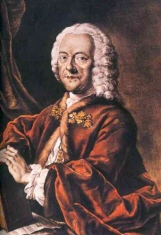
Georg Philipp Telemann (1681-1767) was a German Baroque composer and multi-instrumentalist. He was a contemporary of Bach and Handel and served as an important bridge between the Baroque and Classical music periods. Telemann was already a musical talent as a child mastering the violin, flute, zither, and keyboard by the age of ten and composing an opera called Sigismundus two years later. Beside his family disapproval he became a composer by almost completely self-taught in music. He entered to study law at the University of Leipzig in 1701, but eventually he chooses music as a career. During his University years he founded the Collegium Musicum (later directed by Bach) which gave public concerts, wrote operatic works for the Leipzig Theatre, became musical director of the Leipzig Opera and he was appointed organist at the Neue Kirche in 1704.
In 1705 he accepted a position as Kapellmeister to the court of Count Erdmann II of Promnitz at Sorau (now Zary, Poland). The different styles (French, Italian, Polish) and his association with the Sorau Kantor and theorist Caspar Printz, the reformist poet Erdmann Neumeister were all influenced Telemann. His career cut short by the Great Northern War in early 1706.
Between 1706-1708 he was a court Konzertmeister in charge of singers in Eisenach. During his stay he composed church cantatas, occasional pieces, orchestral and instrumental chamber music. He married to Amalie Louise Juliane Eberlin (lady-in-waiting to the Countess of Promnitz and daughter of the musician Daniel Eberlin) in 1709. His marriage ended tragically when his wife died in 1711. For changing scenery, he moved to the city of Frankfurt-am-Main and became Director of Municipal music as well as Kapellmeister of the Barfüßerkirche and St. Catherine Church. He was also appointed Kapellmeister to the Prince of Bayreuth. This position suited Telemann’s talents very well. He composed occasional music for civic ceremonies, five year-long cycles of church cantatas, oratorios, orchestral music, and a wealth of chamber music. Most of his work was published. By 1720 Telemann adopted the use of the da capo aria and also made his mark with his opera Narciso which brought to Frankfurt in 1719. He married again to Maria Catharina Textor (daughter of a Frankfurt council clerk) and became a family man.
In 1721 the composer accepted the invitation to work in Hamburg as Kantor of the Johanneum Lateinschule and as a musical director of the city`s principal churches. In 1722 he accepted the directorship of the Hamburg Opera, serving until its closure in 1738.
Between 1737 and 1738, Telemann visited Paris where he heard and impressed by an opera called Castor et Pollux which was written by a French composer Jean Philippe Rameau. The composer influence primarily was Italian and German, but after hearing this opera he incorporated the French operatic style into his vocal works.
From the 1740`s until about 1755, Telemann focused less on composition and turned his attention to study music theory. He also picked up some hobbies which shared by Handel such as gardening and cultivating exotic plants. Unfortunately, he was not lucky with his second marriage due to his wife infidelity and gambling problem which brought financial debt. The composer was saved from bankruptcy by the efforts of his friends and by the numerous successful music and poetry publications but by 1736 he was no longer living together with his wife. Telemann remained in Hamburg until his death in 1767. (Georg Philipp Telemann: a detailed biography, n.d.) (Georg Philipp Telemann | Biography & History | AllMusic, 2020)
Lukas Passion TVWV 5:29, 1944
Telemann – LUKE PASSION, ORATORIO – TWV 5:29 (Telemann, 2017)
Between 1716 and 1767 Telemann wrote a series of Passions. The musical compositions reflected Christ`s Passion, the physical, spiritual, and mental suffering of Jesus from the trial until the crucifixion. The works were written and performed in German churches before Easter.
St Luke Passion was written in 1744 and in contrast to his other Passion the musical style is more modern. The Libretto was written by an unknown poet and it based on the biblical text of St. Luke (22:39-23:48), but he also contributed his own texts for all the arias and chorus. Telemann uses expressive arias and dramatic choruses. For example, Jesus dramatic aria, or the first two soprano arias which light and earthiness. He only uses chorales as an opening and as a closing which are harmonically simple. He put more emphasis on the human side of the drama. (Schroeder, n.d.) (Janes, 2018)
Uns ist ein Kind geboren, TWV 1:1452 – Cantata Cycle 1716-1717
G. P. Telemann: Uns ist ein Kind geboren (TVWV 1:1452) (Telemann, 2016)
The Cantata Cycle also known as the Concertante Cycle is a series of cantatas written by Georg Philipp Telemann while he was the Director of Municipal Music in Frankfurt.
Uns ist ein Kind geboren is one of the most beautiful sacred cantatas for Christmas day. It written for solo, chorus and orchestra. The piece opens with a duet for two sopranos which based on Polish-Moravian folklore. It also features two substantial choral movements where the second choral movement defined by two horns. (Hofmann, n.d.)
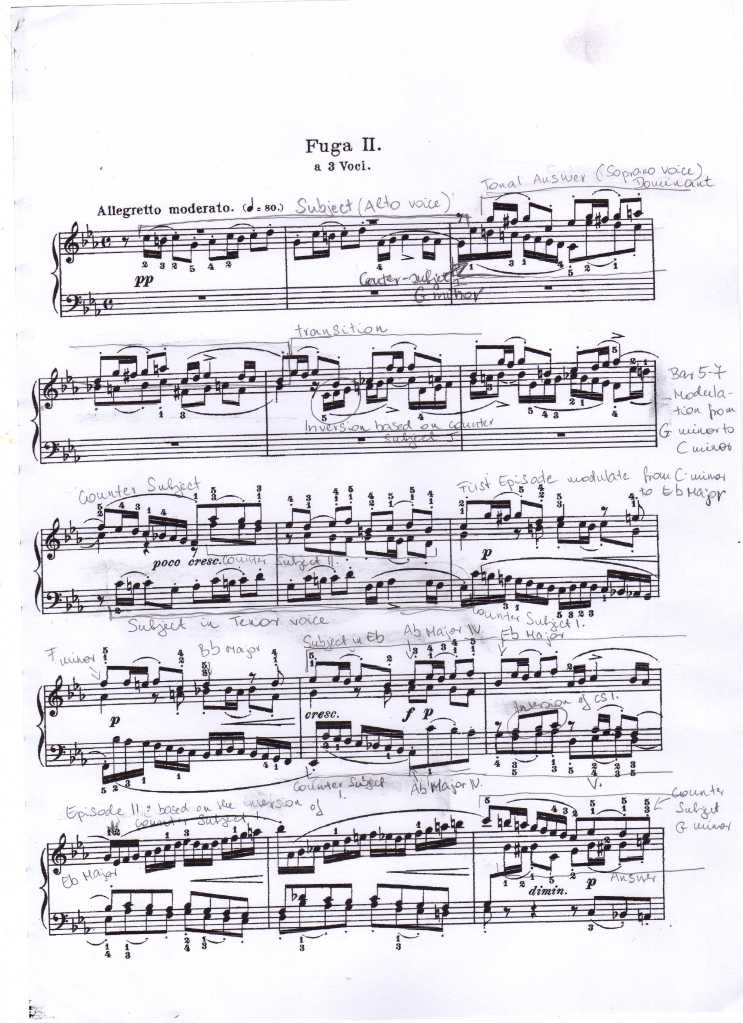
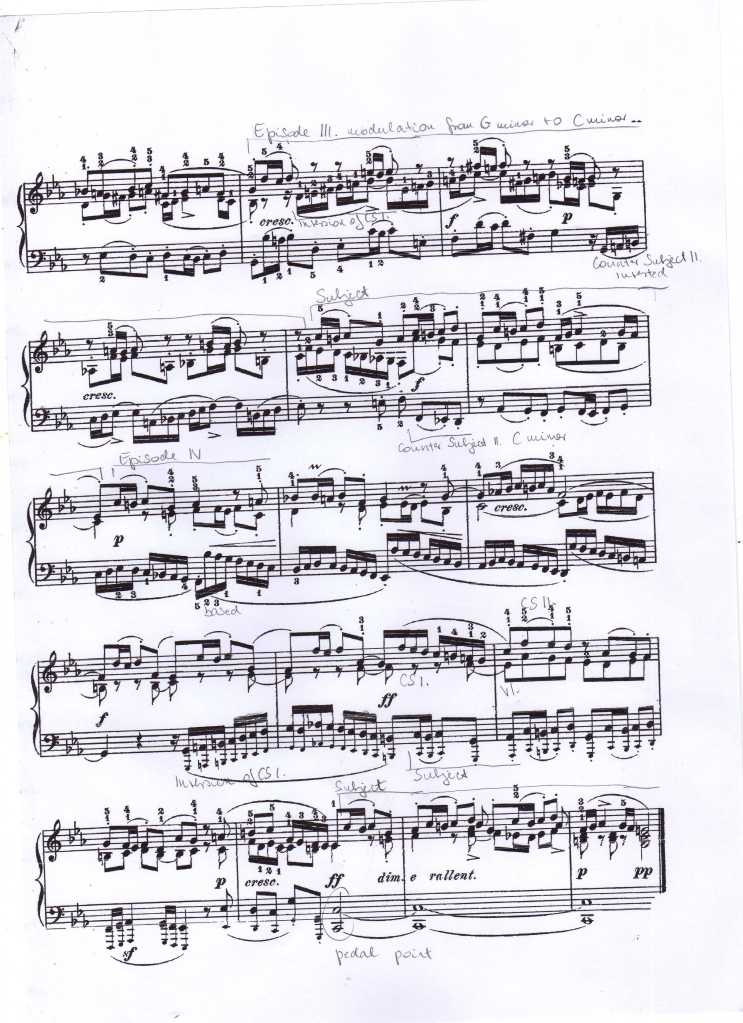
Johann Sebastian Bach (1685-1750) Fugue in c minor Book I
The Fugue is one of the pieces from the Wohltemperirte Clavier (the well-tempered clavier) which is one of Bach`s best known works. The preludes and fugues are organized in two sets of 24 works, each of the major and minor keys.
The manuscript below incorporates the theoretical mapping of the composition.
Partita had several definitions during the music history. Originally it used for a single instrumental piece of music between the 16th and 17th centuries. During the17th and 18th century Baroque composers used this term as a synonym for suite for collections of musical pieces. In the 18th and 19th century the term refers to a multi-movement composition consisting of dances and non-dances movements. (Partita – Definition (Artopium’s Music Dictionary), 2018)
Johann Sebastian Bach – The Six Partitas (BWV 825-830)
Partita No. 1 in B♭ major, BWV 825
Praeludium, Allemande, Corrente, Sarabande, Menuet I, Menuet II, Gigue
Praeambulum, Allemande, Corrente, Sarabande, Tempo di Minuetto, Passepied, Gigue
Partita No. 6 in E minor, BWV 830
Toccata, Allemande, Corrente, Air, Sarabande, Tempo di Gavotta, Gigue
J.S. Bach Six Partitas (BWV 825-830) (Bach, 1960)
Johann Sebastian Bach (1685-1750) was a German composer and musician of the Baroque period. The six partitas were the first of a series of works for keyboard instruments that Bach published between 1726 and 1731 under the title of Clavier-Übung (Keyboard Practice). Bach already established his reputation as a virtuoso keyboard player and composer, but he wanted to show he is a competent teacher as well. So, he presented educational works that he prepared for his pupils. Other influence was J Kuhnau who was also a composer of keyboard works.
The Six Partitas follow the basic suite scheme with Allemande, Courante, Sarabande and Gigue. Each partita has different opening styles which determines the colour and mood of the piece. There are also galanteries (optional dances) added towards the end of each suite, which increased further by having non-dance type pieces such as rondeau and burlesca. These forms contribute more to the musical flow and characters in each suite. The use of foreign styles are also brilliant for example the way Bach distinguishes between corrente (Italian) and courante (French), and follow both the character that is inherent in each dance movement and the diversity of contents. Bach also extends the range of expression within the same type of dance movement by freely expanding their inherent expressive possibilities. For example, Partita No. 1 and4 he uses allemandes but with quite different qualities. In No. 1 he was featuring power and brilliance and in No. 4 he gave a sophisticated lyricism. Another example is the sarabandes in Partita No. 3, 5 and 6 which begin with an anacrusis. Looking the work as a whole the musical flow and the overall balance of texture works very effectively. (Suzuki, 2002)
Chaconne
Similarly, to the passacaglia it is an ostinato or ground bass variation form of Baroque music in ¾ time. A chaconne is a set of variations composed upon a continually repeated bass or chord progression. It originated from Spain in the early 17th century where it was a popular dance. (Chaconne – Definition (Artopium’s Music Dictionary), 2018)
Henry Purcell Chacony in G Minor
Purcell – Chacony in G Minor Z730 (Purcell, 2008)
Henry Purcell (1659-1695) was the first composer before J.S. Bach who has found a place in the repertory of the Symphony Orchestra. He was also the greatest English composer before Edward Elgar. There is not too much information left about this piece. It scored for strings in four parts around 1680 when Purcell took his first job as a composer for the court violin band known as the Twenty-Four Violins. The title of the piece is unusual, and it is unique in music as it would have been expected to call it chaconne after French. Purcell`s work has a credible dynamic structure, consistency of dotted rhythms and distribution of parts. The basses move from a high to a low G which repeated many times with varying textures above. Then it starts moving around the orchestra. This piece is a great example of the baroque chaconne form with its ostinato variations which grow more and more with each repetition of the same eight-measure phrase. (France, 2010)
Cantata
Cantata is a poem set to music to be performed by solo voice, chorus, and instruments. Usually it has several movements such as airs, recitatives, and choruses. The texts based on either secular or sacred subjects. (Cantata | music, 2020)
Giacomo Carissimi (1605-1674) was one of the greatest Italian composers of the 17th century. He especially known by his oratorios and secular cantatas.
Vittoria, mio core is one of Carissimi`s simplest secular cantatas composed in 1646 and it consists a da capo aria. The text was written by anonymous, and it speaks about the victory of being freed from an evil and deceitful woman. The song can also be sung by a woman about a lying man. The song starts with a lively exposition of the first theme and ends with an extended run on the word “sciolta” (shattered). The setting also repeats the word “vittoria” (victory) many times. After this part, the tempo slows down for a recitative – like passage and then returns to the opening. This pattern repeats with another recitative section and closes with a final repeat of the opening. Carissimi used extended runs as musical rhetoric and a discrete modulation between the aria and the recitative sections. The music reflects the mood accurately and with the melody which easily captures the listeners it remains as a favourite recital piece. (Feeney, 2020)
Canzona
Canzona has two meanings. In the 16th and 17th centuries it was a genre of Italian instrumental music. In the 18th and 19th centuries the term canzona refers to a lyrical song or songlike instrumental piece. (Canzona | music, 2020)
There are two varieties of canzona emerged in the 16th century. One was for keyboard and the second was for instrumental ensemble. One of the notable composers was Girolamo Alessandro Frescobaldi (1583-1643) who was an organist and composer from northern Italy. He was the first great masters of organ composition. The keyboard canzona was more polyphonic with a single theme, prepared similarly as fugue. His canzones for unspecified instruments with basso continuo are significance as they led to the development of small instrumental ensembles to the string quartets.
Il Primo Libro delle Canzoni by Girolamo Frescobaldi
Girolamo Frescobaldi – Canzona seconda detta La Bernardinia (Girolamo Frescobaldi – Canzona seconda detta La Bernardinia, 2014)
This is a collection of instrumental Baroque canzonas by Girolamo Frescobaldi. It was published in two different editions. First was in Rome in 1628 and the second was in Venice in 1634. This collection contains 48 canzonas for one, two, three or four instrumental voices in various combinations accompanied by basso continuo. Canzona II “La Bernardinia” is the second piece from Il primo libro delle canzoni, Vol. 2 by Frescobaldi. (Girolamo Frescobaldi | Italian composer, 2020)
Passacaglia
Passacaglia is a musical form of continuous variation in ¾ time and it is also a courtly dance which first appeared in Spain in the 17th century. It is indistinguishable from the contemporary chaconne. (Passacaglia | musical form and dance, 2020)
Passacaglia for Piano by Aaron Copland
Aaron Copland (1900-1990): Passacaglia, per pianoforte (1922) (Copland, 2013)
Aaron Copland (1900-1990) was an American composer, composition teacher, writer, and conductor. The Passacaglia for Piano is an early work which demonstrates the composer`s mature style. It was written between 1921-1922 when Copland was studied at the French school under the direction of Nadia Boulanger. This neoclassic work was strongly influenced by his teacher and the school. The piece is written in G sharp and can be divided into two rhythmically identical four measure phrases. Each phrase also can be divided into another two-measure motive. The first two measures feature the entire theme and the last two bar reaches the climax. (Aaron Copland, composer {Official Site}, 2018) (Whitten, 1981)
Aaron Copland. 2018. Aaron Copland, Composer {Official Site}. [online] Available at: <https://www.aaroncopland.com/> [Accessed 27 May 2020]
Whitten, S., 1981. A Stylistic Comparison Of Aaron Copland’s Passacaglia, Piano Variations, And Four Piano Blues. [ebook] Denton, Texas: University of North Texas, pp.5-9. Available at: <https://digital.library.unt.edu/ark:/67531/metadc331722/m1/1/> [Accessed 27 May 2020]


 Aname
Aname 