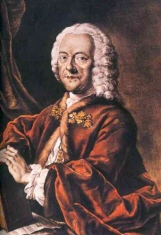
Georg Philipp Telemann (1681-1767) was a German Baroque composer and multi-instrumentalist. He was a contemporary of Bach and Handel and served as an important bridge between the Baroque and Classical music periods. Telemann was already a musical talent as a child mastering the violin, flute, zither, and keyboard by the age of ten and composing an opera called Sigismundus two years later. Beside his family disapproval he became a composer by almost completely self-taught in music. He entered to study law at the University of Leipzig in 1701, but eventually he chooses music as a career. During his University years he founded the Collegium Musicum (later directed by Bach) which gave public concerts, wrote operatic works for the Leipzig Theatre, became musical director of the Leipzig Opera and he was appointed organist at the Neue Kirche in 1704.
In 1705 he accepted a position as Kapellmeister to the court of Count Erdmann II of Promnitz at Sorau (now Zary, Poland). The different styles (French, Italian, Polish) and his association with the Sorau Kantor and theorist Caspar Printz, the reformist poet Erdmann Neumeister were all influenced Telemann. His career cut short by the Great Northern War in early 1706.
Between 1706-1708 he was a court Konzertmeister in charge of singers in Eisenach. During his stay he composed church cantatas, occasional pieces, orchestral and instrumental chamber music. He married to Amalie Louise Juliane Eberlin (lady-in-waiting to the Countess of Promnitz and daughter of the musician Daniel Eberlin) in 1709. His marriage ended tragically when his wife died in 1711. For changing scenery, he moved to the city of Frankfurt-am-Main and became Director of Municipal music as well as Kapellmeister of the Barfüßerkirche and St. Catherine Church. He was also appointed Kapellmeister to the Prince of Bayreuth. This position suited Telemann’s talents very well. He composed occasional music for civic ceremonies, five year-long cycles of church cantatas, oratorios, orchestral music, and a wealth of chamber music. Most of his work was published. By 1720 Telemann adopted the use of the da capo aria and also made his mark with his opera Narciso which brought to Frankfurt in 1719. He married again to Maria Catharina Textor (daughter of a Frankfurt council clerk) and became a family man.
In 1721 the composer accepted the invitation to work in Hamburg as Kantor of the Johanneum Lateinschule and as a musical director of the city`s principal churches. In 1722 he accepted the directorship of the Hamburg Opera, serving until its closure in 1738.
Between 1737 and 1738, Telemann visited Paris where he heard and impressed by an opera called Castor et Pollux which was written by a French composer Jean Philippe Rameau. The composer influence primarily was Italian and German, but after hearing this opera he incorporated the French operatic style into his vocal works.
From the 1740`s until about 1755, Telemann focused less on composition and turned his attention to study music theory. He also picked up some hobbies which shared by Handel such as gardening and cultivating exotic plants. Unfortunately, he was not lucky with his second marriage due to his wife infidelity and gambling problem which brought financial debt. The composer was saved from bankruptcy by the efforts of his friends and by the numerous successful music and poetry publications but by 1736 he was no longer living together with his wife. Telemann remained in Hamburg until his death in 1767. (Georg Philipp Telemann: a detailed biography, n.d.) (Georg Philipp Telemann | Biography & History | AllMusic, 2020)
Lukas Passion TVWV 5:29, 1944
Telemann – LUKE PASSION, ORATORIO – TWV 5:29 (Telemann, 2017)
Between 1716 and 1767 Telemann wrote a series of Passions. The musical compositions reflected Christ`s Passion, the physical, spiritual, and mental suffering of Jesus from the trial until the crucifixion. The works were written and performed in German churches before Easter.
St Luke Passion was written in 1744 and in contrast to his other Passion the musical style is more modern. The Libretto was written by an unknown poet and it based on the biblical text of St. Luke (22:39-23:48), but he also contributed his own texts for all the arias and chorus. Telemann uses expressive arias and dramatic choruses. For example, Jesus dramatic aria, or the first two soprano arias which light and earthiness. He only uses chorales as an opening and as a closing which are harmonically simple. He put more emphasis on the human side of the drama. (Schroeder, n.d.) (Janes, 2018)
Uns ist ein Kind geboren, TWV 1:1452 – Cantata Cycle 1716-1717
G. P. Telemann: Uns ist ein Kind geboren (TVWV 1:1452) (Telemann, 2016)
The Cantata Cycle also known as the Concertante Cycle is a series of cantatas written by Georg Philipp Telemann while he was the Director of Municipal Music in Frankfurt.
Uns ist ein Kind geboren is one of the most beautiful sacred cantatas for Christmas day. It written for solo, chorus and orchestra. The piece opens with a duet for two sopranos which based on Polish-Moravian folklore. It also features two substantial choral movements where the second choral movement defined by two horns. (Hofmann, n.d.)
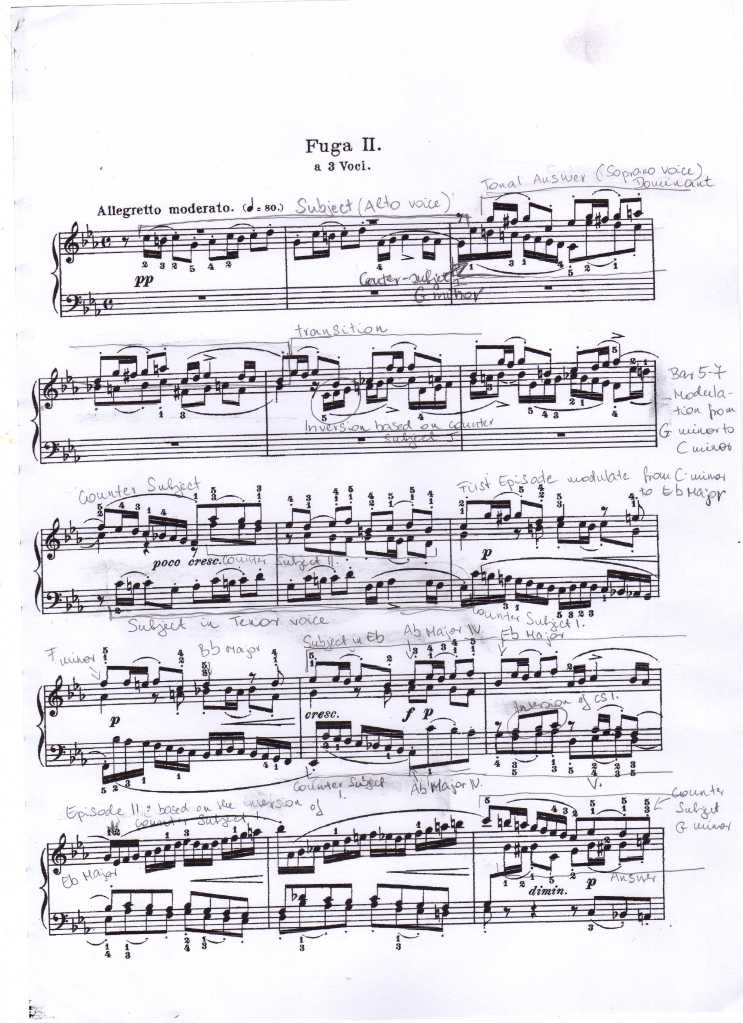
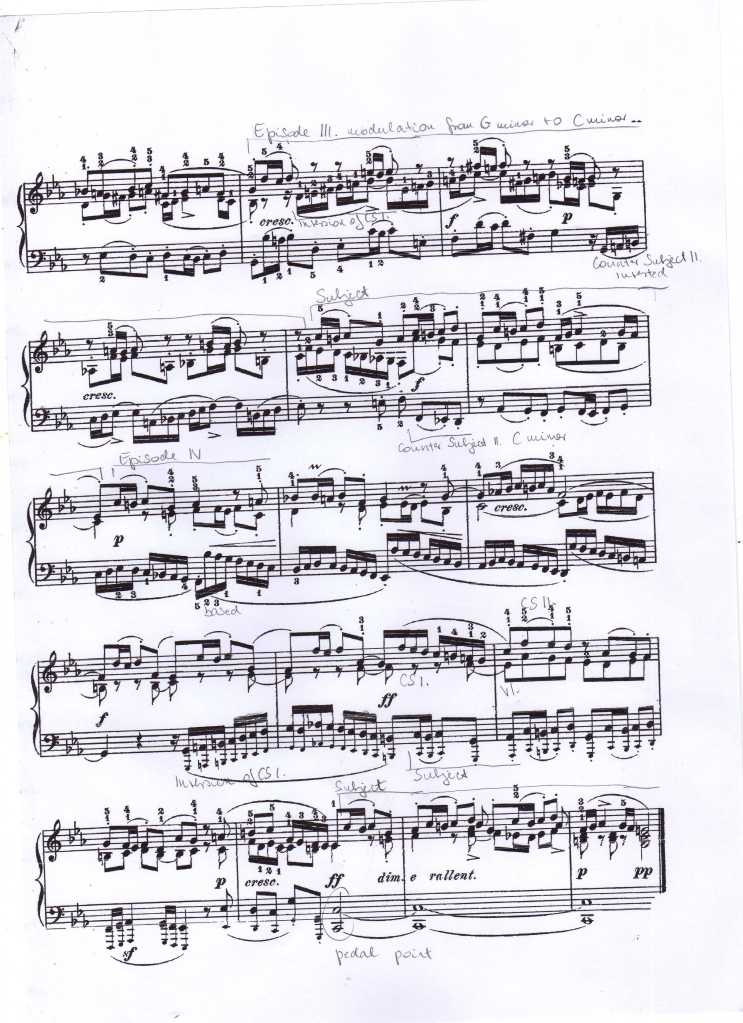
Johann Sebastian Bach (1685-1750) Fugue in c minor Book I
The Fugue is one of the pieces from the Wohltemperirte Clavier (the well-tempered clavier) which is one of Bach`s best known works. The preludes and fugues are organized in two sets of 24 works, each of the major and minor keys.
The manuscript below incorporates the theoretical mapping of the composition.
Partita had several definitions during the music history. Originally it used for a single instrumental piece of music between the 16th and 17th centuries. During the17th and 18th century Baroque composers used this term as a synonym for suite for collections of musical pieces. In the 18th and 19th century the term refers to a multi-movement composition consisting of dances and non-dances movements. (Partita – Definition (Artopium’s Music Dictionary), 2018)
Johann Sebastian Bach – The Six Partitas (BWV 825-830)
Partita No. 1 in B♭ major, BWV 825
Praeludium, Allemande, Corrente, Sarabande, Menuet I, Menuet II, Gigue
Praeambulum, Allemande, Corrente, Sarabande, Tempo di Minuetto, Passepied, Gigue
Partita No. 6 in E minor, BWV 830
Toccata, Allemande, Corrente, Air, Sarabande, Tempo di Gavotta, Gigue
J.S. Bach Six Partitas (BWV 825-830) (Bach, 1960)
Johann Sebastian Bach (1685-1750) was a German composer and musician of the Baroque period. The six partitas were the first of a series of works for keyboard instruments that Bach published between 1726 and 1731 under the title of Clavier-Übung (Keyboard Practice). Bach already established his reputation as a virtuoso keyboard player and composer, but he wanted to show he is a competent teacher as well. So, he presented educational works that he prepared for his pupils. Other influence was J Kuhnau who was also a composer of keyboard works.
The Six Partitas follow the basic suite scheme with Allemande, Courante, Sarabande and Gigue. Each partita has different opening styles which determines the colour and mood of the piece. There are also galanteries (optional dances) added towards the end of each suite, which increased further by having non-dance type pieces such as rondeau and burlesca. These forms contribute more to the musical flow and characters in each suite. The use of foreign styles are also brilliant for example the way Bach distinguishes between corrente (Italian) and courante (French), and follow both the character that is inherent in each dance movement and the diversity of contents. Bach also extends the range of expression within the same type of dance movement by freely expanding their inherent expressive possibilities. For example, Partita No. 1 and4 he uses allemandes but with quite different qualities. In No. 1 he was featuring power and brilliance and in No. 4 he gave a sophisticated lyricism. Another example is the sarabandes in Partita No. 3, 5 and 6 which begin with an anacrusis. Looking the work as a whole the musical flow and the overall balance of texture works very effectively. (Suzuki, 2002)
Chaconne
Similarly, to the passacaglia it is an ostinato or ground bass variation form of Baroque music in ¾ time. A chaconne is a set of variations composed upon a continually repeated bass or chord progression. It originated from Spain in the early 17th century where it was a popular dance. (Chaconne – Definition (Artopium’s Music Dictionary), 2018)
Henry Purcell Chacony in G Minor
Purcell – Chacony in G Minor Z730 (Purcell, 2008)
Henry Purcell (1659-1695) was the first composer before J.S. Bach who has found a place in the repertory of the Symphony Orchestra. He was also the greatest English composer before Edward Elgar. There is not too much information left about this piece. It scored for strings in four parts around 1680 when Purcell took his first job as a composer for the court violin band known as the Twenty-Four Violins. The title of the piece is unusual, and it is unique in music as it would have been expected to call it chaconne after French. Purcell`s work has a credible dynamic structure, consistency of dotted rhythms and distribution of parts. The basses move from a high to a low G which repeated many times with varying textures above. Then it starts moving around the orchestra. This piece is a great example of the baroque chaconne form with its ostinato variations which grow more and more with each repetition of the same eight-measure phrase. (France, 2010)
Cantata
Cantata is a poem set to music to be performed by solo voice, chorus, and instruments. Usually it has several movements such as airs, recitatives, and choruses. The texts based on either secular or sacred subjects. (Cantata | music, 2020)
Giacomo Carissimi (1605-1674) was one of the greatest Italian composers of the 17th century. He especially known by his oratorios and secular cantatas.
Vittoria, mio core is one of Carissimi`s simplest secular cantatas composed in 1646 and it consists a da capo aria. The text was written by anonymous, and it speaks about the victory of being freed from an evil and deceitful woman. The song can also be sung by a woman about a lying man. The song starts with a lively exposition of the first theme and ends with an extended run on the word “sciolta” (shattered). The setting also repeats the word “vittoria” (victory) many times. After this part, the tempo slows down for a recitative – like passage and then returns to the opening. This pattern repeats with another recitative section and closes with a final repeat of the opening. Carissimi used extended runs as musical rhetoric and a discrete modulation between the aria and the recitative sections. The music reflects the mood accurately and with the melody which easily captures the listeners it remains as a favourite recital piece. (Feeney, 2020)
Canzona
Canzona has two meanings. In the 16th and 17th centuries it was a genre of Italian instrumental music. In the 18th and 19th centuries the term canzona refers to a lyrical song or songlike instrumental piece. (Canzona | music, 2020)
There are two varieties of canzona emerged in the 16th century. One was for keyboard and the second was for instrumental ensemble. One of the notable composers was Girolamo Alessandro Frescobaldi (1583-1643) who was an organist and composer from northern Italy. He was the first great masters of organ composition. The keyboard canzona was more polyphonic with a single theme, prepared similarly as fugue. His canzones for unspecified instruments with basso continuo are significance as they led to the development of small instrumental ensembles to the string quartets.
Il Primo Libro delle Canzoni by Girolamo Frescobaldi
Girolamo Frescobaldi – Canzona seconda detta La Bernardinia (Girolamo Frescobaldi – Canzona seconda detta La Bernardinia, 2014)
This is a collection of instrumental Baroque canzonas by Girolamo Frescobaldi. It was published in two different editions. First was in Rome in 1628 and the second was in Venice in 1634. This collection contains 48 canzonas for one, two, three or four instrumental voices in various combinations accompanied by basso continuo. Canzona II “La Bernardinia” is the second piece from Il primo libro delle canzoni, Vol. 2 by Frescobaldi. (Girolamo Frescobaldi | Italian composer, 2020)
Passacaglia
Passacaglia is a musical form of continuous variation in ¾ time and it is also a courtly dance which first appeared in Spain in the 17th century. It is indistinguishable from the contemporary chaconne. (Passacaglia | musical form and dance, 2020)
Passacaglia for Piano by Aaron Copland
Aaron Copland (1900-1990): Passacaglia, per pianoforte (1922) (Copland, 2013)
Aaron Copland (1900-1990) was an American composer, composition teacher, writer, and conductor. The Passacaglia for Piano is an early work which demonstrates the composer`s mature style. It was written between 1921-1922 when Copland was studied at the French school under the direction of Nadia Boulanger. This neoclassic work was strongly influenced by his teacher and the school. The piece is written in G sharp and can be divided into two rhythmically identical four measure phrases. Each phrase also can be divided into another two-measure motive. The first two measures feature the entire theme and the last two bar reaches the climax. (Aaron Copland, composer {Official Site}, 2018) (Whitten, 1981)
Aaron Copland. 2018. Aaron Copland, Composer {Official Site}. [online] Available at: <https://www.aaroncopland.com/> [Accessed 27 May 2020]
Whitten, S., 1981. A Stylistic Comparison Of Aaron Copland’s Passacaglia, Piano Variations, And Four Piano Blues. [ebook] Denton, Texas: University of North Texas, pp.5-9. Available at: <https://digital.library.unt.edu/ark:/67531/metadc331722/m1/1/> [Accessed 27 May 2020]
The exercise was to listen early music preferably on a live concert. Due to the present situation this was not possible. I visited the website of The National Centre for Early Music where I found several recordings from previous events. I listened a few performances and I choose a group called Rumorum. Their concert was broadcasted from NCEM on 30th March 2019 as part of the REMA Conference.
Based on Collins dictionary early music is a broad musical ear in the history of Western art music. It includes the Middle Ages, Renaissance and sometimes the Baroque and early Classical periods. For early music, the approach to musical performance is emphasizing the use of period instrument, historically researched scores and playing techniques. (Early music definition and meaning | Collins English Dictionary, 2020)
Rumorum is a musical group which formed in 2015 by medieval performance students at the Schola Cantorum Basiliensis in Switzerland. The highly trained musicians bring medieval music to the modern concert stage with informed compositions and stylistic improvisations into their performances. Their repertoire is a mixture of instruments and voices. (About, n.d.)
The concert title called Medieval music for voice and instruments. The music was chosen from a variety of pieces written to instruments, solo voices, and instruments with vocals. The concert opened with Principio di Virtú by Anonymous. This is a 14th century Italian dance music from the Trecento period. There is not too much information about this work. Based on F. Alberto Gallo`s research – who was professor of medieval and renaissance music at the University of Bologna – the piece probably composed for the celebrations of the marriage of Isabella, daughter of King John II of France and Giangaleazzo Visconti of Pavia in 1360. By this marriage he became prince of Vertus in Champagne and was known as the “Conte di Virtú”. (Duffin, 2000)
After the opening song, the group continued the medieval journey with various pieces such as Tandernaken, O Rosa Bella, Ballade, and compositions by Machaut.
Tandernaken was a popular Middle Dutch song between 1430-1510. The story is about two girls who are having a conversation about love affairs at the Rhine bank in Andernach, Germany. While they are talking with each other, one of the girls’ lover listening them from a distance.
O Rosa Bella is the title of two popular 15th century chansons composed by Johannes Ciconia and then originally attributed to John Dunstable, but now to John Bedyngham. The text is based on a poem written by Leonardo Giustiniani (1300-1446). The story is about a man who is in love and dies of love again and again for the same woman. He begs this beautiful rose of a woman to have mercy and not allow him to die. (Dickey, 2020)
Guillaume de Machaut (1300-1377) was a medieval French poet and composer. He was one of the leading French composers of the Ars Nova musical style of the 14th century. He was also the last French poet who think of the lyric and its musical setting as a single entity. (Guillaume de Machaut | French poet and musician, 2020)
Rumorum also used period instruments to their performance such as Harp which is an ancient instrument dating back to the Sumerian civilization, Lute which introduced into Europe by the Moors when they invaded Spain in the 8th century, Rebec which originated around the 10th century, Flute which dates back to ancient Rome, Viola d`arco and Clavisimbalum which is an early keyboard instrument and ancestor of the harpsichord.
The concert took place in a beautiful small church which was perfect for this type of music. The repertoire with the period instruments well represented the medieval era. I really enjoyed the performance as the lovely setting with the varied program and the beautiful sound brought the listeners to an excellent journey in the Medieval times.
Ncem.co.uk. 2020. NCEM – The National Centre For Early Music – Early Music Online. [online] Available at: <http://www.ncem.co.uk/?idno=1673> [Accessed 27 May 2020]
Caslabs.case.edu. 2020. Early Music Instrument Database – Ross Duffin | CWRU. [online] Available at: <https://caslabs.case.edu/medren/> [Accessed 27 May 2020]
Music is a universal language and part of our everyday life. Musical instrument is a device for producing a musical sound and it is almost universal components of human culture. It has been used from the earliest times for different purposes such as dances, rituals, work, medicine, and entertainment. The earliest instruments were made or from natural objects such as bones, shells, wood, skin etc. These instruments gradually evolved into more complex forms. (Musical instrument – Classification of instruments, 2020), (Shurkin, 2012)
The shawm first appeared in the 13th century and it became the most important instrument by the end of the Middle Ages. The instrument used in dance bands, ensembles, and court ceremonies.
Alto Shawm (Shawm – Instruments of the world, 2020)
The shawm`s body made from a single piece which ended in a flared bell shape. It is a loud, double-reed wind instrument which is the ancestor of the oboe. Like the oboe, it is conically bored only its bore, bell and finger holes are wider, and it has a wooden disk to support the lips. It produces sound by the vibration of a column air. Unfortunately, the sahwm created such a loud noise, that it was impossible to use it indoors so the oboe was made to replace it.
(Lodico, 2016)
Musicians in different places used different techniques and styles for example the circular breathing technique which allowed the musician to play continuously on the instrument without any pauses. The early use of shawm was in court and civic music. From the 15th century until the beginning of the 19th century every British town had a band called Waiters. They were trained musicians who were originally member of the night watchmen and wakemen in places such as castles, camps, towns etc. (Duffin, 2020)
Shawn – ‘Saltarello’ by David Munrow (The Early Music Consort Of London – Instruments Of The Middle Ages And Renaissance, 1976)
The British musician and early music historian David Munrow bring alive the Medieval court life with his piece called Saltarello. The music is written in the 14th century and the shawm which is the solo instrument accompanied by tambourine, timpani, and trumpet. The title Saltarello is a term use to a Medieval and Renaissance court dance as well as folk dance of present-day Rome. The music well reflects this term as during listening I can imagine a castle where people gathered for dinner and after the delicious food they enjoy of good music and dance. (Saltarello | dance, 2020)
Viol
The Cipher for Viola da Gamba by Caspar Netscher (Dutch ca.1635-1684)
The Viol, also called viola da gamba is a bowed, stringed instrument. It mostly used in chamber music in the 16th until the 18th century. The viol has the same tuning as the Renaissance lute, which is six strings (instead of four) and the fingerboard which is fitted with frets (tied strands of gut). The sound holes are traditionally shaped like the letter “C” instead of “f” and the bow is held underhanded with the palm facing upwards. Viol characterized by sloping shoulders, deep ribs, thin flat backs, and a vertical playing position. The bottom of the instrument was sitting on the knee or held between the legs. The breadth of the bridge was arched which gave the bow separate access to each string. This property with the position of the bow hand (palm uppermost) encouraged the musicians to smooth playing style. The viol made in three sizes such as treble, tenor and bass, with the bottom string tuned to d, G (or A) and D. Later there were two other size made, such as violone and the double bass viol which often turned an octave below the bass. The vibration of the strings produces sound. A bowed string vibrates and moves in a circular motion that produces the fundamental tone, while the vibration produces overtones like a rippling wave. This complex movement of the string is transmitted to the body by the bridge. (Viol (Renaissance) – Early Music Instrument Database, 2020) (Viol | musical instrument, 2020)
(Johannes SCHENCK, Sonata XII (d-Moll) , Allegro-Presto, 2013)
Marin MARAIS: Grand Ballet (Suite en la mineur IIIè Livre)
Viol music was popular in Europe and especially in England. For example, Henry VIII (ca. 1540) engaged a complete consort of Italian players. In France, the bass viol was more popular as a solo instrument. In Germany, the viol was used both solo and chamber music. Composers incorporated the instrument in their pieces for example Heinrich Schultz in his sacred music, Buxtehude in his cantatas and sonatas, JS Bach used the viol as an obligato instrument in his sacred works, Telemann, and C.P.E. Bach in their chamber music. At the second half of the 16th century the viol acquired a significant repertory for ensemble, solo bass, lyra viol and small bass viol (viola bastarda). One of the significant players was Martin Marais (1656-1728). He was not only a composer but a celebrated virtuoso of the viola da gamba. Also Johann Schenck (1660-1712, Dutch) and C.F. Abel (1723-1787, German) were both great viol players. (About the Viol, 2020)
Carl Friedrich Abel (1723-1787): Arpeggio for solo viola da gamba (Abel, 2010)
Crumhorn
Left: Lorenzo Costa’s painting, The Triumph of Death, 1488–90. This complex painting is a biblical scenes with crowds, animals, air-borne saints, angels and figures of death. Right: The small detail in the bottom right corner of a seated vielle player and, on his right, a small child holding a crumhorn. (Pittaway, 2016)
The name refers to the letter “J” shape and comes from an old German word meaning “curved horn”. Similarly to the modern oboe or bassoon, the crumhorn or Krummhorn is a double reed wind instrument but the difference is that the reed is not held between the lips. It encased in a wooden capsule at the top of the instrument. It`s fingering system is similar than the recorder. The crumhorn works like the bagpipe by using the wind pressure in the chamber around the reed to start it vibrating. Because the reed is not controlled directly, the instrument has a limited range (just over an octave) and also the sound is softer due to the cylindrical bore. The tone is reedy and nasal. The instrument was made in a range of sizes and pitches for example great bass or sopranino. It was really difficult to play well.
Crumhorns were flourished between the 15th until the 17th century. It was more popular in Europe such as Germany, Italy, France and England. The first record of the instrument came from the 15th century court of Albrecht Achilles of Ansbach (reigned 1440–1486) in Germany and it called Krummpfeyffen which means curved pipes. Also the first image is from an Italian painter Lorenzo Costa who illustrated crumhorn on his painting called The triumph of death (1488-90). (Crumhorn | musical instrument, 2020)
A “Salterello” for Solo Crumhorn (Early Renaissance Music – A “Salterello” for Solo Crumhorn, 2008)
Crumhorns were played for religious, court entertainments, royal and municipal occasions. There are no examples of any musician either owing or playing a crumhorn in any country who was not either a professional court or municipal musician or a member of the aristocracy. For example musicians who were employed by the town council to perform at official occasions, weddings, baptisms, royal visits etc. In England they called them waits, in Germany stadtpfeifers and in Italy piffari. They had exclusive right to provide official music within the boundaries of the town or city. (Crumhorn (Renaissance) – Early Music Instrument Database, 2020)
Sackbut
Shawm band. Fresco (detail, ca.1503). Pinturichio. Fresco over the door to the Piccolomini Library within Siena Cathedral (Sackbut (Renaissance) – Early Music Instrument Database, 2020)
The word sackbut is from the old French verbs sacquer and bouter which describe the pulling and pushing arm motion of the player. It is an early trombone, invented in the 15th century probably in Burgundy. It has thicker walls than the modern trombone which gives a softer tone. It`s bell also narrower. It is a low-pitched wind instrument sounded by lip vibration against a cup mouthpiece. It has an extendable slide that can increase the length of the instrument`s tubing. Sacbuts were made in tenor, alto and bass sizes.
Adam Woolf Introduces the Sackbut (Adam Woolf Introduces the Sackbut, 2015)
Its earliest use was in an ensemble where it was a regular member of the shawm band. It was also used to accompany voice and as a solo instrument. Despite the property of the instrument (wide range of dynamics or dramatic compass) and its ability to be played the sackbut did not become a regular member of the orchestra until the early 19th century.
O vos omnes – Tomás Luis de Victoria (1548-1611) (The English Cornett and Sackbut Ensemble, 2020)
Dulcimer
Dulcimer. Birth of Christ (detail, 1512) by Jacob van Oostzanen. Naples, Museo e Gallerie Nazionali di Capodimonte. (Dulcimer (Medieval) – Early Music Instrument Database, 2020)
The name dulcimer comes from the Latin and Greek words dulce and melos which means sweet tune. Dulcimer is a late medieval stringed instrument and it is similar looking than the psaltery. The difference is that the strings of the dulcimer were struck with little hammers rather than being plucked. The earliest evidence of the dulcimer can be found on a 12th century ivory book-cover made in Byzantium. It contains a typical trapiziform instrument with lateral strings. No other dulcimer representation is found until the middle of the 1400’s, when the instrument was introduced to western Europe. After the introduction dulcimers were found in Germany, Italy, Poland, Hungary, Bohemia, Flanders, northern France, and England.
Dulcimers often had one or two bridges over which the strings crossed providing the opportunity for more pitches because the performer could strike a sound on each side of the bridge. In the 15th century images we can see that dulcimers had single courses of six to nine strings and were played on the lap or on a table. They used hammers which held between the index and middle fingers. A century later, the multiple bridges were more common with between eight and twelve double courses. Sometimes they used a neck strap which helped for portability. The soundboards of the instrument were commonly decorated. (Dulcimer | Musica Antiqua, 2020)
European dulcimers are hackbrett in the Alpine, the cimbalom in Hungary, the tambal in Romania, santouri in Greek, sanṭūr in Persia and Yanggin in China. These instruments have two or more strings for each note which stretched across a flat, usually trapezoidal sound box. They pass over one and under the other of two long bridges, sloping alternately to right and left to facilitate rapid playing with the light beaters.
The pianoforte is also a dulcimer where the keyboard mechanism operates the beaters. One of its immediate predecessors was the pantaleon, which is a 5-foot (1.5-metre) or longer dulcimer from the early 18th century.
The dulcimer from the United States (Appalache) is called zither which is a narrow folk instrument with three to five metal strings running over a fretted fingerboard, which is set centrally along the dulcimer’s entire length. The player’s right-hand strums with a small stick or quill, and the left hand stops one or more strings to provide the melody.
Because the dulcimer range it can be used for many different types of music. At the beginning the instrument used in folk music and in concerts. Later it appeared in jazz, blues, ragtime, Cajun, gospel and even rock and roll. (Dulcimer | musical instrument, 2020)
Lukács Miklós – Zöld az erdő (Lukács Miklós – Zöld az erdő (cimbalom), 2012)
Clavichord
Clavichord made by Christian Kintzing in 1763 Neuwied, Germany (Clavichord, 2000)
The name clavichord comes from the Latin word clavis which means key and the Greek word chorda which means string. It was invented in the early 14th century. One of the earliest references to the instrument can be found in England in an expense record of Elizabeth of York, Queen of Henry VII, dated in August 1502.
The clavichord is a European stringed rectangular keyboard instrument that was used from the late Middle Ages through the Renaissance, Baroque and Classical eras. It mostly used as a practice instrument and for composition as it was easy to keep in tune, but it was not loud enough for larger performances. The instrument produces sound by striking brass or iron strings with small metal blades called tangents. Vibrations are transmitted through the bridge to the soundboard. The clavichord was one of the piano`s ancestry. (Clavichord (Renaissance) – Early Music Instrument Database, 2020)
Clavichord, Italy, late 16th or early 17th century Watch My Cows by by Luis de Narváez (1538) (Museum of Fine Arts, Boston, 2016)
Clavichords can be fretted or unfretted. In fretted instruments each string could produce three or four different pitches. In unfretted ones each note has its own pair of strings. Clavichords were usually fretted until the early 18th century, after that they were frequently unfretted. In the early 15th century the range of the instrument was around four octaves, but in the 18th century it increased to five octaves or more. Because the clavichord was primarily used to learn, to practice and to compose on there were no music written specifically for this instrument before the mid-18th century. After there were a large number of music composed in Germany where the clavichord was still common. At first clavichord was used of home concerts. At home it was ideal instrument for solo keyboard music and instrumental accompaniment. Today clavichords are played by musicians who enthusiast by Renaissance, Baroque and Classical music. The firs leading musicians who exposed clavichord were Christopher Hogwood (English conductor, harpsichordist, writer, and musicologist) and Thurston Dart (English musicologist, conductor, and keyboard player). The instrument also used in other genres of music in the form of clavinet which is an electric clavichord that uses a magnetic pickup to produce a signal for amplification. There are several musicians used this instrument in their work for example Stevie Wonder Higher Ground or Superstition, Guy Sigswoth with Bjork, in All Is Full of Love, Tori Amos in Little Amsterdam, Oscar Peterson in Porgy And Bess, Keith Jarreth in his album called Book of Ways where he plays a series of clavichord improvisations, Paul McCartney (Beatles) in For No One and Rick Wakeman in The Battle. (What is a… Clavichord? | Definition and History | Classical-Music.com, 2016) (Durfee, 2020)
Oscar Peterson (clavichord) & Joe Pass (guitar) de “Porgy and Bess”: “I Loves You, Porgy” (Oscar Peterson (clavichord) & Joe Pass (guitar) de “Porgy and Bess”: “I Loves You, Porgy”, 2013)
Casson, A., 2019. Cantigas De Santa Maria For Singers. [online] Cantigas de Santa Maria for Singers. Available at: <http://www.cantigasdesantamaria.com/> [Accessed 14 May 2020]
Duffin, D., 2020. Early Music Instrument Database – Ross Duffin | CWRU. [online] Caslabs.case.edu. Available at: <https://caslabs.case.edu/medren/> [Accessed 15 May 2020]
The Early Music Consort Of London – Instruments Of The Middle Ages And Renaissance. 1976. Directed by D. Munrow. UK: EMI Records Ltd.


 Aname
Aname 